

The protection provided by patents gives an inventor an exclusive legal monopoly on their invention. IP ownership is indeed an important business achievement. However, realizing actual financial gain from the invention sometimes necessitates its strategic distribution, scaling up, or even exiting by means of a patent assignment.
Irrespective of whether you are a single inventor, a budding start-up, or a seasoned company, knowing how to assign patent rights will help keep your financial interest safe during the process. Under the provisions of the Indian Patents Act, 1970, and the Patents Rules, 2003 (amended), parties must follow a strict legal procedure to transfer ownership.
This complete guide explains the entire legal procedure of selling, assigning a patent, filling out forms of the Indian Patent Office, and the costs involved.
What Does It Mean to Transfer Patent Rights?
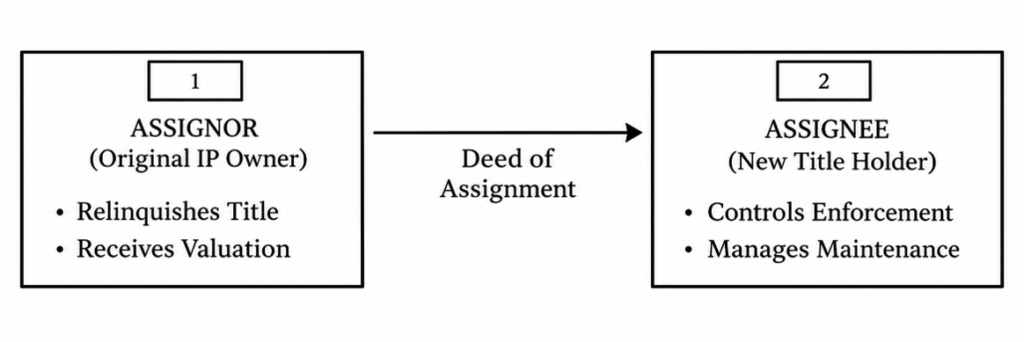
Patent assignment refers to the legal process where one party transfers ownership rights of a patented invention to another.
Legally speaking, the Assignor refers to the party or person that assigns the patent ownership. On the other hand, we call the party receiving the patent ownership the Assignee. The moment the process of assignment of patent ownership takes place legally, the role of the assignee becomes identical to that of the original owner of the patent.
Assignment vs. Licensing: Key Differences
Patent assignment and patent licensing are often misunderstood by inventors as identical processes. Although the two techniques serve the same purpose, there is a fundamental difference between the two.
| Feature | Patent Assignment (Selling) | Patent Licensing |
|---|---|---|
| Ownership Status | Permanent transfer of legal title. | Retained by the original owner (Licensor). |
| Control Level | Assignee acquires full absolute control. | Licensee gains restricted usage rights. |
| Legal Action | Assignee can sue infringers independently. | Licensee usually needs the owner's consent. |
| Financial Structure | Upfront lump-sum payment or structured payouts. | Ongoing milestone payments or periodic royalties. |
| IPO Requirement | Requires updating the Register of Patents. | Recorded under registered user agreements. |
The choice between the two is wholly dependent on your ultimate objectives. An assignment yields money immediately while a license generates continuous income.
Pre-Grant vs. Post-Grant Patent Transfers
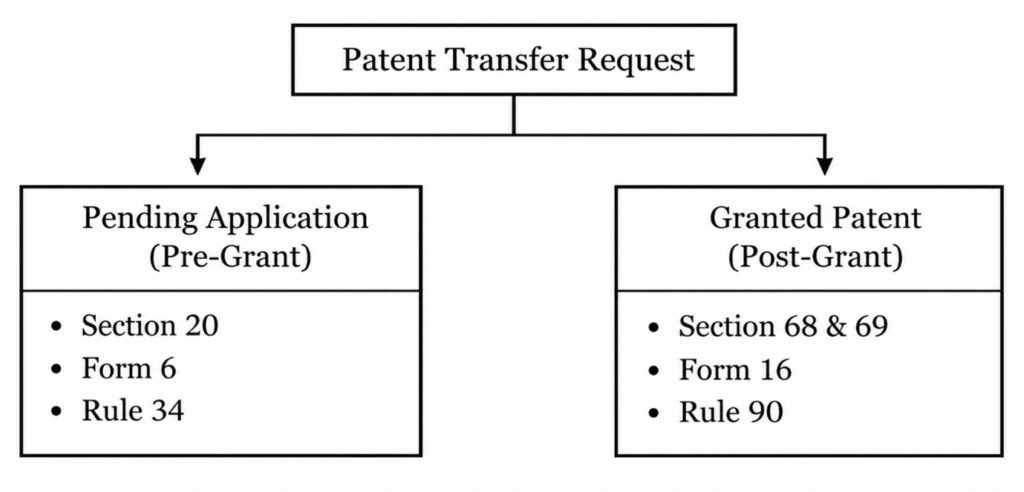
Is it possible to transfer an application that is still pending and does not yet have the status of a granted patent? Yes, according to Indian patent legislation, it is possible to do so for both types of patents.
1. Pre-Grant Assignment (Pending Applications)
According to section 20 of the Indian Patents Act, 1970, rights may be assigned even during the period when the patent application is under consideration.
- Key Document: Form 6 (Claim concerning change of applicant name/assignment).
- Effect: The Indian Patent Office changes the applicant name. The final patent is issued in the name of the new Assignee.
2. Post-Grant Assignment (Patents Granted)
According to Sections 68 and 69 of the Patents Act, 1970, a patented product should be assigned using a written document and registered with the Patent Office.
- Important Document: Form 16 (Application for registration of title or interest).
- Consequences: There will be an official revision of the Register of Patents.
Documents Required for Transferring Patent Ownership
For efficient handling of your patent application by the Indian Patent Office, you should submit the following documentation:
- Original Written Assignment Agreement Deed (Signed by both the assignor and assignee).
- Proof of Stamping (Proof of stamp duty payment).
- Form 6 or Form 16 (Based on the nature of the patent application).
- Form 26 (Power of Attorney, in case of a Patent Agent as the applicant).
- Form 3 (Statement and undertaking with respect to foreign filings).
- Government ID & Corporate Documentation (Registration papers).
Essential Clauses in a Patent Assignment Agreement
According to Section 68 of the Patents Act, 1970, any kind of patent assignment will not be a legally binding agreement if not done in writing and covering all the terms between both parties. Any kind of oral deal will have no legal validity.
Your document must contain the following mandatory clauses:
- Identities of Parties: Identity, address, corporate identities of both assignor and assignee.
- Description of Title: Application numbers, patent grant numbers, title of the invention, international filing dates.
- Contribution Clause: Monetary details about contribution and/or lump sum contribution amounts.
- Warranties & Covenants: Clause to guarantee unencumbered title and freedom from any liens and disputes.
- Further Assurance Clause: Clause for help in signing any future documents, if required.
- Jurisdiction and Governing Laws: Under Indian law.
Step-by-Step Guide to Assigning a Patent
Following a procedure will make sure that you are able to carry out your legal transfer smoothly without any hitches.
Step 1: Do Due Diligence on Title and Status
Do the legal due diligence to check the status of the patent through the IPO’s website (InPASS). Make sure that all the maintenance fees have been paid. Ensure that there are no pending oppositions.
Step 2: Value the Rights
Assign a fair market value to the rights in the patent. Some methods used include:
- The Cost Method, which computes the precise cost incurred in developing the technology.
- The Income Method, which projects future cash flows at present value.
- The Market Method, which involves comparing transactions in the same industry sector.
Step 3: Preparation & Execution of the Assignment Deed
Prepare the deed contract adhering to Section 68 guidelines. Both the parties should sign the agreement in front of official witnesses.
Step 4: Payment of the Appropriate Stamp Duty
Pay the relevant stamp duty according to the Indian Stamp Act, 1899. In case of insufficient stamp duty, the assignment deed will be impounded and will not constitute any legal evidence in court.
Step 5: Submission of Forms to the Patent Office
Fill out and file the relevant forms on the IPO website. The documents should contain a copy of the stamped deed.
Step 6: Check Patent Register Entry
Once the documents have been examined by the patent office, the register can be checked online to ensure that the Assignee’s name has been entered.
Official Government Fees for Recording Transfers
Official Government charges depend on the class of the entity applying/owner. E-filing charges are lower than physical filing charges.
| Action / Form | Natural Person / Startup / Small Entity / Educational Institution | Large Entity / Other Corporate Bodies |
|---|---|---|
| Form 6 (Pre-Grant Change) | ₹800 per application | ₹4,000 per application |
| Form 16 (Post-Grant Title Recordal) | ₹1,600 per patent | ₹8,000 per patent |
Special Legal Scenarios in Patent Ownership Transfers
Can One Co-Patentee Assign Without Permission?
Not at all. As per Section 50 of the Indian Patents Act, 1970, the co-owner or the joint patentee cannot assign, license or transfer his/her share without obtaining the written consent of all joint owners. Where a joint owner fails to cooperate, the complaining party shall file an application with the Controller of Patents seeking directions under Section 51.
Assignment of Patent Rights to a Company
Where a patent owner assigns rights to a company (e.g., employer, company or startup), the assignment deed should specifically mention whether the rights assigned include prior infringement rights or not. In addition, employment agreements should explicitly contain automatic IP assignment clauses.
Final Thoughts
The process of successful patent assignment involves being meticulous, well-informed, and legally compliant according to the Indian Patents Act. This is achieved by putting everything down in writing, paying stamp duty, and filing either Form 6 or 16 to protect your business interests. It is recommended that you seek advice from experts regarding patent assignment in India. Intellect Bastion is here to assist you at each stage of the process—get in touch with us now to make your patent assignment smooth sailing.
Frequently Asked Questions (FAQs)
What do you understand by the transfer of patent rights?
The transfer of patents is defined as the method by which the rights to an invention or patent may be legally transferred from the owner of that patent to another natural person or entity (such as a company, corporation, start-up, or educational organization) for all or part of those rights.
What is the difference between patent assignment and patent licensing?
Patent Assignment refers to the legal transfer of all the rights, while Patent Licensing refers to granting permission to the other party to use the patented technology.
Is it possible to assign an application for a patent that is yet to be issued?
Yes. As per Section 20 of the Patents Act of 1970, it is possible to assign an application through Form 6 filed with the Indian Patent Office.
Who are the Assignor and Assignee in case of assignment of a patent?
The Assignor is the person who is selling the invention, while the Assignee is the one who buys it.
Which legal documents must parties produce to assign patent rights?
Applicants need a written assignment deed, stamp duty payment receipts, and Form 6 or Form 16. They may also need Form 26 and Form 3.
Which clauses are essential in a patent assignment contract?
There are party identities, patent particulars, financial aspects, title warranties, and assurances, among others.
Does failing to notarize or register the patent assignment agreement affect its validity?
According to Sections 68 and 69, courts or the Controller of Patents cannot consider an unregistered deed as legal evidence. So yes, failing to notarize or register the patent assignment agreement affect its validity.
What kind of forms must applicants file with the patent office to change patent ownership details?
Submit Form 6 in case of pending applications and Form 16 for granted patents.
How much would be the official government fee required for patent assignment registration?
The official filing fee through electronic filing system for registration of transfer/assignment before grant under Form 6 shall be ₹800 (for individuals, start-ups, small organizations, and educational institutions) or ₹4,000 (for large corporate organizations) per application. The official filing fee through electronic filing system for post-grant registration of assignment under Form 16 shall be ₹1,600 or ₹8,000 per patent, respectively.
How can patent rights be valued before their transfer or sale?
The evaluation of patent value involves using the cost approach, income projection, and market transactions analysis techniques.
YASHIKA KORANGA, Senior Patent Associate at Intellect Bastion