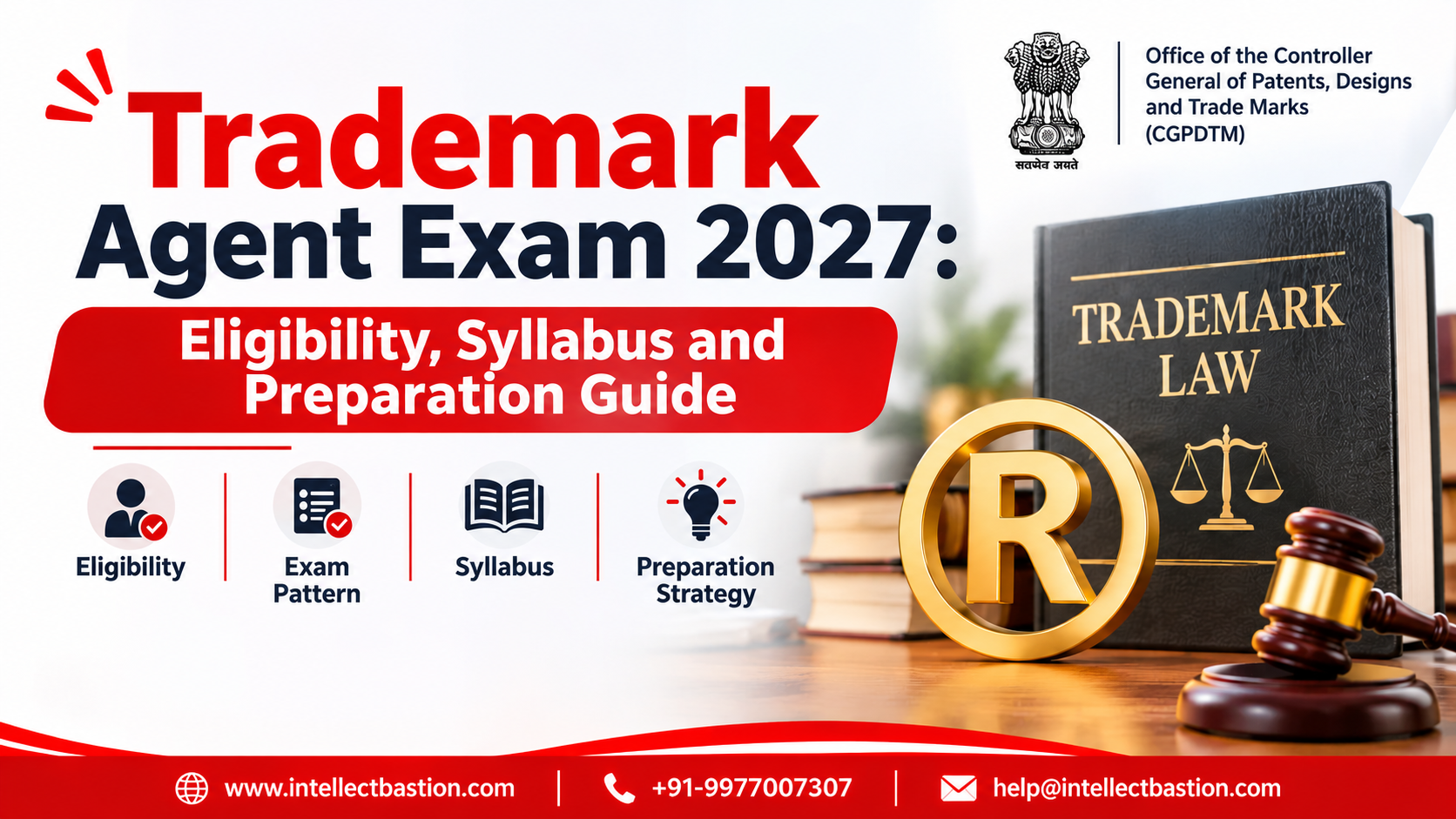
The Trademark Agent Exam 2027 is conducted by the Intellectual Property India under the Ministry of Commerce & Industry. Specifically, this exam allows qualified candidates to become registered Trademark Agents in India and represent clients before the Trade Marks Registry.
The Trademark Agent Examination 2027 is one of the most important competitive exams for individuals aspiring to build a career in Intellectual Property Law, particularly in trademark practice. Conducted by the Controller General of Patents, Designs and Trade Marks (CGPDTM), this exam therefore qualifies candidates to register as Trademark Agents under the Trade Marks Act, 1999.
Moreover, the Trademark Agent Exam 2027 will take place on 9 January 2027 – so start early as this qualification tests knowledge of trademark law as well as assessment of how you will use the Trademark.
1. What is the Trademark Agent Exam 2027?
The trademark agent is the registered professional qualifying examination conducted under the Trade Marks, 2017. Essentially, it is a qualifying exam conducted under the Trade Marks Rules, 2017. In addition, the CGPDTM holds this exam to make sure that candidates have an understanding of trademark law and are ready to practise.
The Trademark Agent exam is generally divided into written examination and viva voce. More specifically, the written exam tests knowledge of trademark law, procedures, and practical aspects, while the viva voce evaluates communication skills and practical understanding of trademark practice.
If you meet the eligibility requirements and pass the required process you can apply to be listed in the Register of Trade Marks Agents. Subsequently, once you are, on the register you can practise before the Indian Trade Marks Registry long as you follow the legal rules that apply.
The quick facts:
- Conducting authority: Office of the CGPDTM, Government of India
- Exam name: Trade Marks Agent Examination 2027
- Expected date: 9 January 2027
- Governing law: Trade Marks Act, 1999 and Trade Marks Rules, 2017
- Stages: Paper I, Paper II and Viva Voce
- Centres: 15 proposed centres across India
2. Who can apply?
Eligibility is set by Rule 144 of the Trade Marks Rules, 2017. Notably, you don’t need a law degree. In fact, graduates from different academic backgrounds can apply as long as they meet the conditions, which makes this an accessible route into IP.
You’ll need to meet these criteria:
- Nationality: You must be an Indian citizen.
- Age: You must be at least 21.
- Education: You must hold a graduate degree from a recognised university in India, or an equivalent qualification.
- Professional qualifications: Advocates under the Advocates Act, 1961 and members of the Institute of Company Secretaries of India (ICSI) are also recognised under Rule 144.
- Character: The Registrar must consider you a fit and proper person for registration.
3. Exam pattern and marking scheme
The exam checks your grasp of trademark law and your ability to handle practical trademark work. Specifically, it has objective questions, descriptive questions and a viva voce. Therefore, prepare for all three stages rather than only the theory. For instance, Paper I tests how well you understand the concepts, while Paper II looks at legal interpretation and drafting.
| Stage | Marks | Nature |
|---|---|---|
| Paper I | 100 | Objective / MCQ |
| Paper II | 100 | Subjective / Descriptive |
| Viva Voce | 50 | Oral assessment |
| Total | 250 |
To qualify, you need:
- At least 50 marks in Paper I
- At least 50 marks in Paper II
- At least 60% aggregate marks overall
- Candidates who clear the written papers move on to the viva voce, subject to the prescribed selection process
The minimum marks in each written paper matter. In other words, a strong score in one paper won’t make up for failing the other.
4. Syllabus for Paper I and Paper II
The syllabus is built around the Trade Marks Act, 1999, the Trade Marks Rules, 2017, and trademark law and practice more broadly. In addition, you need to know the statutory provisions and also how they work in practice. The official notification and instructions are the final word, but the topics below give you a solid framework.
Paper I: objective questions
Paper I tests your understanding of trademark concepts, statutory provisions, definitions and procedure. Accordingly, concentrate on the key sections, the rules and the legal terminology.
Topics to cover:
- Introduction to intellectual property rights
- Definition and characteristics of trademarks
- Types of trademarks, and classification of goods and services
- Absolute grounds for refusal (Section 9)
- Relative grounds for refusal (Section 11)
- Well-known trademarks and how they’re protected
- Trademark ownership and proprietorship
- Distinctiveness and likelihood of confusion
- Assignment and transmission of trademarks
- Renewal, restoration and removal of trademarks
- Infringement and passing off
- Collective marks and certification trademarks
- The Madrid Protocol and international registration
- Relevant provisions of the Trade Marks Rules, 2017
Furthermore, pay particular attention to Sections 9, 11, 18, 21, 25, 28, 29, 34, 47 and 57 of the Trade Marks Act, 1999.
Paper II: descriptive questions
Paper II tests whether you can apply the law to practical situations. Consequently, expect detailed answers, legal reasoning and drafting exercises. Additionally, practise writing structured answers instead of memorising provisions word for word.
Areas to prepare:
- Drafting and filing trademark applications
- Preparing replies to examination reports
- Understanding objections under Sections 9 and 11
- Drafting notices of opposition and counterstatements
- Preparing evidence in opposition proceedings
- Rectification and cancellation proceedings
- Assignment and transmission documents
- Renewal and restoration procedures
- Responding to procedural objections
- Analysing infringement scenarios
- Hearings before the Trade Marks Registry
Give drafting extra time. After all, it’s where statutory knowledge turns into the work agents actually do.

5. Best Books and Drafting Tips for Trademark Agent Exam Paper 2
The choice of best books and some drafting tips for the Trademark Agent Exam Paper 2 is a decisive factor in determining your final score. Additionally, remember that Paper II requires formal, timed legal writing, so prepare with well-formed templates in advance so that there is no panic during the exam.
Further, clarity of expression, proper citations of the statute and logic with argument is valued not flowery speech. Hence, use clear headings, numbered paragraphs and correct prayers for relief in every descriptive answer.
- Law of Trade Marks and Geographical Indications (K.C Kailasam), and (Law of Trade Marks – P. Narayanan) provide clear conceptual understanding.
- Official Study Manuals: IP India’s official study manuals are free download available on IP India site.
- In drafting Examination Replies, always acknowledge/respond to Section 9 objections through acquired distinctiveness and overcome Section 11 objections by emphasizing the differences in visual, phonetic and structural features.
- Designating Opposition Notices: Make sure to reference the opponent’s locus standi, the date of earlier adoption, reputation evidence and any specific statutory grounds of refusal.
- Affidavit Formatting: Practice on affatively perfecting verification clause and jurat blocks and affidavit annexures for exhibits in a Rule 25 Relationship Affidavit.
6. Acts and rules to study
The Trade Marks Act, 1999 is the foundation, but study the rules alongside it. Indeed, they show how the procedures work in practice. Furthermore, a section-by-section approach helps: first understand why each provision exists, then learn its procedural requirements.
Core study materials:
- Trade Marks Act, 1999
- Trade Marks Rules, 2017
- Relevant amendments and notifications
- Important judgments of Indian courts
- Intellectual Property Office guidelines and practice directions
- Relevant international treaties, especially the Madrid Protocol and the TRIPS Agreement
Provisions to prioritise:
| Section | Subject |
|---|---|
| Section 9 | Absolute grounds for refusal |
| Section 11 | Relative grounds for refusal |
| Section 18 | Application for registration |
| Section 21 | Opposition to registration |
| Section 25 | Duration and renewal |
| Section 28 | Rights conferred by registration |
| Section 29 | Infringement of registered trademarks |
| Section 30 | Limits on the effect of registered trademarks |
| Section 34 | Saving for vested rights |
| Section 47 | Removal for non-use |
| Section 57 | Rectification and correction of the register |
Trademark Agent Exam 2027 Study Plan and Preparation Strategy
To complete the Trademark Agent Exam 2027 study plan and strategy for a disciplined preparation required by the candidates will ensure them with complete coverage of the Trademark Agent Exam Syllabus on 9th January 2027. Ideally, a suitable 12 week Mind Map should have a mix of reading passages, followed by MCQ solving, and timed writing.
Further, it also helps avoid non-uniformity between the trade marks and the geographical indications acts. As a result, you can even hone your time management skills for morning and afternoon sessions by dedicating time for mock tests for a specific period of weeks.
- Month 1 (Foundation): Following (highlights) and completing the Trade Marks Act, 1999 and the Trade Marks Rules, 2017, covering salient provisions, definitions, liable fines etc. and Appellate Board transfers.
- Cover Geographical Indications Act, Madrid Protocol rules and create 2 complete legal pieces of draft each week in Month 2 – Allied Laws & Drafting.
- Week 3 (Revision & Mocks): Do previous year papers (2023-2026) under tightly monitored exam style of questions and mark paper and note down the areas that require revision.
- Viva Voce Preparation: Go through the recent public notification of IP India, summarise the complex parts of the document orally and keep abreast of the ongoing trademark disputes.
Why Become a Trademark Agent?
Becoming a Trademark Agent is an excellent career option for individuals interested in branding, business, and law. Besides, Trademark Agents play a key role in protecting brand identity and helping businesses secure their trademarks.
This profession offers:
- High demand in startups and corporate sector
- Opportunity to work globally
- Flexible career (job + independent practice)
- Strong earning potential
Finally, it is especially beneficial for those preparing for Judiciary, CLAT PG, UPSC, and other law exams, as it strengthens core IP law concepts.
FAQs
1. What is the eligibility criteria for the Trademark Agent Exam 2027?
In short, to qualify the trademark agent exam under Rule 144 of the trademark, 2017, you must be the citizen of India, atleast 21 years old and must hold a Bachelor’s degree from the UGC recognized university.
2. Can a non-law graduate apply for the Trademark Agent Exam 2027 in India?
Yes, you can any graduate from science, arts or commerce can apply. Notably, unlike Patent agent exam which is specifically for the science graduates but trademark agent exam there is no boundation till now.
3. What is the age limit and educational qualification required for the Trademark Agent Exam?
Specifically, candidates must have completed at least 21 years of age, while there is no upper age limit. Educationally, you must possess a completed graduation degree from a recognized university before submitting your online application.
4. Is the Viva Voce compulsory after clearing the written Trademark Agent Exam?
Yes, candidates must clear viva voce after the written exam.
Author: Shubhra Pandey