
Obtaining a trademark registration in India is crucial for doing business in India. In recent years, people have often wondered whether a business can trademark a common English word in India.
The Trade Marks Registry of India, based on the trademark legislation of India, reviews all applications for registration of brand names. This guide helps you understand how applicants can use generic trademark guidelines, Section 9 of the Trade Marks Act, and case law for descriptive trademark registration.
Understanding Trademark Distinctiveness in India
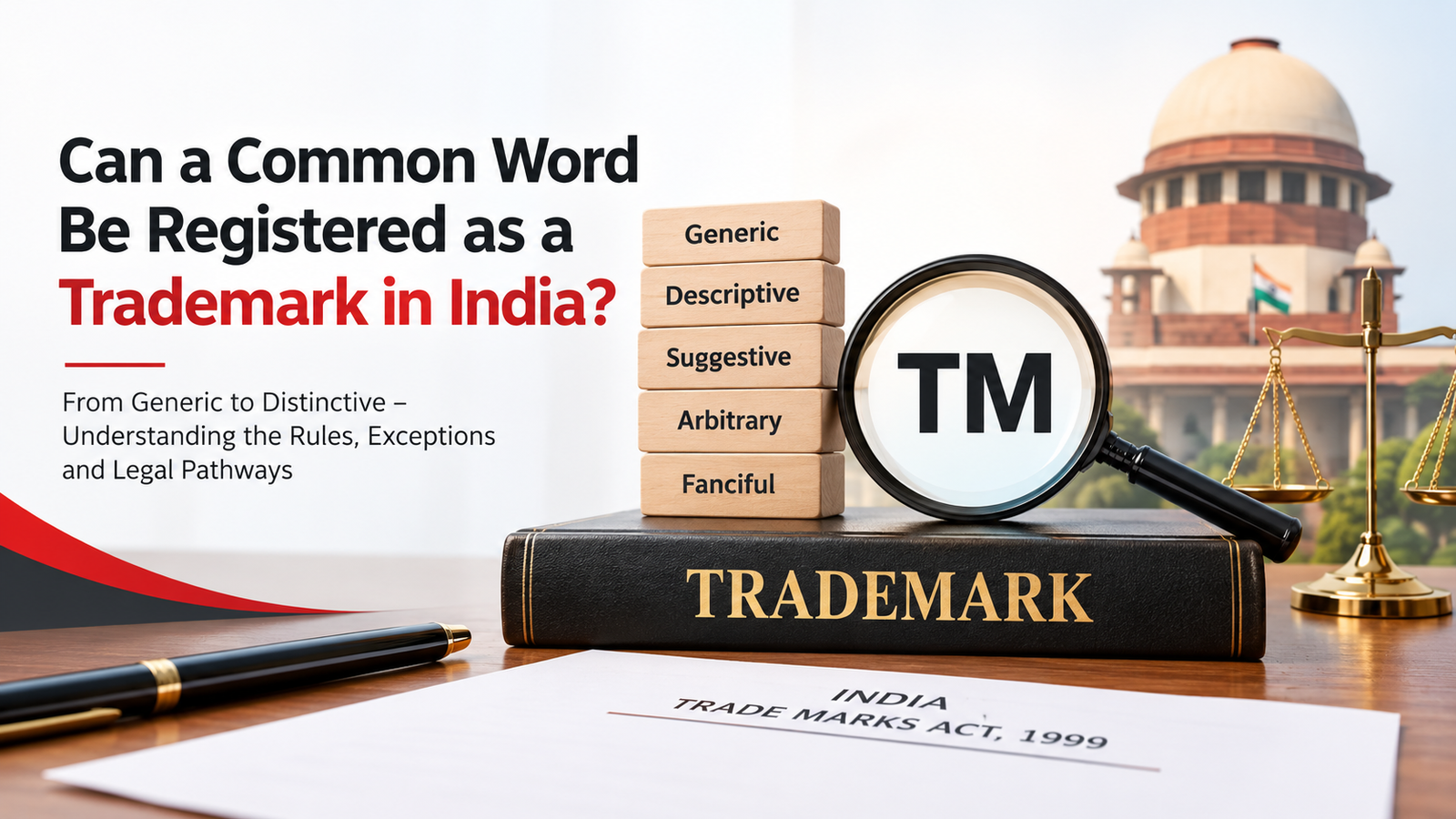
Trademark protection primarily serves the purpose of source identification. Your mark should be able to differentiate your goods and services from those of your competitors. Specifically, according to intellectual property law, brand names can therefore be classified into five types, depending on trademark distinctiveness.
Generic Mark
A mark whose name indicates an entire category of goods and not a particular brand is generic. For instance, “Car” would indicate automobiles, while people use “Computer” for laptops. Consequently, courts do not recognise any exclusive rights in generic trademarks, since all merchants require them to name their common goods.
Descriptive Mark
Such a mark is a description of the characteristic features of the goods. For example, “Cold” would be a descriptive mark when a company uses it for cold beverages. The Registry does not accept such marks under Section 9 of the Trade Marks Act requirements.
Suggestive Mark
Suggestive words do not tell anything about the features but only suggest them. “Jaguar” would be a suggestive mark for cars indicating speed. Such words qualify for registration since they involve imagination.
Arbitrary Marking
An arbitrary mark refers to an everyday word from the dictionary, which is completely irrelevant to the product on which the brand name is used. “Apple” for mobile phones and “Blackberry” for cellular phones serve as the best examples. The distinction between arbitrary and descriptive trademarks in India is enormous. Arbitrary trademarks have high intrinsic distinctiveness.
Fanciful/Coined Markings
Coinage refers to marks that do not have any meaning in the dictionary, like “Kodak” or “Exxon.”
Statutory Provisions: Section 9 of the Trade Marks Act, 1999
The laws pertaining to common word trademark applications in India are based on the absolute grounds for rejection of registration found in Section 9 of the Trade Marks Act provisions.
| Section | Statutory Provision | Application to Common Words |
|---|---|---|
| Section 9(1)(a) | Marks devoid of any distinctive character. | Rejects ordinary words that fail to identify source origin. |
| Section 9(1)(b) | Marks designating kind, quality, or intended purpose. | Blocks purely descriptive terms like "Best Quality" or "Sweet". |
| Section 9(1)(c) | Marks customary in current language or trade practices. | Prevents monopoly over industry jargon and ordinary terms. |
Therefore, the Indian Patent Office and Trademark Registry enforce such laws to prevent individual traders from monopolizing regular language. However, an important legal exception exists under the proviso to Section 9(1).
The Proviso Exception: Acquired Distinctiveness and Secondary Meaning
What do we understand by acquired distinctiveness in Section 9 of the Trade Marks Act 1999? According to the proviso to Section 9(1), a mark which is descriptive or non-distinct can be registered provided it acquires distinct character because of continuous and long usage in commerce.
Whereby a company continues using an ordinary word of its own for many years, the people tend to think of that particular word with a certain source. This phenomenon is known as secondary meaning trademark recognition.
An Ordinary Dictionary Word —-> Long & Continuous Commercial Usage —-> Secondary Meaning Acquired —-> A Valid Registered Trademark
Acquisition of Secondary Meaning in India
The proof of commercial exposure is required by the Trade Marks Registry:
- Continuous figures of sales turnover supported by chartered accountancy certification.
- The amount of advertising and promotional expenditures for more than one year.
- Long-term commercial exposure by way of invoices, taxation reports and billings.
- Evidence through media reports, customer perception studies and affidavits from trade associations.
Key Landmark Indian Court Rulings
Indian courts consistently evaluate claims over common word trademarks.
1997: Apex Court establishes test for common words (Godfrey Philips)
│
2008: High Court restricts monopolies on descriptive terms (Marico)
│
2023: High Court affirms limitations on common English words (Delhi HC)
Godfrey Philips India Ltd. v. Girnar Food & Beverages Pvt. Ltd. (2004)
The Supreme Court of India held that a descriptive term can receive legal protection if it attains a secondary meaning through extensive market use. The applicant must prove that consumers associate the word exclusively with their business.
Marico Limited v. Agro Tech Foods Limited (2010)
The Delhi High Court analysed the use of descriptive terms like “LOW-ABSORB” for cooking oil. The court ruled that registering descriptive words creates a heavy legal burden. Granting monopolies over descriptive terms hurts fair competition, so courts strictly examine these applications.
Asian Paints Ltd. v. Registrar of Trade Marks
The court reinforced that adopting arbitrary common words like “Royal” or “Lotus” for non-related product classes is valid. However, direct descriptive terms face strong objections unless backed by massive evidence of market penetration.

Strategic Steps to Register a Common Word Trademark
Therefore, if you plan to register a common dictionary word, follow this strategic roadmap to improve approval chances.
- Conduct a Trademark Availability Search: Prerequisite before filing Form TM-A. Search the Indian Trademark Registry database across relevant classes. Confirm that no prior identical or similar word marks exist for similar goods.
- Determine the Nature of Use: Evaluate arbitrary vs. descriptive usage. First, verify whether your mark is arbitrary or descriptive. Using a common word for an unrelated industry simplifies the examination process.
- Enhance Distinctiveness with Composite Elements: Lowering refusal risks under Section 9. Combine your common word with unique typography, a distinct logo mark, or a catchy tagline. As a result, composite marks face fewer objections during examination.
- Compile Strong Proof of Prior Commercial Use: Rule 25 User Affidavit requirement. Draft a comprehensive User Affidavit under Rule 25 of the Trade Marks Rules, 2017. In addition, attach sales invoices, marketing expenses, and promotion samples dated before the filing date.
- Respond Promptly to the First Examination Report (FER): Addressing Section 9 objections. Submit a legal response within 30 days of receiving an examination report. Cite relevant judicial precedents and attach user evidence to clear objections.
Key Takeaways for Brand Owners
Registering a common word as a trademark in India requires careful legal strategy. On one hand, arbitrary dictionary words enjoy quick legal protection, but descriptive terms demand extensive proof of secondary market reputation. Building a strong evidentiary portfolio helps protect your legal brand rights effectively.
For expert legal guidance and complete trademark registration support, contact Intellect Bastion today.
Frequently Asked Questions (FAQs)
Can an ordinary dictionary word be legally registered as a trademark in India?
Yes. You can register an ordinary dictionary word if it serves as an arbitrary mark for unrelated goods (like “Apple” for phones) or if it acquires secondary meaning through long, continuous use.
Why does the Indian Trademark Registry usually object to common or generic words?
The Registry objects under Section 9 of the Trade Marks Act, 1999, to prevent single businesses from monopolizing everyday language. This restriction ensures that competitors can freely describe their products.
Can a common word be trademarked if it is used in a non-related industry or class?
Yes. Using a common word for a completely unrelated product makes it an arbitrary mark. Arbitrary marks possess strong inherent distinctiveness, making them easier to register.
Does adding a unique logo, design, or tagline help in registering a common word?
Yes. Filing a composite mark or device mark with distinctive graphic elements, custom fonts, or unique slogans helps overcome absolute grounds for refusal under Section 9.
What evidence is required to prove that a common word has acquired secondary meaning?
Applicants must provide sales invoices, audited turnover statements, advertising bills, tax filings, media clippings, and consumer perception surveys.
How can a business respond to a Section 9 examination report objection for a generic mark?
You must submit a formal response within 30 days. Your response should highlight arbitrary use, distinct structural design, or prior continuous use backed by a Rule 25 User Affidavit.
Can competitors challenge or seek cancellation of a registered common word trademark?
Yes. Competitors can file rectification or cancellation petitions under Section 57 of the Trade Marks Act, 1999 if a mark was registered without proper distinctiveness or if it has turned generic over time.
YASHIKA KORANGA
Senior Patent Associate at Intellect Bastion