

A patent approval is always a great milestone for any inventor or company. Nevertheless, a patent approval does not mean that your patent will be protected automatically in the market. Governments provide exclusive rights through their patent offices, but these agencies do not monitor market activities on your behalf. It means that you have to detect all violations of your intellectual property yourself. Otherwise, your rivals will be able to undermine your market position and make your innovation less commercially valuable.
In order to protect yourself from patent infringement, you need to follow a well-planned scheme. You have to use market information, digital instruments, and patent claim analysis to keep your IP assets secure. Early detection will enable you to react in time and save your money. Here you will find a guide to patent surveillance techniques and tools.
The Business Imperative for Active Patent Monitoring
Most innovators have faith that other businesses will naturally comply with the borders set out by their patents. Regrettably, reality is often harsher than expectations in this regard. Fast product cycles make it easy for companies to duplicate the successful elements of their competition. In most instances, the competing team is unaware that they are infringing on someone else’s patent rights. In some cases, the business deliberately steals from the protected invention to save on R&D and secure a piece of the market quickly.
Patent monitoring systems provide many commercial advantages. Firstly, patent monitoring allows you to protect your income from illegal copies before they take over the market. Secondly, regular monitoring gives you leverage during the negotiations for the license since your rivals will be ready to become your licensees. Additionally, patent infringement detection will allow you to stop them from getting established in the market.
In order to ensure comprehensive monitoring, it is necessary to track both product copies and architectural adaptations. Consequently, patent monitoring process setup is crucial for any technology business today.
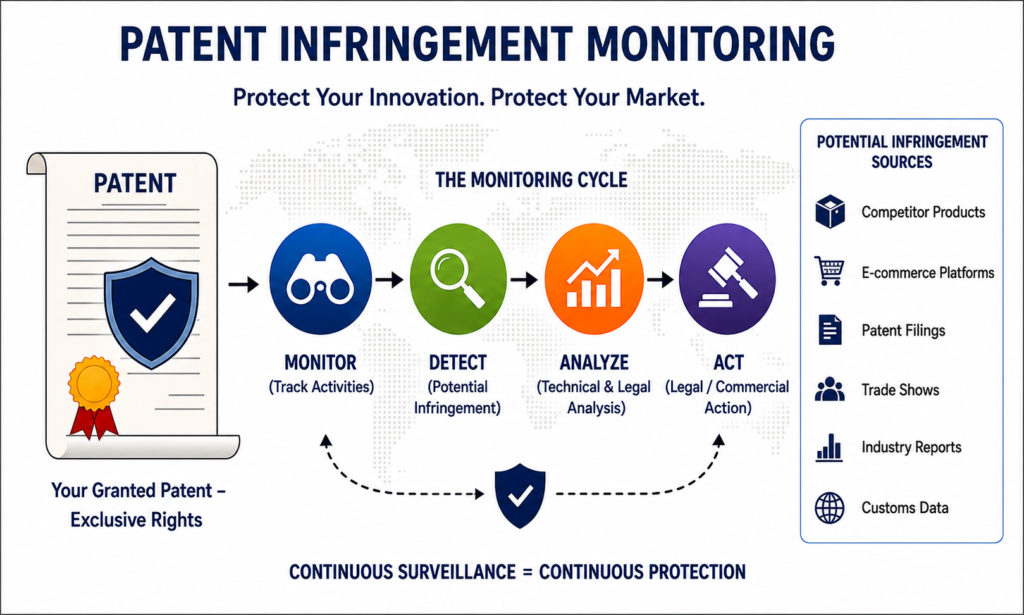
Core Strategies: How to Detect Patent Infringement in Competitors
Identification of possible infringements requires an integrated system of detection. If you solely depend on one method of observation, you will not be able to see through because various industries have their own problems of visibility.
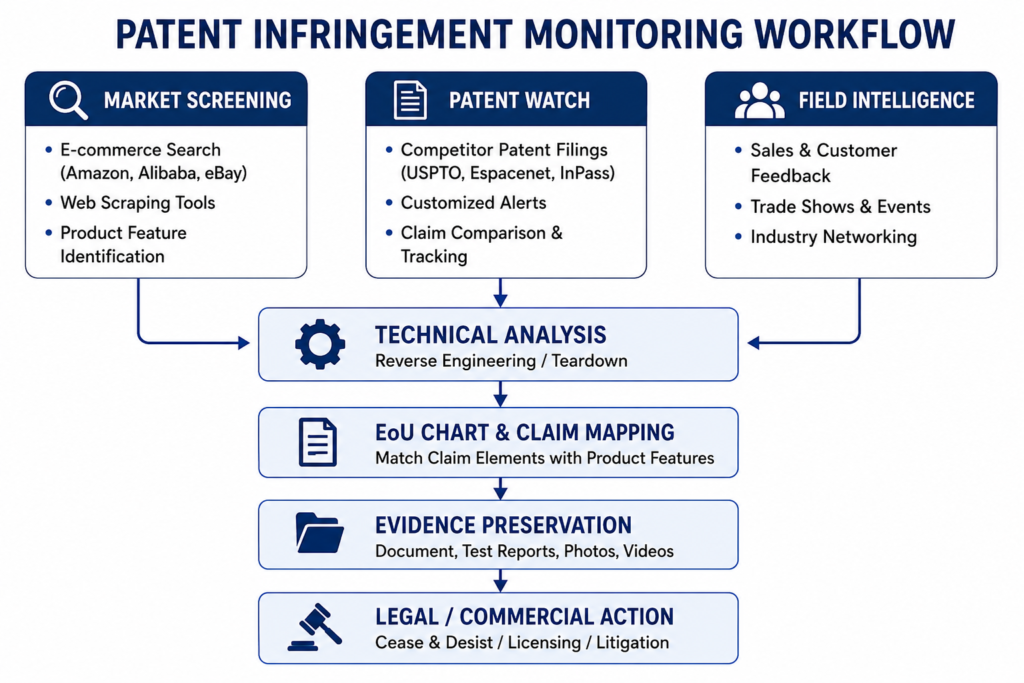
- Online Market Screening & E-Commerce Scraping
Sellers list millions of new products for sale online. Therefore, searching manually for these products is not enough anymore. Today’s companies make use of specific computer programs to automate the process of searching for products within Amazon, Alibaba, eBay, and various industry distribution networks. Industry experts consider these tools some of the most effective means of patent infringement surveillance on internet consumer platforms.
While trying to find your products online, pay attention to the features they have rather than the brands. The infringers do not try to use your brand’s vocabulary. They describe your product by its functions using general vocabulary. The web scraping tool will help detect any newly released product that matches your product’s features.
- Patent Applications and Publications from Competitors
Determining how to determine whether your patent is being infringed by other companies starts in the patent office. Patent offices generally make patents publicly available 18 months after an applicant files the patent application. This means that monitoring the patent filings from competitors will give you an insight into their future product pipelines.
You need to set up customized alerts in the international and national patent databases such as USPTO, Espacenet, WIPO Patentscope and India’s official InPass (Indian Patent Advanced Search System) portal. You should also customize these alerts to track certain IPC codes and competitor filing activities. If a competitor files for a patent, compare their published claims to the patent claims in your patents. In case of similar technical disclosures, you can track their product release timelines.
- Field Intelligence and Trade Show Activities
The salespeople, customer support employees, and field service engineers act as your front-line field intelligence unit since they deal with customers regularly and can detect changes within the marketplace in real-time.
In order to utilize this network, you should train your field people regarding the main inventions within your company’s product line. They will learn how to monitor any kind of infringement of a patented technology on-site when dealing with customers or networking at industry gatherings. Additionally, attending industry trade shows presents an excellent chance for the examination of new hardware and software technologies.
Technical Analysis and Reverse Engineering Protocols
Outward identification of similar products is just the first step towards patent surveillance. However, proving any infringement of a patent demands technical confirmation and claim analysis.
- Technical Disassembly and Software Code Examination
A visual comparison by itself cannot prove infringement in many cases of complex microelectronic, machinery, or computer algorithms. For this reason, you need physical or software access to suspected products. After that, technical specialists conduct disassembly to check out the inner design of hardware components and circuitry.
As regards software inventions, technical specialists will analyze compiled code, observe API calls, or even analyze data flow in communication. Reverse engineering will reveal whether the inner design of a rival product uses your invention or not. In addition, be sure to record all steps of reverse engineering in detail. Photography and laboratory notes will be the basis of your claim in court.
- Developing an Evidence of Use (EoU) Document
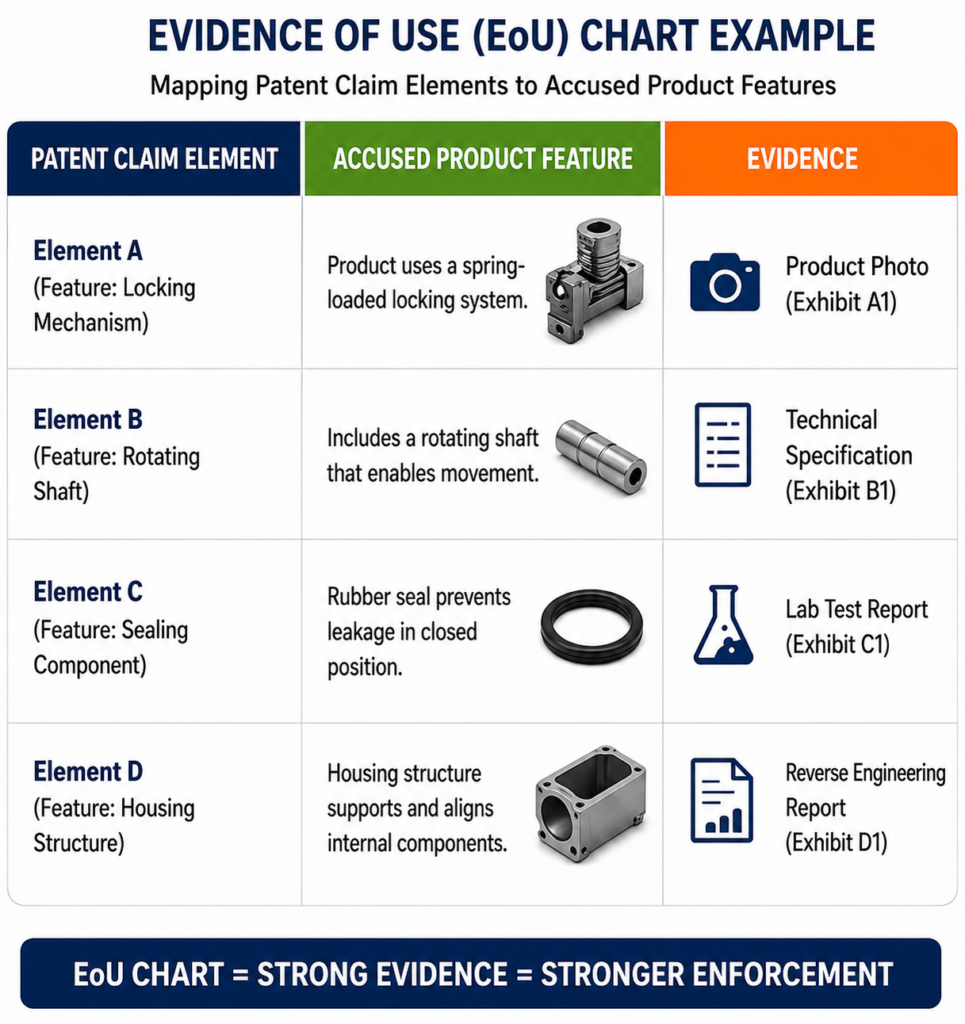
After having completed technical analysis to show matching, now it is time to organize your findings into a well-formed Evidence of Use (EoU) chart. Each component of your patent claim must be mapped out to equivalent features of the target product.
The development of such an EoU document ensures clarity. The evidence presented in the document gives clear proof that the target product meets all the elements of an independent claim. That is why this document is used as the base for corporate strategy, licensing deals, or litigation.
| Monitoring Strategy | Primary Method & Tools | Best Used For | Key Advantages |
|---|---|---|---|
| Market Screening | Web scrapers, keyword trackers, e-commerce alerts | Consumer goods, retail items, public software | Immediate visibility into active retail sales |
| Patent Watch Services | USPTO, Espacenet, WIPO alerts, InPass (India), IPC code tracking | Early competitor R&D tracking | Spots infringement 18 months before product launches |
| Field Intelligence | Sales force reporting, trade show inspections | B2B machinery, commercial hardware | Direct observation of live commercial implementations |
| Technical Teardowns | Lab teardowns, reverse engineering, code analysis | Deep tech, electronics, backend software | Provides bulletproof technical evidence for litigation |
| Customs Tracking | Import/export manifests, border surveillance | Overseas manufacturing, physical imports | Intercepts infringing shipments at international borders |
Steps To Take If You Believe There’s a Patent Infringement
If there is an indication of any infringement, there should be swift action taken. Firstly, all forms of documentation should be preserved, whether digital or physical. This includes invoices, packaging of the product, flyers, or even archived web pages. Secondly, you need to buy several units of the suspected infringing products. Lastly, you must hire experienced IP lawyers and draw an Evidence of Use chart before contacting the suspect. You can contact Intellect Bastion for the best support and guidance.
Frequently Asked Questions
What is an Evidence of Use (EoU) chart and how does it constitute evidence of patent infringement?
An EoU chart is an analytical document that correlates each claim element of the patent against the corresponding element of an accused product. To successfully claim patent infringement, you have to demonstrate that there is another product out there which fulfils all the elements of an independent patent claim. The EoU chart helps you do so by comparing both elements side by side using annotated photographs, circuit schematics, code excerpts, and lab tests. As such, EoU charts are very important for proving infringement while negotiating a license or in court.
What can be done to monitor process-based or manufacturing patents to ensure patent violation does not occur?
It is difficult to monitor process-based or manufacturing patents due to the secrecy of the process inside the factory. Nonetheless, you can detect patent violations based on the structure or composition of the end product your patented process produces. Also, customs records, hiring practices of competing firms, and technical literature may help you determine whether competitors are using your process. Industry shows, and machinery purchases may also be important indicators of process usage.
What part does reverse engineering of the products play in revealing patent infringement?
Reverse engineering is the technical connection between suspicion of and proving infringement. Numerous features of patents, such as the design of semiconductors, the linkage within the products, and the backend programming code, may not be observable from the outside of the product. Reverse engineering peels back the suspect product to get to its inner workings. Consequently, technical experts can find concrete evidence of infringement that marketing materials or product user guides do not reveal.
How does patent monitoring and surveillance service work?
An automated algorithm and an intelligent IP database perform the patent monitoring and surveillance process by continuously tracking global marketplace activities. The tracking includes new patent filings, granted patents, trademark filings, and company assignments in certain technology areas. As soon as any competitor files a patent or releases a product based on your criteria, the system immediately alerts you.
Is it possible for one to know of patent infringement occurring outside the country?
Yes, it is possible to detect patent infringement that occurs abroad through the use of global monitoring tools and intelligence. National and global patent databases—such as InPASS for India, USPTO for the U.S., Espacenet for Europe, and WIPO PATENTSCOPE for international PCT applications—make it possible to monitor foreign patent filings and national phase entries across key commercial jurisdictions. Additionally, by monitoring international trade databases and customs manifests of imports and exports, and global e-commerce sites, one can know the foreign companies that manufacture products that infringe on their patents. Nonetheless, enforcing patents abroad requires having patents in those foreign countries.
What are the legal risks associated with falsely accusing a firm of patent infringement?
If you falsely accuse someone of patent infringement, it poses huge legal and financial threats to your business. The accused firm will sue you under various causes of action, such as tortious interference with business relations, unfair competition, or defamation. Accused firms can initiate declaratory judgment proceedings against you, forcing you to spend heavily to defend your patent’s validity in court. Thus, it is necessary to prepare an Evidence of Use Chart first.
What is the effect of claim construction on the monitoring and proving of the infringement?
The claim construction is the process that determines the legal scope of your patents. In case of litigation, the judge interprets your claims and explains the meaning of particular terms used in them. In case your claims have broad language, the competitor may argue that their product does not belong to your scope or use prior art to invalidate your patent. Narrow claims, however, will provide an easy way for your competitor to avoid your invention.
YASHIKA KORANGA
Patent Associate at Intellect Bastion