
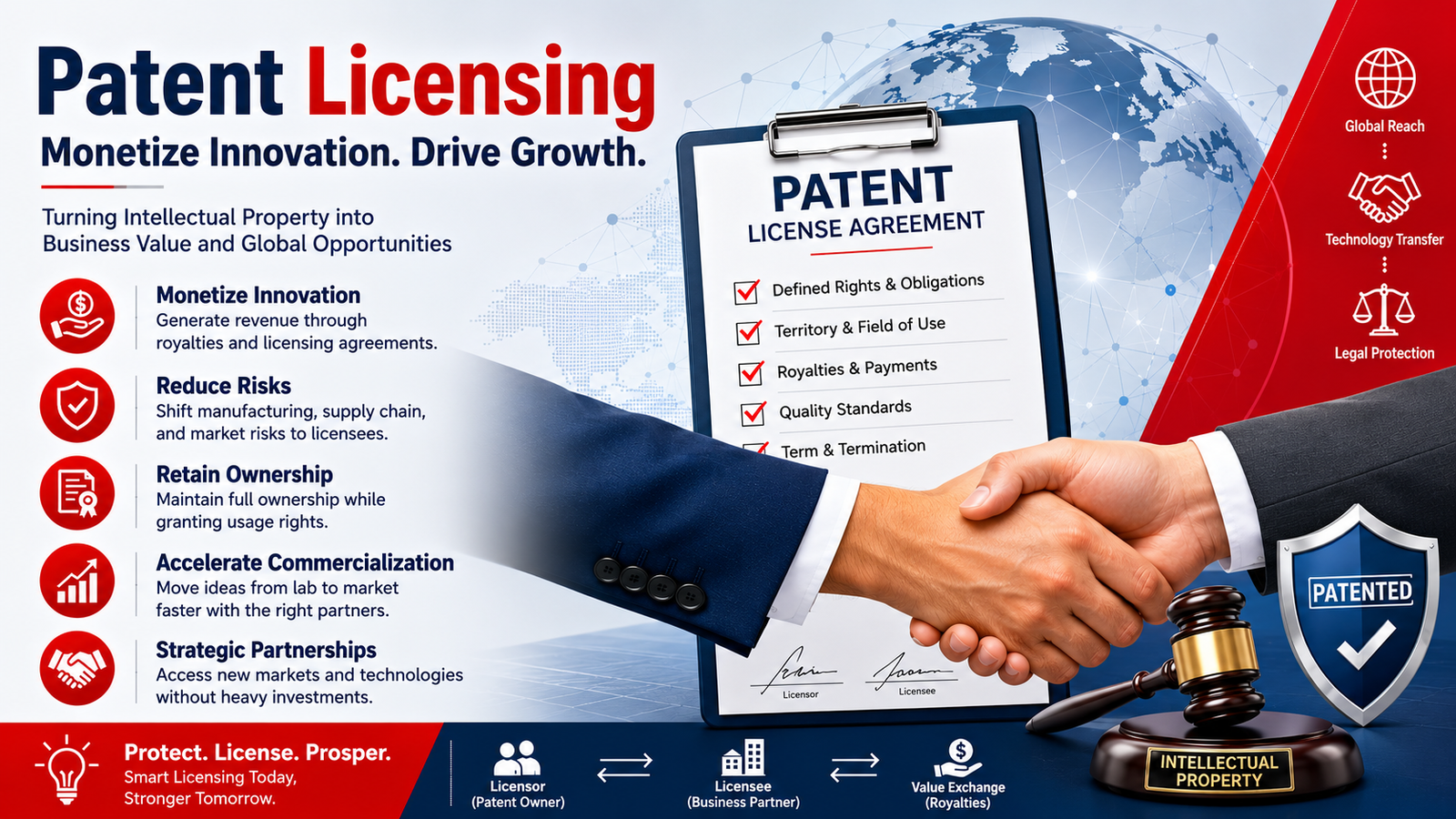
Licensing a patent means granting written commercial permission to another business entity to manufacture, market or sell an invention. A patent gives an inventor all the legal rights over an invention. Instead, the owner can allow any other person or company to use the patented technology under the agreed terms by the owner. This is called as patent licensing.
Patent licensing usually helps innovators turn their intellectual property into a source of income. It becomes very helpful when a business needs to access new technologies without developing them from scratch. Therefore, licensing your intellectual property becomes a crucial step for IP monetisation and technology transfer.
Under global patent law, any granted patent gives inventors all the exclusive legal rights and helps them maintain a monopoly in the market through their technological innovation. Therefore, intellectual property licensing becomes an important part of IP monetisation, technology transfer and modern patent law.
What is Patent Licensing?
Patent Licensing is a kind of legal contract agreement in which a patent owner who is known as the licensor, gives another party, known as the licensee, proper permission to use the patented invention. The licensee receives all exclusive rights under the agreements in return of paying royalties, which is the fixed amount of payment or in form or recognition,
Importantly, Licensing does not transfer ownership of the patent. The inventor or patent owner continues to own the patent. The licensee only has the exclusive rights described in the agreement.
Key elements of patent licensing include:
Effective IP Monetisation: It is the process in which we can convert legal ownership of intellectual assets such as patents, trademarks, copyrights or trade secrets into direct financial revenue. For example, simply holding a patent costs money in filing and maintenance fees. It maximises the return on investment (ROI), which far exceeds the cost of acquiring, maintaining, and defending the IP.
Operational Risk Mitigation: It shifts costly manufacturing overhead, supply chain disruptions, and retail distribution risks that can directly affect local industry distribution networks.
Preservation of Legal Ownership: It ensures the original investigator retains full intellectual property ownership while receiving all the structural lifetime payments.
Commercialisation Acceleration: It moves innovative technical concepts from the laboratory to retail store shelves at unprecedented commercial speed.
Intellectual property licensing agreements can be explained simply as formal contracts that govern commercial rights between patent owners and corporate operating partners. Moreover, these legally binding documents contain so much power in them which can define exact operational boundaries, allowable geographic territories, explicit royalty percentages and crucial quality standard controls.
Now, without detailed written agreements, both parties risk expensive litigation over product modifications, sales territories, or unexpected revenue shortfalls. Through contract negotiations, establish transparent financial expectations, precise asset flows and clear legal protections before factory production begins.
Licensor and Licensee Roles: It identifies the original patent owners as the licensor, and the commercial entity, which is the second party, is Licensee.
How you can monetise an invention through Patent Licensing
We need to learn how to monetise an invention through patent licensing requires a proactive, highly competitive mindset and an outreach strategy. When inventors conduct comprehensive market research to pinpoint and establish manufacturers that already have robust distribution pipelines and compatible product lines.
Inventors can create compelling technical presentations and working prototypes to demonstrate immediate commercial viability to prospective corporate partners. Consequently, demonstrating clear consumer demand and strong profit margins, which empowers investors to negotiate higher royalty rates during deal structuring.

What are the main Types of Patent Licenses?
Patent owners can structure licenses in different ways. The most suitable structure can depend upon the business objective of both the parties.
Exclusive Patent License
An exclusive license gives the licensee all the exclusive rights to use the patent within the agreed period of time. It depends upon the agreement; even the patent owner might be restricted from using the technology under its respective agreement.
This type of model can help investors to create multiple revenue streams. It can also work particularly well when several companies operate in different markets or product segments.
Sole Patent License
A sole patent license is one that allows one licensee to use the patent while the patent owner loses their right to use the invention. The exact rights will depend upon the contracts.
The parties define the meaning of “sole” in the license. Otherwise, disagreements arise over whether the patent owner can license the technology to additional parties.
Non-Exclusive Patent License
It is the type of license that allows licensors to issue identical operating licenses to multiple competing corporations simultaneously. It helps patent owners to generate high revenue from that patent.
Field-of-Use Restriction
It limits commercial usage rights to specific industries and professional market segments to limit use of the patent without authorisation. It is one of the exclusive rights of patent filing and grant, which allows patent owners to prevent all types of unauthorised use.
Geographic Territory Division
It restricts commercial permissions, which are defined by cities, national borders or any geographical location that permits the misuse of the legal patent.
Why Companies Choose Licensing over Outright Patent Purchases?

Examining why a company would choose to license a patent instead of buying it lies in the key strategic financial advantages associated with it. Primarily, licensing allows the reputations among ambitious corporations to integrate cutting-edge technological innovation without depleting critical working capital reserves on expensive outright purchases.
Moreover, acquiring external patent rights through flexible licensing arrangements mitigates corporate research and development risks significantly. As a result, businesses preserve capital agility while rapidly expanding their product catalogue to dominate the market.
Conclusion
Patent licensing gives inventors a way to commercialise their inventions without necessary manufacturing or sell products themselves. It allows businesses to access valuable technology while keeping the original patent owner involved. For inventors, this becomes commercially advantageous as they gain an IP monetisation strategy. However, it depends upon the success of demand, patent strength, negotiation, and drafting by the agent. Before entering into the patent license, both parties should clearly define the rights being granted, payments is secured and ensure proper distribution of rights involved in validly drafted documents to avoid any kind of conflicts. With proper planning, patent licensing can create a valuable asset for the owner as well as for the business. For more such information or any kind of support, you can contact Intellect Bastion LLP!
FAQs
1. What is the difference between assigning a patent and licensing a patent?
A patent license usually does not move ownership. Instead, the person who owns the patent allows another person or company to use the invention in exchange for agreed-upon terms. The license can include products, certain areas, certain industries or certain time periods. In words, a transfer means giving over ownership, and a license means giving permission to use the patent.
2. How do inventors make money from a patent license agreement?
Inventors can earn money from patent royalties, upfront payments, milestone payments or a mix of these. The license agreement decides how and when the person using the patent has to pay the inventor. The inventor may get a percentage of money the person from the licensee while making any kind of profit from the patent. The amount of money the inventor actually gets depends on things like the value of the invention, how strong the patent is and how long it is valid, how many products the person using the patent sells, the royalty rate, how much people want the product and if the inventor has exclusive rights in a certain area.
The income from patent royalties is different for every inventor because it depends on many things. So there is no set amount that inventors make from patent royalties. The patent royalties can be a lot of money or a little; it really depends on the invention and the agreement the inventor has with the person using the patent.
3. How are patent royalty rates typically calculated?
Patent royalty rates are not the same. The people involved in the deal talk about the rate and decide on it based on how useful the patented technology’s how much the company that gets the license will benefit from it.
The royalty can be a percentage of what the company sells, a fixed amount for each product, a minimum amount that has to be paid every year, or a combination of these ways. Patent royalty rates are figured out in various ways.
4. Can an individual inventor license a patent without a lawyer?
Yes, an individual inventor can negotiate and enter into a patent license without a lawyer. However, patent licensing agreements can involve complex legal, financial, and commercial terms. But A poorly drafted agreement may create uncertainty about royalties, exclusivity, sublicensing, infringement, or termination. Professional legal assistance can help an inventor understand these risks and negotiate suitable terms.
5. What happens if a licensee breaches a patent agreement?
When a licensee does not do what the agreement says, that is a breach of the agreement. For instance, the licensee might stop paying the money they are supposed to pay, which is called royalties. The licensee might also use the patented thing in a way that is not allowed. They might tell someone else a secret that they were not supposed to share.
The agreement should say what happens when someone breaches it. So if the licensee breaches the agreement, the person who owns the patent might send them a notice that says they breached the agreement. The patent owner might give the licensee some time to fix the problem. They might just cancel the license that allows the licensee to use the patented thing. The patent owner might also try to get the money they are owed. They might do something else to fix the situation depending on what the agreement says and what the law says about this kind of thing.
6. Can you license a patent that is still pending approval?
Yes. Parties can enter into agreements that cover pending patent applications, but they should clearly identify the application’s status.
A pending application does not provide the same certainty as a granted patent. The patent office may amend, narrow, or reject the claims. Therefore, the licensing agreement should explain what happens if the application receives a narrower scope, gets rejected, or becomes abandoned.
Author: Shubhra Pandey



Pingback: Decoding SEPs & FRAND Licensing: Landmark Court Rulings