
Discussions between the entrepreneur and the investors will always revolve around revenue, customer acquisition, and the addressable market size. However, for tech, biotech, or software startups, future enterprise value depends on intellectual property (IP), not tangible assets or Monthly Recurring Revenue (MRR).
Choosing the right IP valuation method strengthens your leverage during fundraising, M&A deals, or strategic partnerships.
Below is an essential guide to startup IP valuation, investor perspectives, and preparing for formal evaluation.
What Is a Startup IP Portfolio and Why Does It Matter?
Startup IP includes all created or acquired intangible assets that provide a competitive advantage. While tangible assets are physical items like equipment, IP assets derive value from legal protections, proprietary data, and market exclusivity.
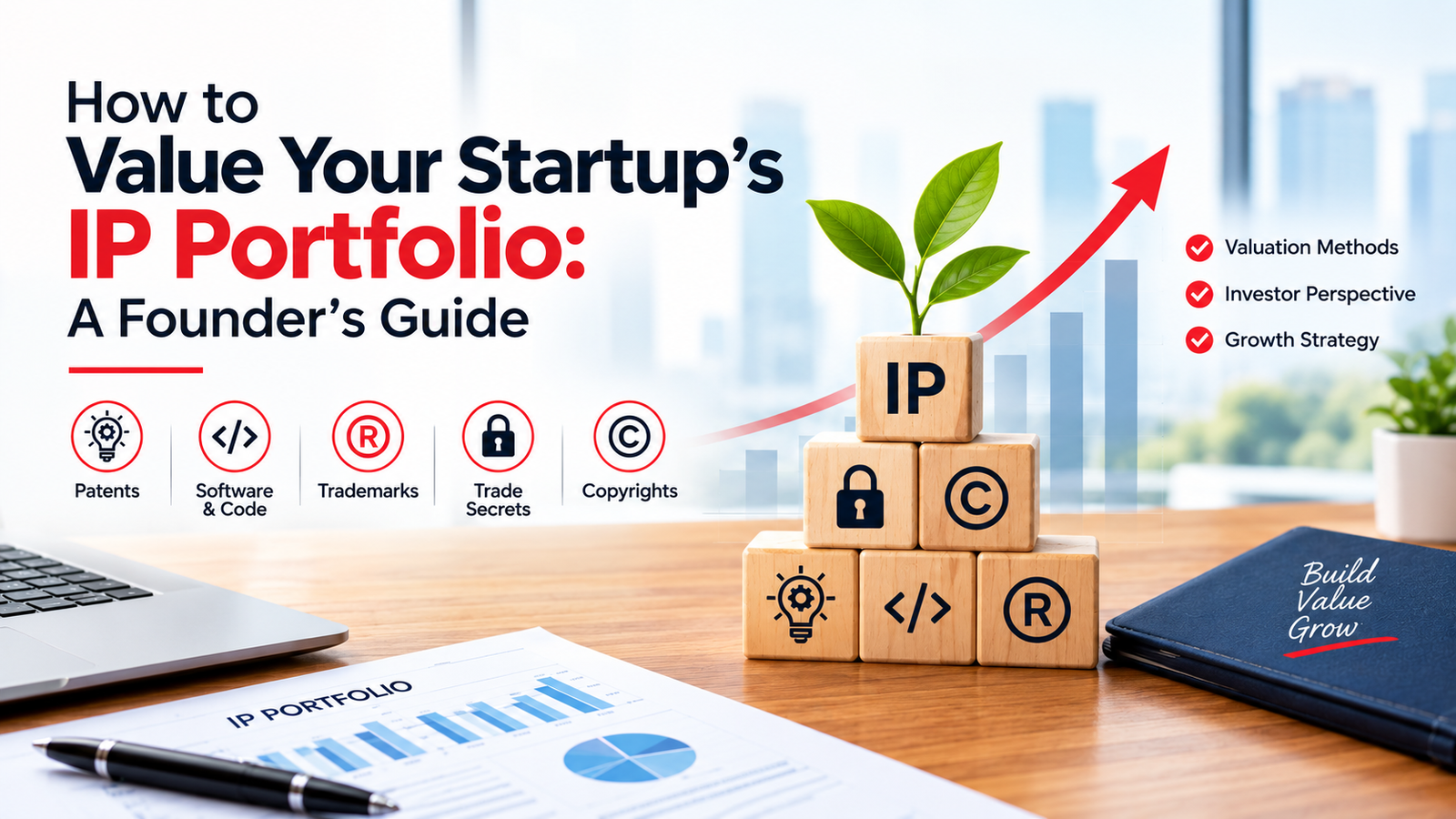
Intellectual property assets that an entrepreneur needs to own in order to have a good IP asset portfolio include:
- Patents: Utility or design patents covering innovations, hardware, and methods/processes.
- Proprietary Software/Code: Algorithms and codes used, databases, and custom software.
- Trademarks/Branding Assets: Brand names, logos, taglines, and domain names.
- Trade Secrets: Datasets, formulae, internal workings, and operational information.
- Copyrights: Written and graphic information including documentation and user interface designs.
Why Intellectual Property Value Drives Enterprise Success
In early-stage start-ups with little income, intellectual property value typically accounts for more than 80% of the total market capitalization. Carrying out an organized valuation will accomplish four strategic goals:
- Increase Pre-Money Valuation: Showcasing its defensibility and a strong barrier to entry, enabling start-up entrepreneurs to obtain pre-money valuations without equity dilution.
- Accelerate VC Due Diligence: Identifies any loopholes or risk factors early on, reassuring cautious VC investment committees.
- Accesses Non-Dilutive Financing: Enables access to various non-dilutive financing options such as IP-based debt or venture loans.
- Protects Key Trade Secrets and Patents: Assists in choosing which inventions to file for expensive patents and international applications.
Core Startup IP Valuation Methods (Income, Market, Cost)
Valuation of intangible assets necessitates financial approaches. There are three main ways of IP valuation of startups that are accepted by accountants, appraisers, and venture capitalists: Cost Approach, Market Approach, and Income Approach.
- The Cost Approach
This method values intellectual property based on the total cost to reproduce or replace the asset.
- Historical cost: Covers all development expenses, including developer salaries, filing fees, testing, prototyping, and legal services.
- Replacement Cost: Is the cost of producing the identical IP asset today using modern technology and labour rates.
When to use: Ideal for early-stage startups (Pre-Seed or Seed) with unique technology but no stable commercial revenue.
- The Market Approach
The Market Approach values IP based on comparable market transactions involving similar patents, software, or technology.
- Comparable Transactions: Assesses the acquisition price or terms of licensing of similar IP portfolios within the same industry verticals.
- Relief from Royalty Method: Values the IP by estimating the hypothetical royalty costs saved by owning it.
When to use: Ideal for active sectors like SaaS or biotech with frequent deals. However, disruptive startups may lack comparable market transactions.
- The Income Approach
The Income Approach involves assessing the economic benefits associated with the intellectual property in the future by translating those expected cash flows into a current value of dollars.
- Discounted Cash Flow (DCF): Estimates the net cash inflows produced by the intellectual property over the course of its economic lifetime by applying a discount rate that captures early stage risk.
- Multi-period Excess Earnings Method (MPEEM): Captures the cash flows derived solely from the key intellectual property by removing returns on the contributing assets like working capital or machinery.
When to use it: Useful when dealing with growth-stage Series A startups with sound unit economics and stable cash flows.

How Investors Assess Startup IP Portfolios
Insight into how venture capitalists view startup IP portfolios enables entrepreneurs to pitch their products in such a way as to instill confidence and address concerns.
Factors to Consider When Investing in Startups:
- Defensibility/Moat: Is the IP able to block well-resourced competition from duplicating functionality of your business? The wider the utility patent, the better protection you have, while narrower and defeatable patents don’t give much protection.
- Freedom to Operate (FTO): Has the startup conducted an FTO study to make sure that the product isn’t infringing any patents owned by third parties? Litigation problems may be deal-killers at this stage.
- Market Fit: Is the patented technology relevant to what drives revenue in your business? Patenting of minor technology is not as valuable to enterprise as patenting core algorithms.
- IP Assignments for Team Members: Have all of the current and past employees, co-founders, contractors, and advisors executed IP assignment agreements?
How to Protect and Value Proprietary Software and Patents
Software, algorithms, and trade secrets call for an integrated approach to asset management. An effective blend of legal measures and operating procedures increases both the strength and value of your technology portfolio.
Securing Proprietary Source Codes
Different from conventional inventions, software innovations progress swiftly. To protect proprietary source codes, multiple safeguards should be in place:
- Copyright Protection: Source code is automatically protected by copyright law as soon as it is written down. Filing of the source code for copyright registration leaves a clear public record.
- Patent Protection: It is available for innovative technical features of software, user interfaces, and functioning of machine learning models that address technical issues in new ways.
- Trade Secrets: Important in securing algorithms, training data sets, and back-end processes. Effective access management and NDAs should be in place.
Optimizing Patent Valuation Impact
In order to maximize the economic value associated with patents under consideration and already issued:
- Have flexible patent prosecution by making use of provisional applications and continuations so as to modify claims in accordance with your changing core product.
- Maintain chain-of-title documents such as laboratory notebooks, commit records, and inventor assignment forms.
- Concentrate efforts on protecting valuable differentiators rather than on patent proliferation.
Summary Strategy for Founders
The accurate valuation of startups’ intellectual property converts the intangibles into tangible value for funding rounds. The effective use of cost, market, and income approaches, combined with clean title methodologies, can help entrepreneurs build robust valuations for their corporations, protect their market share, and successfully close deals. For any assistance, valuation advice, or IP audit, please connect with Intellect Bastion.
Frequently Asked Questions (FAQ)
What is an IP portfolio in a startup and how does it affect valuation?
An IP portfolio is the entire set of intangibles that belong to the firm, including patents, trademarks, software, trade secrets, and copyrights. IP portfolio affects the valuation process since it ensures technical defensibility and provides market entry barriers and constitutes a significant share of a startup’s enterprise value.
What are the occasions for the formal intellectual property valuation of a startup?
The formal IP valuation of a startup should be carried out before significant fundraising (Series A funding), in case of M&A negotiation, during restructuring of the company, and in case of establishing licensing and royalty agreements with strategic partners.
What is the basic approach towards valuation of startup IP?
The three main approaches towards startup IP valuation are:
- Cost Approach: The asset is valued through replacement or replication in accordance with historical development costs.
- Market Approach: Valuation based on comparison of IP portfolio to prices/royalties from transactions in the market.
- Income Approach: Calculation of the present value of direct income derived from IP.
How does the pending patents and trademark registration affect the pre-money valuation?
Patents and trademarks that have been granted create the element of exclusivity and low execution risks that result in increased pre-money valuations. The pending patent applications are also extremely valuable since they signal innovation and give warning to other competitors even though they may be discounted by investors until grants are published.
What is the distinction between enterprise valuation and intellectual property valuation?
Enterprise valuation is concerned with the total value of the entire business, taking into account its working capital, tangible assets, personnel, revenue, and future prospects. On the other hand, intellectual property valuation focuses on the value of the intangible IP of the company.
How do venture capitalists and investors appraise the value of intangible assets of a business?
Investors value intangible assets through market defense analysis, freedom to operate (FTO) analysis, inventor assignment chains, international protection, and the ability of the protected technology to generate recurring revenue.
How can trade secrets and proprietary software be considered during the IP audit process?
Trade secrets and proprietary software are analyzed in terms of ownership, technological uniqueness, and security during an IP audit. The sources of the code are verified, the compliance with any restrictive licenses, such as those from open-source software is checked, and stringent access control and NDAs are enforced.
How can founders guarantee that their startup has rightful ownership of all created intellectual property before conducting valuation?
To make sure that your startup has total ownership of its intellectual property, you need to make sure that all founders, staff members, contractors, and programmers have signed the Intellectual Property Assignment Agreement and Invention Assignment Agreement before starting programming.
YASHIKA KORANGA
Senior Patent associate at Intellect Bastion