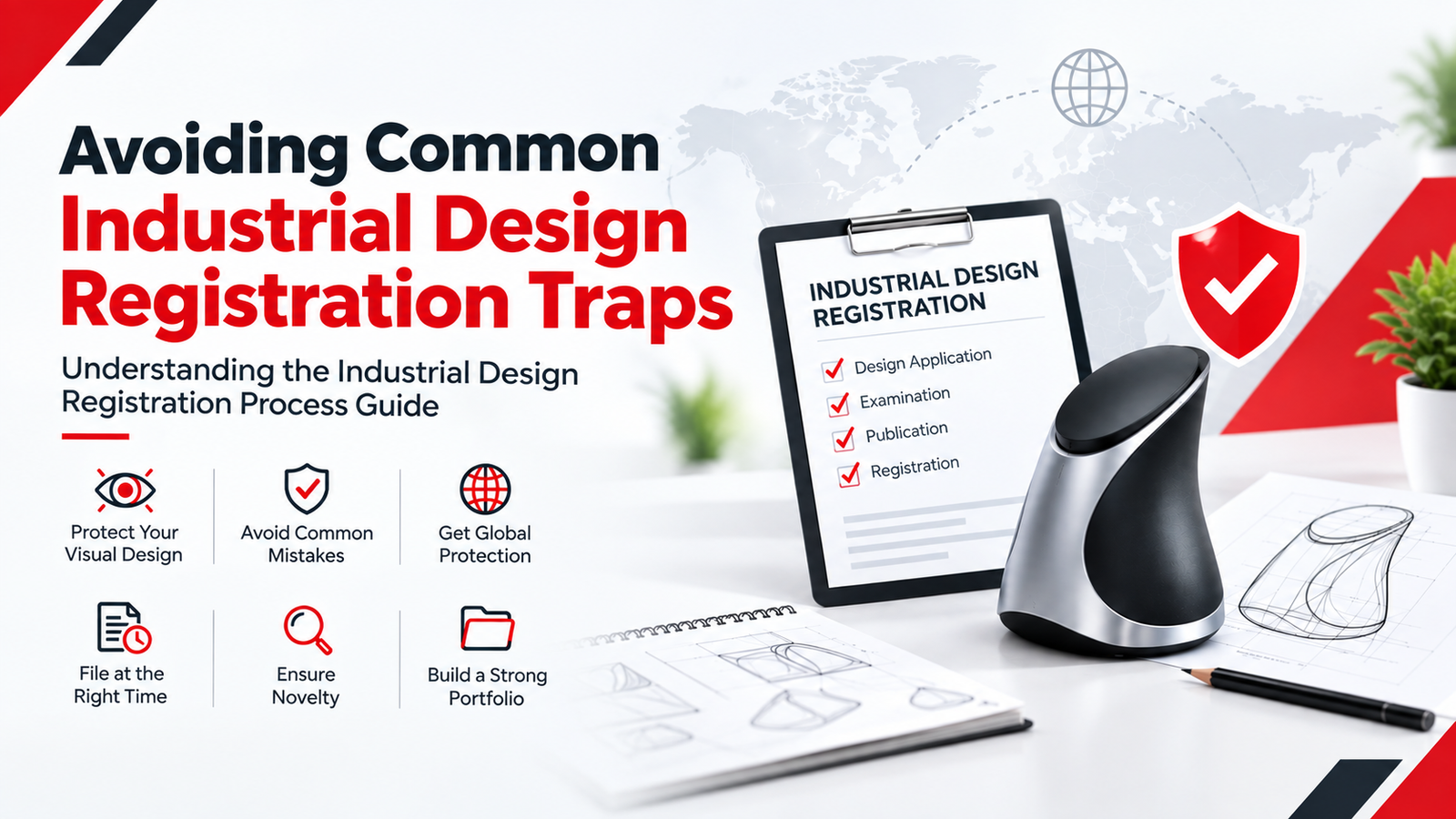
Effective protection of intellectual property turns your visual creation into a commercial shield. Hence, the utilisation of the industrial design registration process guideline assists founders in tackling legal challenges efficiently. Moreover, the IP protection of the product protects your unique visual design from competitive threats in the marketplace. As a consequence, companies are granted exclusive rights to the shape, configuration, pattern, or ornament of the product.
The confusion between the aesthetic protection of the visual design and the technical invention arises at the beginning of the product development stage for many original designers. In particular, a utility patent protects the functionality of the invention, while the industrial design protects the appearance of the product. Nevertheless, opting for the wrong protection path creates legal risks for your business right away.
- Scope Identification: Focus your filing exclusively on visual aesthetics rather than internal mechanical functions.
- Filing Timelines: File your formal applications before the launch of your product or its marketing in the public arena.
- Jurisdiction-wise Protection: Ensure that you register your designs in all international markets where you plan to sell your products.
- Asset Evaluation: Regard your registered design rights as an important asset for investment and licensing negotiations.
- Regular Monitoring: Stay aware of the developments in the market to spot any unauthorised duplication of your design.
- Portfolio Organisation: Maintain clean ownership records for every visual variation created within your design team.
Differentiating Patent vs Design Rights for Product Aesthetics
Knowledge of the line between utility patents and design rights will provide you with the ultimate power of protection in the future. Moreover, utility patents provide protection for functionality, whereas design rights offer protection for appearance. In that regard, the submission of improper protection documents will leave your company vulnerable to third-party infringement. Therefore, managers have to analyse the product features in advance.
Moreover, the use of two protection types in combination will bring the most successful defence strategy on the market. For example, a smart device has innovative hardware components along with a unique ergonomic design. As a result, the application of both utility patents and industrial design will ensure multi-layered protection for your product.
- Functional Separation: Exclude purely technical mechanisms from your visual design application submissions.
- Dual Protection Strategy: File both utility and design applications simultaneously for high-value physical hardware.
- Cost Allocation: Budget separate funds for design aesthetics and complex technical utility patents.
- Term Differences: Remember that design rights usually expire sooner than standard utility patents.
- Infringement Tests: Note that design infringement relies on overall visual impact rather than claims analysis.
Enforcement Speed: Leverage fast design registration approvals to stop market knock-offs quickly.
Meeting Novelty Requirements for Industrial Design Protection
Strict novelty criteria in the case of industrial design demand that your design be completely new globally. What is more, any prior public disclosure makes the design lose its novelty. In this way, understanding what can cause application failures can help you see how premature social media promotion can ruin the situation. Simply displaying your prototype on social media can deprive you of your right to protection.
In addition, international grace periods vary dramatically across different global legal jurisdictions. Therefore, relying on local grace periods creates extreme risk for international brand expansion. In contrast, filing early guarantees priority status across foreign intellectual property offices worldwide. Ultimately, maintaining strict confidentiality until filing prevents competitors from hijacking your unique product aesthetics.
- Pre-Filing Secrecy: Keep all product visuals strictly confidential until formal application submission.
- Non-Disclosure Agreements: Enforce binding NDAs with external manufacturers, vendors, and creative consultants.
- Grace Period Caution: Avoid relying on 12-month grace periods when planning global market launches.
- Priority Dates: Take advantage of international treaty law for establishing original priority dates in several nations.
- Cleaning Digital Footprints: Inspect your internal team’s social media accounts to avoid any images being leaked before filing.
- Restrictions on Exhibits: Check the proper standards that need to be followed before showing off prototypes at trade shows.

Conducting a Prior Art Search for Industrial Designs
The conducting of an exhaustive search of prior art for industrial designs ensures that there will be no costly mistakes during the process of registration of your designs. Furthermore, an exhaustive search will locate designs that are registered and similar to the design concept that you intend to register. Therefore, the applicants can avoid infringing on the rights of competitors.
Many start-up founders skip thorough searches to save initial product development funds. However, skipping this vital research phase drastically increases common industrial design registration mistakes. For example, official examiners reject applications that mirror existing registered visual patterns. Therefore, spending resources on professional search tools saves substantial time and legal expense later.
- Global Database Searches: Search global databases such as WIPO, USPTO, and EUIPO extensively.
- Criteria for Visual Comparison: Conduct visual comparisons of overall shape, outline, and ornamentation.
- Commercial Catalogue Searches: Search trade magazines, retail sites, and online catalogues.
- Classifications: Use Locarno Classification Codes to filter out relevant classes.
- Patent Agents: Employ registered patent agents for complicated international searches.
Search Records: Keep records of search procedures to establish due diligence in any future legal proceedings.
Navigating Legal Requirements for Design Registration
Fulfilling the criteria necessary for design registration leads to a trouble-free application process via official registries. In addition, the patent office requires you to provide precise and standardised visual depictions of your physical product. This means that you have to include high-quality line drawings of your physical product from different standardised viewpoints. This is because visual depictions help in clarifying the scope of your protection under the law.
Poorly drafted line drawings cause delays during examination and office action procedures. However, knowing how to prevent your design application from rejection protects your important launch dates. One way of preventing rejection is by eliminating technical dimensions and text in the aesthetic drawings.
- Standardised Views: Provide isometric, front, back, top, bottom, and side perspective drawings.
- Neutral Backgrounds: Render designs with clean and plain backgrounds using only white, without any additional visual clutter.
- Consistency in Drawings: Make sure that all drawings depict the same features and proportions of products.
- Solid and Broken Lines: Use solid lines when depicting protected features and broken lines for context.
- Colour and Black & White: Select black & white line drawing for wider visual coverage.
Shading Methods: Use delicate shading for the depiction of contours only.
Identifying Why Industrial Design Applications Fail
By identifying common errors in industrial design registration, it is possible for executive teams to ensure their company’s intellectual property portfolio is strong and resilient. One of the common problems is the delay in filing industrial designs overseas, past the six-month threshold. The consequence is that companies no longer have the chance of obtaining foreign rights through the initial filing date.
Additionally, failing to register minor commercial design variations leaves dangerous loopholes for competitors. Consequently, rival firms copy slight aesthetic modifications without infringing on your primary registration. In contrast, filing a family of related design registrations seals off potential competitor workarounds. Ultimately, strategic portfolio expansion provides comprehensive market protection for your flagship products.
Conclusion
Navigating the complex world of visual IP requires proactive planning and meticulous legal execution. Therefore, avoiding common industrial design registration mistakes saves your company valuable capital and preserves your market advantage. In addition, prioritising an early prior art search for industrial designs protects your creative team from immediate third-party infringement claims. Consequently, thorough pre-filing preparation creates a clear path toward long-term brand security and commercial success.
Furthermore, mastering the subtle nuances of patent vs. design rights ensures comprehensive coverage for your flagship physical products. As a result, growing businesses effectively defend their non-functional visual aesthetics alongside complex technical functions. Moreover, strictly adhering to global novelty requirements for industrial design prevents accidental self-disclosure traps before official product launches. Therefore, maintaining strict visual confidentiality remains the absolute foundation of strong intellectual property rights. For any kind of guidance, you can contact Intellect Bastion LLP!
FAQs
1. What constitutes prior art in industrial design registration?
Prior Art is defined as anything that existed as a design, a product, a photograph, a listing on a catalogue, a patent, registration or even an exhibition in the public domain worldwide prior to your filing/priority date. It could be something posted on social media, something you launched in a crowdfunding campaign or any listing on an e-commerce website or even something that was exhibited at a trade show.
2. How does a lack of novelty cause design application rejections?
For design registration, a design must be novel and have its own unique character in comparison with other existing visual arts. When examining an application, the examiner will compare the application with prior art databases across the globe. Where he/she finds an existing design to be identical in appearance or gives the same visual effect to an informed user, the application will fail the novelty test and be rejected.
3. When should you conduct a prior art search during product development?
It is advisable to carry out a prior art search at an early stage in the process of generating new ideas in order to avoid infringing on registered designs that may still be in use. This will save the company money and will ensure that the product looks visually distinctive.
Author: Shubhra Pandey