
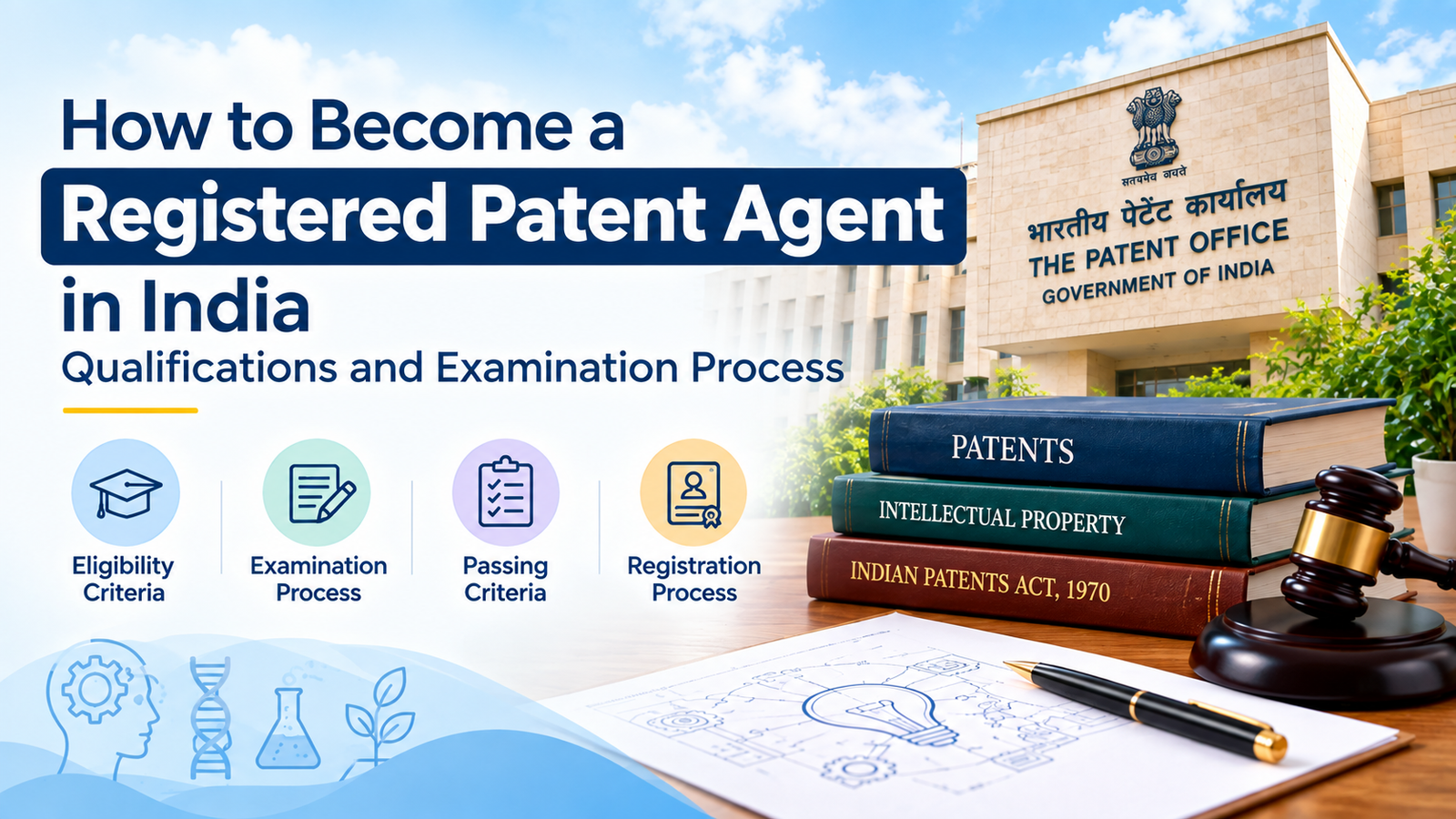
Career as a registered patent agent is one of the lucrative opportunities for science and technology experts who wish to pursue a special career in the field of intellectual property. The Indian Patent Office that operates through the Controller General of Patents, Designs and Trade Marks (CGPDTM) regulates patent agent registration in India as per the provisions of the Patents Act of 1970. Patent agents are the individuals who have the capability of bridging the gap between innovation and law in terms of patent filing and other patent related issues.
There is an increasing demand for patent agents who have the expertise to practice their work in India. There is a rapid increase in the domestic patent filing for various fields including biotechnology, pharmaceuticals, artificial intelligence, and green energy. It takes considerable knowledge of both technicalities and statutes to operate patents.
Who is a Registered Patent Agent?
An individual who is a registered patent agent is one who is authorized and whose name is included in the Register of Patent Agents kept by the Indian Patent Office. As per Section 127 of the Patents Act, 1970, patent agents have the right to practice before the Controller of Patents. Thus, they have the legal right to draft the patent application and attend hearings.
Difference Between Patent Lawyer and Patent Agent India
Many aspirants confuse a patent agent with a patent lawyer. While both handle intellectual property matters, their eligibility requirements and professional scopes differ under Indian law.
| Feature | Patent Agent | Patent Lawyer / Patent Attorney |
|---|---|---|
| Primary Qualification | Degree in Science, Engineering, or Technology | Degree in Law (LL.B.) registered with a State Bar Council |
| Mandatory Exam | Must pass the Indian Patent Agent Examination | Must pass the All India Bar Examination (AIBE) |
| Governing Act | Indian Patents Act, 1970 | Advocates Act, 1961 |
| Scope before Patent Office | Drafts specifications, files patents, and represents clients in Controller hearings | Represents clients in Controller hearings and handles IP litigation |
| Scope before Courts | Cannot represent clients in High Courts or the Supreme Court | Can represent clients in High Courts and the Supreme Court for infringement suits |
An individual who holds both a science degree and a law degree, and who clears the qualifying examination, can act as both a patent agent and a patent lawyer. This dual qualification provides a significant advantage in the Indian IP market.
Eligibility Criteria for Indian Patent Agent Examination
The conditions to be met for getting registered have been laid down in Section 126 of the Patents Act, 1970. No exceptions are made in regard to these conditions by the Controller General for every exam cycle.
Educational Qualifications for Registration as a Patent Agent in India
The candidates should have an engineering/science/technology degree from any recognized university in India, which is established under the Central/State Acts in India. Alternatively, candidates with equivalent qualification as recognized by the Central Government will also be eligible. Some of the accepted academic qualifications are:
- Bachelor of Technology (B.Tech) or Bachelor of Engineering (B.E.) in any branch.
- Master of Science (M.Sc) or Bachelor of Science (B.Sc) in Physics, Chemistry, Biology, Biotechnology, Pharmacy, etc.
- Doctor of Philosophy (Ph.D.) in science or technology.
Degrees in humanities, commerce, business administration, and pure law degrees without any scientific background will not meet the requirements.
Age Limit & Requirements for Citizenship
There are two personal requirements set by the Indian Patent Office as per Section 126:
- Citizenship: The aspirant should be an Indian citizen. Non-Indian citizens cannot become patent agents of India even if they are qualified scientifically.
- Age Limit: The candidate should have attained the age of 21 years or above at the time of application. No maximum age limit is prescribed in the act, hence anyone can pursue this career irrespective of experience.
Is Registration Possible for Final Year Students?
Final year science and engineering students have questions about their eligibility for the examination. For registration to the exam one needs either their final degree certificate or marksheets showing successful completion before applying for the Patent Agent Examination. Those who do not have final marksheets cannot apply until they get their qualifying marksheets.
Alternative Pathways to Register Without Taking the Exam
Although clearing the exam acts as the main entry point, Section 126(1)(c)(i) gives another route through which the person could be registered. An individual who has been employed in the Indian Patent Office as Examiner of Patents for at least ten years can also seek to get registered directly. Such people should however apply for registration within the required period after leaving the patent office.
Syllabus and Pattern of Patent Agent Exam 2026
CGPDTM organizes the Patent Agent Examination in various metropolitan cities in India. The selection procedure tests the candidate on three different levels – Paper 1, Paper 2, and Viva-Voce.
Paper 1: The Patents Act and the Patents Rules
This paper will test the theoretical knowledge of Indian patents law.
- Format: MCQs and Descriptive questions.
- Maximum Marks: 100 Marks.
- Time duration: 2 Hours.
- Main topics to be covered:
- Basics of the Patents act along with Section 3 and 4 of the Patents Act defining patentable inventions.
- Procedures for filing of patent applications (Provisional and Complete specification applications).
- Processes of publication, examination, and search.
- The process of opposition (Pre-Grant and Post-Grant opposition).
- The process of surrendering and revocation of patents and the restoration of lapsed patents.
- The compulsory licensing of inventions and the government use of invention.
- PCT (Patent Cooperation Treaty) and Paris Convention
- Time schedules, fees and forms under Patents rules, 2003.
Paper 2: Drafting and Interpretation
Paper 2 assesses the practical skills of reading and interpretation of technical disclosures into patent documents which are legally binding.
- Format: Subjective, descriptive and scenario based drafting questions.
- Total Marks: 100 Marks.
- Time Allotted: 3 Hours.
- Topics Included Are:
- Drafting independent and dependent claims of patents.
- Drafting provisional and complete specifications out of technical abstracts.
- Drafting replies to first examination reports (FER).
- Drafting opposition petition and counter statements.
- Interpreting case laws and provisions of law.
Viva-Voce Interview
The candidates who qualify for Papers 1 and 2 are selected for Oral Interview (Viva-Voce). The interview is held by a team of experts who are senior patent officials.
- Totals Marks: 50 Marks
- Areas of Evaluation: Practical knowledge in IP management, developments in Indian patent law, professional ethics, and argumentative skills.
Passing Marks Breakdown
For the success of the Indian Patent Agent Examination, candidates need to clear not only the paper-wise cutoff but also an overall aggregate requirement.
| Qualifying Marks Structure | |
|---|---|
| Paper 1 (Patent Act and Rules) | Minimum 50% is Required (50/100) |
| Paper 2 (Drafting) | Minimum 50% is Required (50/100) |
| Viva-Voce (Oral Examination) | Minimum 50% is Required (25/50) |
| Aggregate Requirement | Minimum 60% Aggregate (150/250) |
Getting 50% in each paper is compulsory. Getting 50% in all papers gives only 125 marks in total out of 250, which is less than the required 150 marks for 60% aggregate. Candidates should get good marks in either Paper 1 or Paper 2.
Step-by-Step Guide to Clear Patent Agent Exam
Passing the exam of the patent agent involves preparation in an organized manner for many months to come. There should be a proper balance between statutory reading and continuous practice of drafting.
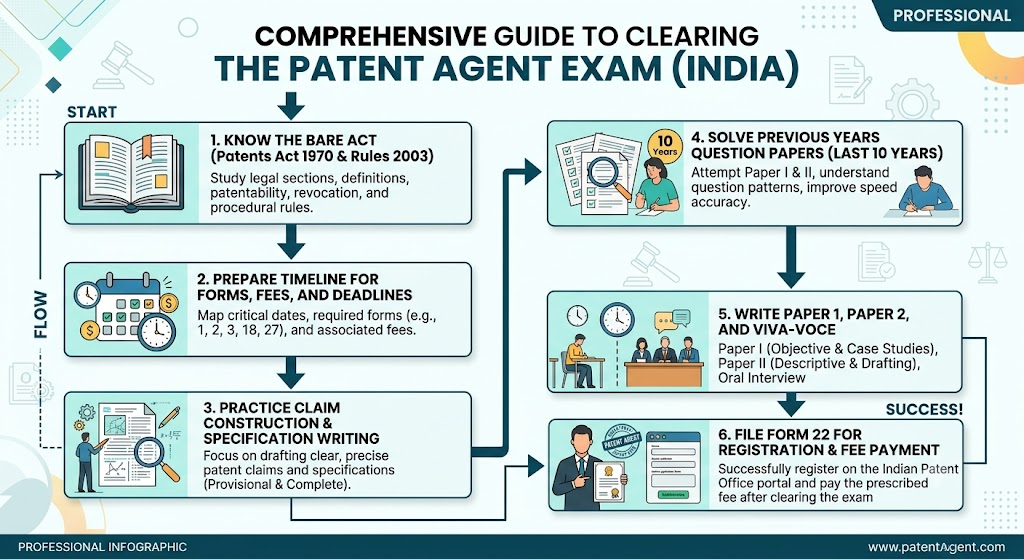
Step 1: Become Familiar with the Bare Act
Study the Patents Act, 1970 together with the Patents Rules, 2003. Pay particular attention to the exceptions to patentability as mentioned in Section 3. Learn about non-patentable subject matter such as software per se, business methods, treatment methods and scientific theories.
Step 2: Memorize Forms and Deadlines
Prepare well-structured tables of statutory provisions and associated forms and deadlines. Remember the timelines for filing complete specifications after provisionals (within 12 months), for filing Form 18 (examination request), and filing replies to FERs.
Step 3: Build Claim Drafting Skills
Practice claim drafting frequently through real inventions in engineering and chemical domain. Learn how to draft a patent document with its title, field of invention, prior art, technical problem, solution, description, drawings and claims. Learn the usage of transitional phrases such as “comprising”, “consisting of” and “characterized in that”.
Step 4: Solve Previous Years' Examination Questions
Solve the previous year question papers of last 10 years published by CGPDTM. Solving the examination papers will help you learn time management during the examination and recurring question patterns.
Step 5: Preparing for the Interview
Be aware of some of the latest landmark judgments in Indian courts on compulsory licensing, Section 3(d) drug efficacy test, and standard essential patents (SEP). Rehearse your answers clearly to ensure you remain calm while answering orally.
Filing Form 22: Post-Examination Patent Agent Registration
Clearing the written papers and oral exam is the main milestone, but according to procedure, candidates have to undergo formal registration with the register. According to Rule 109 of the Patents Rules, 2003, candidates have to go through the registration process.
- Obtain official result notice issued by IP India portal.
- Access the Patent Agent Portal on the CGPDTM website.
- Complete Form 22 (Application for Registration as Patent Agent).
- Submit degree certificate, identity proof and photograph.
- Pay prescribed registration fee.
- Get Patent Agent Number and Certificate from Controller.
Upon verification of documents, the Controller General registers the name of the applicant in the official Register of Patent Agents. A unique Patent Agent Registration Number (such as IN/PA/XXXX) is provided to the patent agent.
Conclusion
Registering as a patent agent in India gives the scientific fraternity an obvious advantage in the modern era of the knowledge economy. Those candidates who go through an exhaustive study of the Patents Act, 1970, constantly engage in drafting claims, and pass the exam conducted by the CGPDTM gain a very lucrative professional credential. Patent agents have a vital role to play in the protection of inventions around the world. For complete guidance and structured preparation to ace the exam, contact Intellect Bastion.
Frequently Asked Questions (FAQs)
What are the minimum educational qualifications that a candidate must have in order to take the Indian Patent Agent Exam?
The candidates should be graduates of Science, Engineering, or Technology from any Indian university or have an equivalent qualification recognized by the Central Government.
Is it necessary to have a law degree in order to be a patent agent?
No, it is not essential. Only a scientific or technical degree is necessary according to the law. Even though having both law and science degrees increases career prospects, only an LLB without a scientific degree will not qualify anyone.
How does one qualify to become a registered patent agent?
One should be a citizen of India and must have attained the age of 21 years. No upper limit is set for registration.
What is the format and pattern of the Patent Agent Examination?
The exam consists of three papers: Paper 1 (Objective & Short answers on Patents Act & Rules, 100 marks, 2 hours); Paper 2 (Descriptive Drafting & Specification preparation, 100 marks, 3 hours); and Viva-Voce (Oral interview, 50 marks).
What is the number of marks that need to be scored in order to pass Paper 1, Paper 2, and Viva-Voce?
The candidates need to score at least 50% marks in Paper 1, 50% in Paper 2, and 50% marks in Viva-Voce. Moreover, they need to score a minimum aggregate percentage of 60% marks in all three papers.
Are the final-year science and engineering students eligible for applying for the patent agent exam?
Yes, the final-year students may apply for the patent agent exam only when they receive their final degree certificate or mark sheet before the application deadline.
What is the procedure for applying for patent agent registration by filling out Form 22 after passing the exam?
The applicants who clear the exam have to fill out Form 22 under Rule 109 on the official website of IP India. They have to upload their proof of academic qualification, marksheets, pass certificates, national identity proofs, and have to pay the registration fees for getting the registration number.
Is there any other way to register as a patent agent without clearing the exam?
Yes, an individual who has worked as Examiner of Patents in the Indian Patent Office for at least ten years can become a registered patent agent under Section 126(1)(c)(i) without giving the written examination.
YASHIKA KORANGA
Senior Patent Associate at Intellect Bastion