The journey of granting the patent application to the inventor goes through up-and-down slopes rather than a smooth, straight line. Most applicants generally face an intense phase of patent prosecution after receiving the First Examination Report (FER) of their application. Many inventors lose hope during this stage. However, with a clear strategy, an FER can be easily defended. First Examination Report requires drafting a response, which should be precise, clear and strictly adhere to the timelines.
The issuance of a First Examination Report (FER) represents the most significant pivot in the patent lifecycle. It marks a formal transition from administrative legal disclosure with the Patent Office. Hence, FER is not a final rejection; it is a procedural invitation to negotiate.
Now, understanding how to address the patent objections can transform a stressful process into a manageable outcome. This ultimately can protect their valuable intellectual property.
Securing high-value intellectual property requires a fundamental mindset shift: the applicant must move from the creative enthusiasm of the invention to clinical, structural defence of legal claims. The FER provides the roadmap that identifies the specific statutory and technical hurdles standing between an application and a grant.
The FER provides the roadmap that identifies the specific statutory and technical hurdles standing between an application and a grant. This guide serves as a masterclass for navigating these objections, leveraging procedural nuances to protect the inventive core and ensure the resulting patent maintains maximum commercial utility.
Understanding the First Examination Report (FER)
The Indian patent system utilises a “defended examination” under Section 11B of the Patents Act, 1970. First Examination Report is a legal examination document issued by the Patent Office. It is a detailed statutory document outlining objections against your application. Receiving an FER does not mean your application is out of the race. It just means that your application encountered a setback in its journey toward securing the grant.
An FER simply marks the opening move of formal patent prosecution. Distinguishing a standard office action from a final patent rejection keeps the process moving forward smoothly.
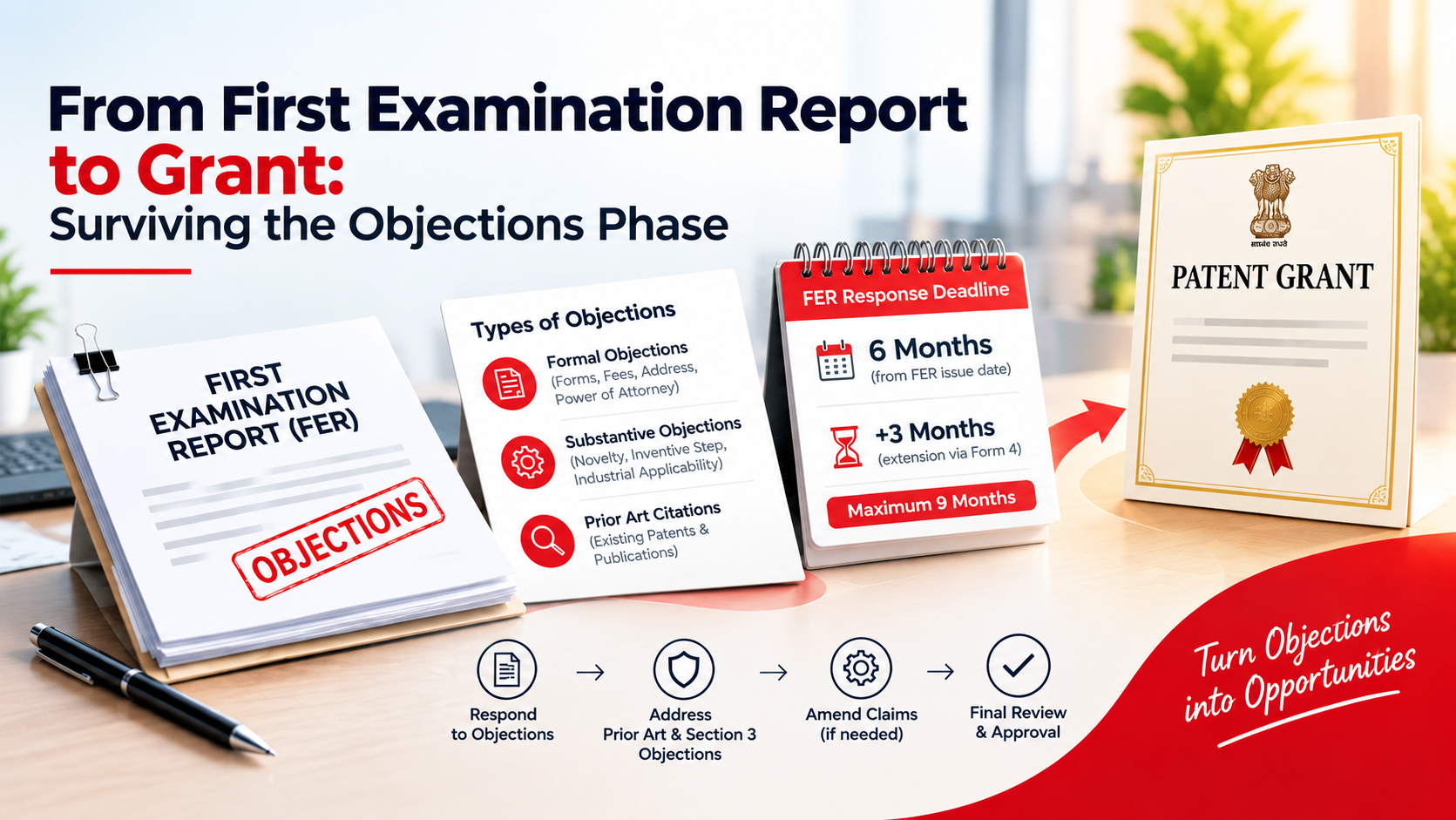
Types of Objections
- Formal Objection: It is an issue that is regarding missing forms, incorrect fees, wrong address or power of attorney errors. These errors are quite common and usually occur. Hence, the Patent Office generally mark these corrections and sends the formal FER.
- Substantive Objections: These objections, which the Patent Office raises, challenge the novelty, inventive step and industrial applicability or statutory exclusions. It is quite difficult to overcome, and the Patent Office demands proper evidence that shows that the invention is novel.
- Prior Art Citations: These contain Lists of existing patents or published Literature that might undermine the novelty of your invention. You can use them to distinguish the differences and technical advancements of your invention. That’s why conducting a Patent Search Report before filing any patent application becomes crucial.
Strict Deadlines for Filing an FER Response
Timing is everything; missing any date can lead to rejection of the patent. After surviving the patent objection phase, it is very important to keep a record of every date. In jurisdictions like India, applicants have a strict window of 6-months from the date of FER issuance. They have a strict window of 6-months from the date of FER response filing. Missing this deadline causes the application to be rejected.
Applicants have a right to request a time extension of up to three additional months by submitting Form 4 before the initial six-month period expires. However, early filings ensure enough time to handle everything properly in order to collect the evidence and make a proper response. Filing requires sufficient evidence and an expert level of drafting, which could make the response more convincing to the Patent Office.
- Initial Response Window: Opens for 6 months from the FER issue date.
- Extension Window: It is up to 3-months with prescribed government fees.
- Absolute Outer Limit: It is for 9 months maximum to address all the objections.
Overcoming Prior Art Rejections
Examiners generally cite their FER with a series of Prior art references that will be quite similar to your inventions and claim that your invention lacks novelty and inventive step due to the presence of prior art in the market. Overcoming these prior art objections requires in-depth knowledge, similarity in technical language, and you have to demonstrate how your invention is different from prior art or any cited references.

Effective responses do not just reject the examiner’s argument; but it shows proper mapping of the differences, which can convince the examiner or otherwise lead to rejection of the response. Amending the cited claims without introducing new subject matter usually resolves these objections. There are many ways which you can add to your response to make the response more convincing for the examiner.
- Differentiate Features: Highlight unique structural or procedural features which are absent in the cited prior art.
- Demonstrate technical advancements: It is providing the data showing unexpected results or experimental sheets with improved efficiency compared to the prior art.
- Amend Claims Narrowly: Narrow your independent claims to cover the core novel aspects of your invention, as more irrelevant feature which is not very crucial for the invention can generate the prior art.
Handling Section 3 Non-Patentability Objections
Statutory exclusions, such as Section 3 under the Indian Patents Act, 1970 it represent some of the toughest hurdles. Section 3(d) targets incremental innovation without proven efficacy. Section 3(k), it excludes all software algorithms. Handling Section 3 Objections effectively requires aligning your claims with legal exceptions.
Applicants must reframe claims to emphasise technical effects or comparative therapeutic advantages. Providing solid comparative test data remains the most effective strategy to clear your statutory hurdles.
- Section 3(d) (Pharma): It requires submitting experimental data that proves significantly enhanced therapeutic efficacy over the known substance.
- Section 3(K) (Software/CRIs): In this, you can reframe the software claims to highlight the hardware combination and technical solution provided in your invention.
Section 3(i): In this method-of-treatments claims into device apparatus or composition claims.
Conclusion
Navigating the patent examination phase demands a proper strategy, technical knowledge and strict compliance with the statutory deadlines. Receiving the First examination report is never the end of the journey; it is just a hurdle. It serves as an essential procedural milestone to correct your claims and strengthen the legal boundaries of your invention.
Traditionally, addressing prior art citations will not convince the examiner, so to distinguish your invention, you need to submit a detailed response that can technically distinguish your invention from prior art to ensure your application remains on the fastest track to approval.
Ultimately, surviving the objections phase relies on transforming legal hurdles into opportunities to showcase the invention more briefly to the Patent Office. Armed with technical arguments and timely execution, you can protect your invention, gain the legal rights and navigate the journey from any FER to the grant with complete confidence. For any kind of guidance you can contact Intellect Bastion!
FAQs
1. What is a First Examination Report (FER) in patent prosecution?
A First Examination Report (FER) is a formal communication that contains a series of objections after the examiner reviews your patent application. It outlines official objections regarding the formal requirements, novelty, inventive step and statutory patentability that must be addressed before a patent can be granted.
2. What is the official deadline to file a response to a First Examination Report?
In India, the submission of the complete response to the FER is six months from the date the FER is issued to the applicant or their patent agent, but an extension window of up to 3-months with prescribed government fees can provide an additional 3 months for response filing.
3. Is receiving an FER considered a final patent rejection?
No, receiving does not mean the end of the patent application. It is the standard procedural step in patent prosecution that allows an applicant to clarify the technical details instead of directly rejecting the patent application. Patent Office provides a chance to justify the novelty over any prior art.
4. What steps are involved in amending claims to meet the examiner's requirements?
Amending claims means going through the examiner’s cited art and any objections. You look for the new features that are already supported in your original specification. Then you focus the claims by making them narrower to include those features. Finally, you submit both the marked-up version and the clean version of the amended claims.
5. Can the deadline for submitting an FER response be extended?
Yes, the deadline can be extended for up to three months if you file Form 4 and pay the required official fees before the first six-month period ends. That will bring the time to nine months.
6. What happens after submitting a successful patent FER reply?
If the examiner finds the reply satisfactory and all objections resolved, the patent office issues a formal notification of acceptance and proceeds to issue the patent grant certificate.
7. At what stage does a patent application officially move from examination to grant?
The application goes from being reviewed to being approved when all the formal and substantive issues that were brought up in the FER or in later meetings are completely fixed, and the Controller agrees by signing the final approval document.
8. How do you handle Section 3 non-patentability objections under Indian law?
Handling the objections under Section 3 means making sure the claim is in line with the exceptions.
Section 3(d): You need to give data that shows the new medicine works much better than the old ones.
Section 3(k): You have to change the way you write about software or algorithms. You must show that they do something like work with hardware or solve a technical problem, not just show code.
Section 3(e): Submit data showing that combined ingredients yield a true synergistic effect rather than a mere aggregation of known properties.
Author: Shubhra Pandey