
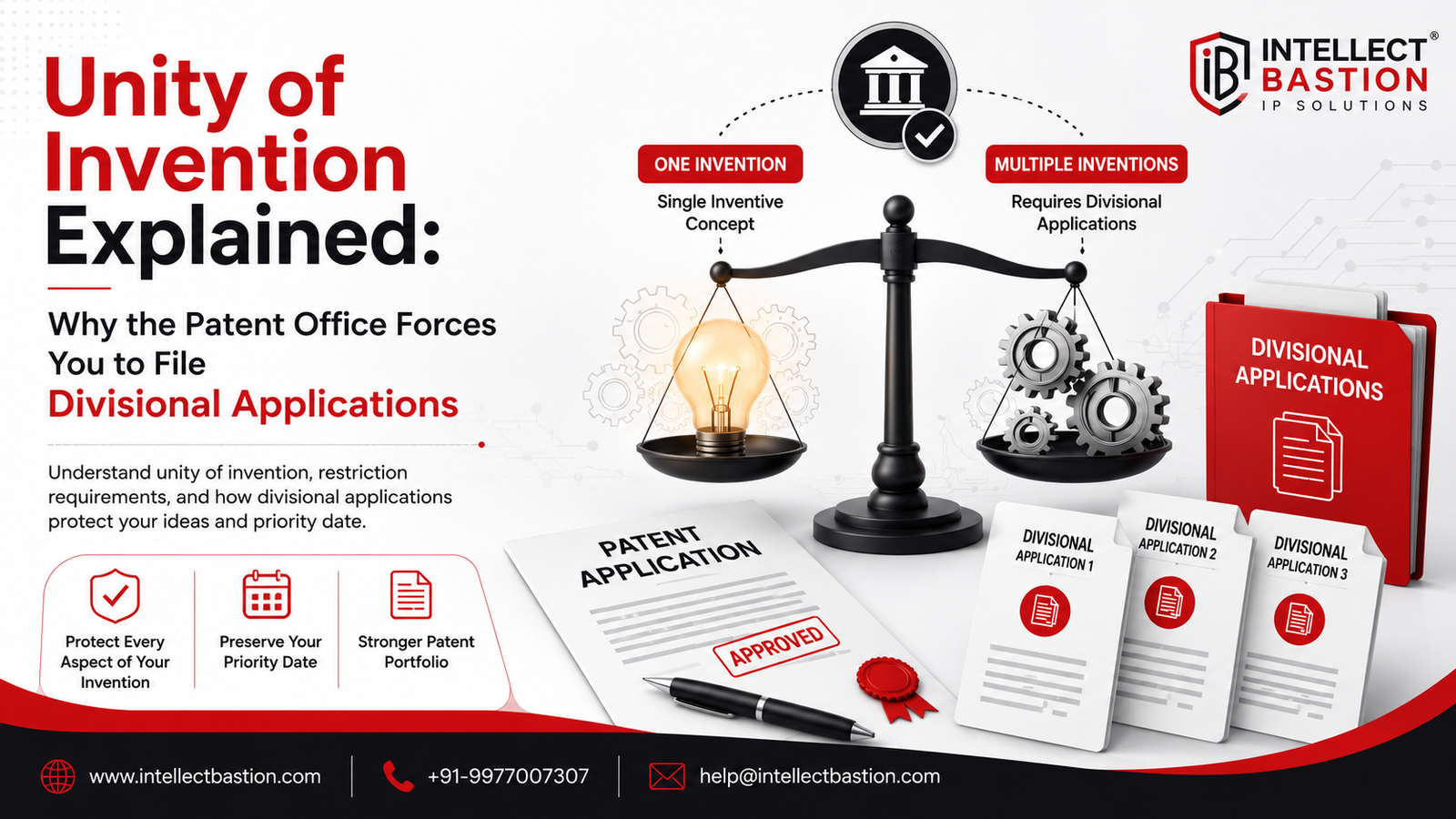
Patenting your invention is always a big milestone in any inventor’s life or business. You have spent so much time, money, and creativity creating something innovative. While applying for a patent, one expects to claim all aspects of their innovative technology. Many inventors try to include all different inventive aspects in a single patent filing, protecting themselves and saving on initial filing fees.
However, all patent offices operate under strict statutory guidelines. Patent office often rejects patents if the patent includes different inventive aspects. If the patent covers more than one aspect, the patent office raises an objection referred to as a restriction requirement or nonunity objection.
According to Section 10(5) of the Indian Patents Act, 1970, in addition to global statutes including the Patent Cooperation Treaty (PCT) and USPTO, a single patent filing should generally cover just one inventive aspect. Understanding the rules regarding the unity of invention will help you handle such objections and keep the priority date safe and make a strong patent portfolio using a divisional application.
What Is Unity of Invention in Patents?
In order to grasp the meaning of unity of invention in relation to patents, we should understand what the basic bargain is between the applicant for the patent and the public. The patent system gives the inventor a temporary monopoly in return for the complete disclosure of his invention. The patent office builds its classification, fee, and search system on the basis of individual technological ideas.
Unity of invention means that patent claims must relate to a single invention or a group of inventions so closely linked that they form a single general inventive concept.
The Statutory Framework: Indian Patents Act vs. Global Standards
Under the Indian Patents Act, 1970, Section 10(5) explicitly provides for this requirement in India. The law requires the claims of a complete specification to relate to one single invention or group of inventions connected with each other to form one inventive concept.
Patent offices throughout the world follow this rule. This is clear from the following:
- Indian Patent Office (IPO): Section 10(5) follows the single inventive concept rule, whereas Section 16 controls the filing of a divisional patent application.
- Unity of Invention Rules Explained by USPTO: The USPTO has restriction requirements according to 35 U.S.C. 121 for domestic applications, and according to 37 CFR 1.475 for international applications entering the national phase.
- European Patent Office (EPO): Article 82 of the European Patent Convention (EPC) requires that a European patent application relate to only one invention or a group of inventions forming a single inventive concept.
Can You Have Multiple Inventions in One Patent Application?
Strictly speaking, one is allowed to write a patent specification, which contains several inventions, processes, or mechanisms. But then again, the patent office cannot issue a single patent that protects more than one invention.
When the patent office discovers different inventions in your application, the examiner will halt the examination process for additional inventions until you reduce the claims to one invention. As such, one needs to file these inventions as individual applications known as divisional applications.

Unity of Invention vs Multiple Inventions Patent
It is important to differentiate between unity of invention and multiple inventions patent applications to write better claims. One patent application can include several claims if those claims belong to one common inventive concept.
| Feature | Single Patent (Unity of Invention) | Multiple Inventions Patent Filing |
|---|---|---|
| Claim Relationship | Claims share a common technical feature providing novelty. | Claims cover distinct, unrelated technical features. |
| Examination Fee | Single filing and examination fee structure. | Requires additional divisional application fees per invention. |
| Patent Office Action | Proceed directly to examination on merits. | Results in a patent office restriction requirement. |
| Commercial Scope | Protects one core technology and direct variations. | Protects multiple independent commercial products. |
What Triggers a Divisional Patent Application?
What provokes a divisional patent application during examination? One major factor is the objection that the patent examiner raises while examining the application.
Process of Patents Restriction Requirement
The patent examiner issues a directive known as a patents restriction requirement. While reviewing your full specification, the patent examiner checks whether the independent claims have any common technical feature that contributes something new in relation to the prior art.
If the examiner finds that the claims define separate inventions without a technical connection, the examiner raises a restriction requirement or unity of invention objection.
Practical Scenarios Triggering Restriction Objections
A number of typical drafting situations which raise restrictions include the following:
- Independent Categories: You claim both a chemical compound and a separate mechanical device to deliver it.
- Alternative Embodiments: You claim several distinct chemical compounds that lack a common structural feature.
- Combination and Subcombination: The claim is made for both a combination vehicle control system as well as a separate brake pad system.
- Different Methods of Manufacture: There are two distinct methods of manufacture of a common product.
Section 16 of the Indian Patents Act: Filing a Divisional Application
Whereas there are many inventions included in an application, Section 16 of the Indian Patents Act, 1970 offers legal provisions to take care of such situations. The knowledge regarding how Indian law deals with the divisional patent application is very important to ensure compliance and coverage.
Key Provisions of Section 16
Section 16 provides that you may divide the parent application into another application called divisional application. There are two main grounds based on which one may file a divisional patent application in Indian law:
- Sua Sponte (Voluntary Division): You may file a divisional application out of your own will to divide the application before the grant of the parent patent.
Filing a Divisional Application to Cure Objection: You may file a divisional application to cure the objection made by the Controller of Patents relating to lack of unity of invention under Section 10(5).
Strict Judicial Limits: The Plurality of Claims Requirement
Landmark judgments by the Delhi High Court, in particular, in Boehringer Ingelheim v. Controller of Patents and upheld by the Division Bench in Syngenta Limited v. Controller of Patents, have laid out the ambit of Section 16 in India.
The court has settled that for a divisional application to be valid, the parent application must claim a plurality of inventions.
Thus,
- You cannot file a divisional application for subject matter that you only disclosed in the description of the parent application but never claimed in it.
- The parent application should have claimed distinct inventions in order for those claims to become the basis of divisional application.
- You must file the divisional application strictly before the Indian Patent Office either grants or refuses the parent application.
How to Respond to a Restriction Requirement in a Patent Application
If the examiner raises an objection under unity of invention, you must provide a timely response within the statutory period. It is important to know how to respond to a restriction requirement patent objection in order to avoid unintentional abandonment of your intellectual property.
Strategy 1: Choose One Invention and File a Divisional Application
This is always the most viable option when responding. You choose one of your inventions (the “elected invention”) to pursue in the parent application while simultaneously filing a separate “divisional” patent application for the “non-elected invention.”
- Pros: Maintains your pursuit of your main invention and saves your secondary inventions.
- Execution: Cancel or withdraw the non-elected claims from the parent application and file them in the divisional application.
Strategy 2: Argue Against the Requirement (Election with Traverse)
If you believe the patent examiner erred regarding lack of unity, you can raise an opposition stating that all claims share a common inventive idea.
- Traverse: You clearly state your opposition to the examiner’s restriction requirement and elect one set of claims provisionally.
- Technical Relationship: You will need to show that there is some technical relationship through which a common inventive idea exists above the prior art.
- Consequences: In case the examiner agrees, they will withdraw the restriction and examine all the claims together; otherwise, the restriction will remain in place.
Why Do I Need a Divisional Patent Application?

Innovators commonly ask: What use have I for a divisional patent application when I can just hold on to my main patent application? The divisional application is more than just an administrative task. It actually provides a strategic advantage.
- Protection of Secondary Commercial Products: Your parent application may be providing protection for your main commercial product. But what about your non-elected claims? They may be providing coverage for secondary commercial products which others might exploit.
- Avoiding Loss of Prior Art: When you file a divisional application, you secure the initial filing date under Section 16(2). Abandoning the non-elected claims and filing a new application later may mean that intervening publications may render your invention non-novel.
- Value Addition of Patent Portfolio: Investors and acquiring firms prefer patent portfolios comprising multiple patented inventions related to an underlying core technology platform.
USPTO Divisional vs. Indian Divisional Patent Practice
Though the basic concept of unity of invention is universal, knowing the operational difference between the different patent offices is useful when handling global IP portfolios.
US Patent and Trademark Office (USPTO)
Under the USPTO divisional system, the examiner issues restrictions under 35 U.S.C. 121. The applicant needs to choose an invention for examination. Also, USPTO divisional applications can be filed so long as the parent application is still pending (before issue or abandonment). Also, USPTO practice permits continuation and continuation-in-part (CIP) applications.
Indian Patent Office (IPO)
However, in India, under the provisions of Section 16 of the Patents Act, 1970, the scope of divisional practice is strictly based on the plurality of claims in the parent application. According to the Syngenta judgment, a divisional application cannot be filed in India to claim a matter which was mentioned only in the specification but never claimed in the parent application. Also, in India there is no provision for filing continuation and CIP applications.
Step-by-Step Guide: Navigating the Divisional Filing Process
Proper process during prosecution avoids the risk of losing rights and compliance to statutory time limits.
1. Examine the First Examination Report Carefully
When the Controller raises an objection on the First Examination Report (FER) under Section 10(5) of the Patent Act, thoroughly study the claims considered as being separate by the examiner.
2. Audit the Original Claims Before Making Amendments
Check if the claims are part of the claim set in the parent filing. If the claims have never been claimed before, one needs to check if amendments can be made within the scope of the disclosure prior to division.
3. File Form 1 and Complete the Specification
Prepare the complete specification for the divisional application. Ensure that the background, description, and claims match the filing of the parent specification.
4. Pay the Statutory Fees
Make payment of filing fees, examination fees, and claim extension fees according to the entity category of your choice: Natural Person, Startup, Small Entity, or Large Entity.
5. Reference the Details of the Parent Filing
Reference the parent filing number, filing date, and priority date during filing of the divisional application.
Conclusion
The management of sophisticated patent portfolios involves knowledge of how to navigate the procedures at the patent office. Through a mastery of the concept of unity of invention and Section 16 divisional applications, inventors will be able to effectively protect their technological innovations and obtain patent rights. For thorough support and guidance, you can contact Intellect Bastion.
Frequently Asked Questions (FAQs)
What do you understand by 'Unity of Invention'?
Unity of Invention is an essential requirement of patent law in which all claims made in the same application must be based on one single inventive concept. If there are multiple inventions covered in the same application but without a link between them, the applicant will have to make separate applications for them.
Why does the patent office require a restriction requirement?
The patent office requires a restriction requirement so that the examination process can be manageable. The examiners specialize in certain technical classes. Thus, the application should only have one invention, to ensure appropriate fees and avoid complexities while searching. Also, it will help keep the public records organized.
How do you differentiate between parent patent application and divisional application?
A parent application is a patent application that is filed initially in the patent office. A divisional application is a secondary application, which is split off from the parent application. It covers an independent invention, which was included in the parent application.
Can I contest the restriction requirement raised by a patent examiner?
Yes, you can contest the restriction requirement by submitting a response letter with a “traverse” in which you need to submit technical arguments showing that all claims are related with a common inventive idea. However, you need to provisionally elect one invention until your arguments are considered by the examiner.
What will be the impact on my priority date in case of filing a divisional application?
The priority date will remain protected as is. According to Section 16(2) of the Indian Patents Act and the relevant international provisions, a divisional application enjoys the same filing and priority date as that of the parent application, unless it includes any new technical information.
How many inventions can be included in a patent application?
Only one single invention or one set of inventions having a common inventive idea can be included in a single patent application. Any number of inventions included in the application will require you to divide them.
What do we mean by a non-elected invention? Can I continue the prosecution of my non-elected invention?
Non-elected inventions refer to a collection of claims which you have decided to put on hold at the time of addressing the restriction requirement. You can prosecute a non-elected invention through filing a divisional patent application before the grant or rejection of the parent application.
What is the cost involved in filing a divisional patent application?
Divisional patent applications entail filing charges, examination fees, and fees for professional assistance like a patent attorney. If you are applying for filing a divisional patent application in India, then filing charges will be different for various applicants depending on whether it is an individual, startup, small entity, or a large entity, varying between INR 1,600 to INR 8,000.