
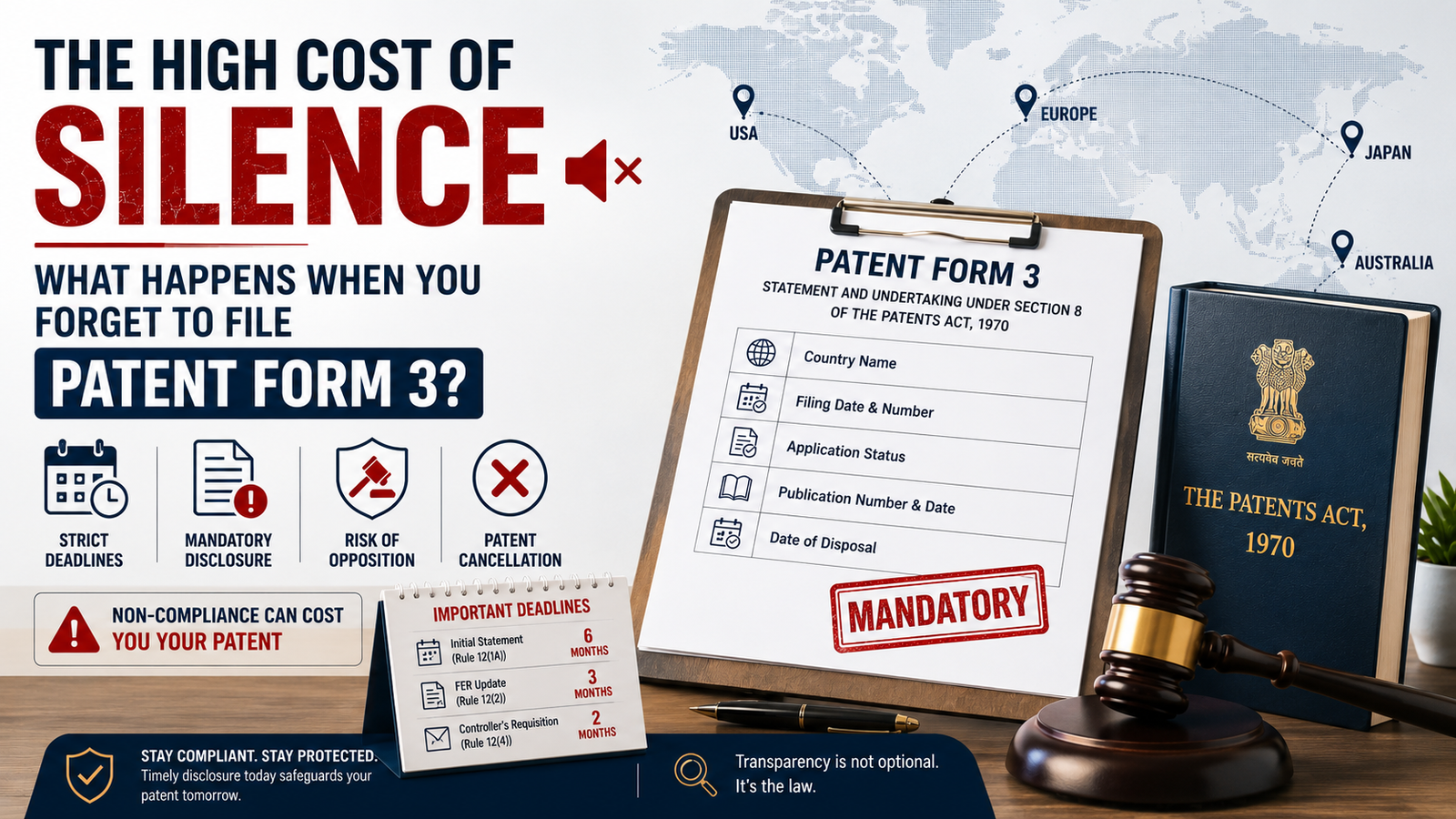
Even a seemingly minor procedural mistake may bring down an otherwise extremely valuable portfolio of patents. According to the provisions of the Indian Patent Act, any person seeking international patent protection is under a strict obligation to disclose all the foreign patent applications that correspond to their application. Thus, Patent Form 3 serves as the formal disclosure and undertaking of the mandatory disclosure requirement. The failure to consider this aspect will immediately expose you to legal risks. In other words, it gives your competitors statutory ground for opposition and rejection.
Indian Patent Office Requirements for Foreign Filings
Section 8 of the Indian Patents Act of 1970 stipulates a clear obligation of constant transparency. Form 3 for the Indian patent is the official administrative tool to notify the Controller of all corresponding international patent filings to the Controller. Compliance with the patent laws obligates you to provide all the information about all the foreign counterparts.
Indian Patent Office requests accurate information about parallel global filings. In particular, your filing must contain the following information:
- Country Name: Official jurisdiction of the parallel filing.
- Filing Parameters: Date of filing and the official filing number abroad.
- Application Status: Official status of the application, including pending, allowed, granted, abandoned, refused, or withdrawn.
- Publication Information: Numbers of publication and dates of publications.
- Date of Disposal: Date of grant, refusal, abandonment or withdrawal.
It is worth noting that the Indian Patent Office changed the standard Form 3 template in accordance with the Patents (Amendment) Rules, 2024. As per the new Rule, column 6 now requests “Date of Disposal” rather than the “Date of Grant”. Accordingly, applicants should reveal abandonments, withdrawals, and refusals, not only the granted foreign patent.
Patent Prosecution Deadlines India
Patent prosecution deadlines in India. Rule 12 of the Patents Rules, 2003 (as amended by the Patents (Amendment) Rules, 2024) specifically governs the statement and undertaking requirements regarding foreign applications under section 8. Comprehending the statement and undertaking rules of Patent Form 3 will ensure that your international applications remain completely valid.
The timeline and latest amendment of the Patent Form 3 rules outline three main statutory deadlines:
- Initial Statement (Rule 12(1A)): You must submit your initial Form 3 within 6 months from the Indian filing date or the PCT national phase entry date.
- FER Consolidated Status Update (Rule 12(2)): You need to file a consolidated status update within 3 months from the date of issuance of the First Examination Report (FER).
- Controller’s Requisition (Rule 12(4)): In case you receive a written request from the Controller in terms of Section 8(2), you have 2 months to comply.
Moreover, the duty of disclosure prevails in the entire prosecution process. If the foreign patent office grants or refuses your application after you submit your FER status, you can avoid future legal problems by voluntarily updating your Form 3.
First Examination Report (FER) Form 3 Update
Updating the First Examination Report (FER) Form 3 is another crucial statutory requirement in accordance with existing procedures. Under the old legislation, applicants had to submit an update every six months for any foreign filing. The 2024 amendment to the rules simplified this process into a single update requirement.

In particular, you need to submit a single updated version of Form 3 no later than three months after Patent Office issues the FER.The updated form shall contain information regarding the current status of your global patent family. Moreover, according to Rule 12(3), the Controllers may refer to publicly available databases such as WIPO PATENTSCOPE, InPass or EPO Global Dossier. Controllers issue written requisitions only when public registries show gaps in the information.
Consequences of Not Filing Patent Form 3
It is important to understand the impact that failing to file Patent Form 3 has for risk management. The legal implications that come with failing to file Patent Form 3 will render the patent void at any stage of the life cycle. The statutory penalty that comes with failing to file patent form 3 involves four enforcement stages:
| Prosecution Stage | Statutory Action / Consequence | Applicable Legal Provision |
|---|---|---|
| Examination Stage | Application Refusal | Section 15 |
| Pre-Grant Stage | Pre-Grant Opposition | Section 25(1)(h) |
| Post-Grant Stage | Post-Grant Opposition | Section 25(2)(h) |
| Enforcement Stage | Patent Revocation by High Court | Section 64(1)(m) |
Opposition parties usually check for any procedural lapses in the prosecution history of the invention. A pre-grant opposition on account of the absence of Form 3 could ruin an invention just at the time it is going to be granted. Further, a patent that is granted can be cancelled under Section 64(1)(m).
Condonation of Delay Patent Form 4
The applicants whose statutory periods have expired must act fast in order to save their rights. Knowing how to modify the filing details of your patent application in India is important in ensuring that any procedural mistake will not cost you dearly.
According to Rule 12(5), you can apply for an extension or condonation of delay in filing Form 4. This mechanism gives applicants a chance to extend the Form 3 period by a maximum of 3 months upon payment of the official fee.
It should be noted that this 3-month extension period is absolute. Rule 137(2)(i) does not allow any discretionary correction of Form 3 deadlines. Similarly, Rule 138 does not provide an opportunity to extend Form 3 filings past the 3-month period. Failure to file Form 4 within this period is irreversible.
IP Protection Strategy
Continuous compliance for patents involves keeping track of the status of the entire global family and the deadlines involved in prosecuting the patents. Doctrinal systems and experienced patent attorneys can assist you in protecting your intellectual property from possible procedural mistakes. Never let any administrative lapse jeopardize your innovations through intellectual property. Please contact Intellect Bastion for assistance.
Frequently Asked Questions (FAQs)
Patent Form 3 in India - Why is it Mandatory under Indian Patents Act?
Filing of Form 3 in India is a mandatory requirement of Section 8. It acts as a formal declaration informing the Controller about all the corresponding foreign applications. The transparency provided by the applicant will enable the patent office to determine the results of an international search report.
What is the hard deadline for filing the first Patent Form 3 in India?
The applicant should file the first Form 3 within 6 months of the filing date in India. In the case of PCT national phase applications, it should be filed within 6 months of the Indian national phase filing date.
Which information and details have to be provided in a Patent Form 3 submission?
In order to make a submission, one must include the following information: target country, application number, filing date, and present status of the application. Moreover, it is mandatory to include the publication number, publication date, and disposal date.
What are the possible consequences of not filing or forgetting Patent Form 3?
Not submitting the form means that there is a violation of the statutory requirements of Section 8. As a result, the Controller is entitled to refuse an application. Moreover, any third party has the right to oppose, challenge, or annul the patent.
Can an omission or delay in the submission of Form 3 result in the refusal or cancellation of a patent?
Yes. Under Section 15, the Controller has the authority to reject non-compliant applications during the examination process. Besides, Section 64(1)(m) specifically permits courts to cancel already-granted patents due to the absence of foreign filing details.
In what circumstances is it necessary to file Form 3?
Subsequent or updated filings are necessary within 3 months from the date of issuance of the First Examination Report (FER). In addition, an applicant needs to file an updated Form 3 within 2 months if the Controller has issued a written requisition under Section 8(2).
What leads to the creation of a new deadline for Form 3 amendments due to the issuance of the FER?
It is important to mention that the issuance of the FER marks the beginning of a 3-month period under Rule 12(2), during which the applicant has to provide a consolidated Form 3 relating to all foreign counterparts.
Is it allowed to get a delay for the provision of Form 3, and how does it happen?
Yes, it is possible to postpone or condone the delay of up to 3 months. For this purpose, you have to use Form 4 and pay the official fee.
Is there any provision for a third party to file pre-grant or post-grant oppositions due to non-filing or misfiling of Form 3?
Third parties may raise issues of infringement of Section 8 provisions in opposition cases. Third parties can file a pre-grant opposition under Section 25(1)(h) or a post-grant opposition under Section 25(2)(h) based on non-filing or mis-filing of disclosures.
What is the difference between statutory obligations of Section 8 and the filing of Form 3?
Section 8 lays down the legal obligation in terms of disclosure of parallel applications abroad. Form 3 is the prescribed form that is filed with the Patent Office to make these disclosures.
YASHIKA KORANGA
Senior Patent Associate at Intellect Bastion