
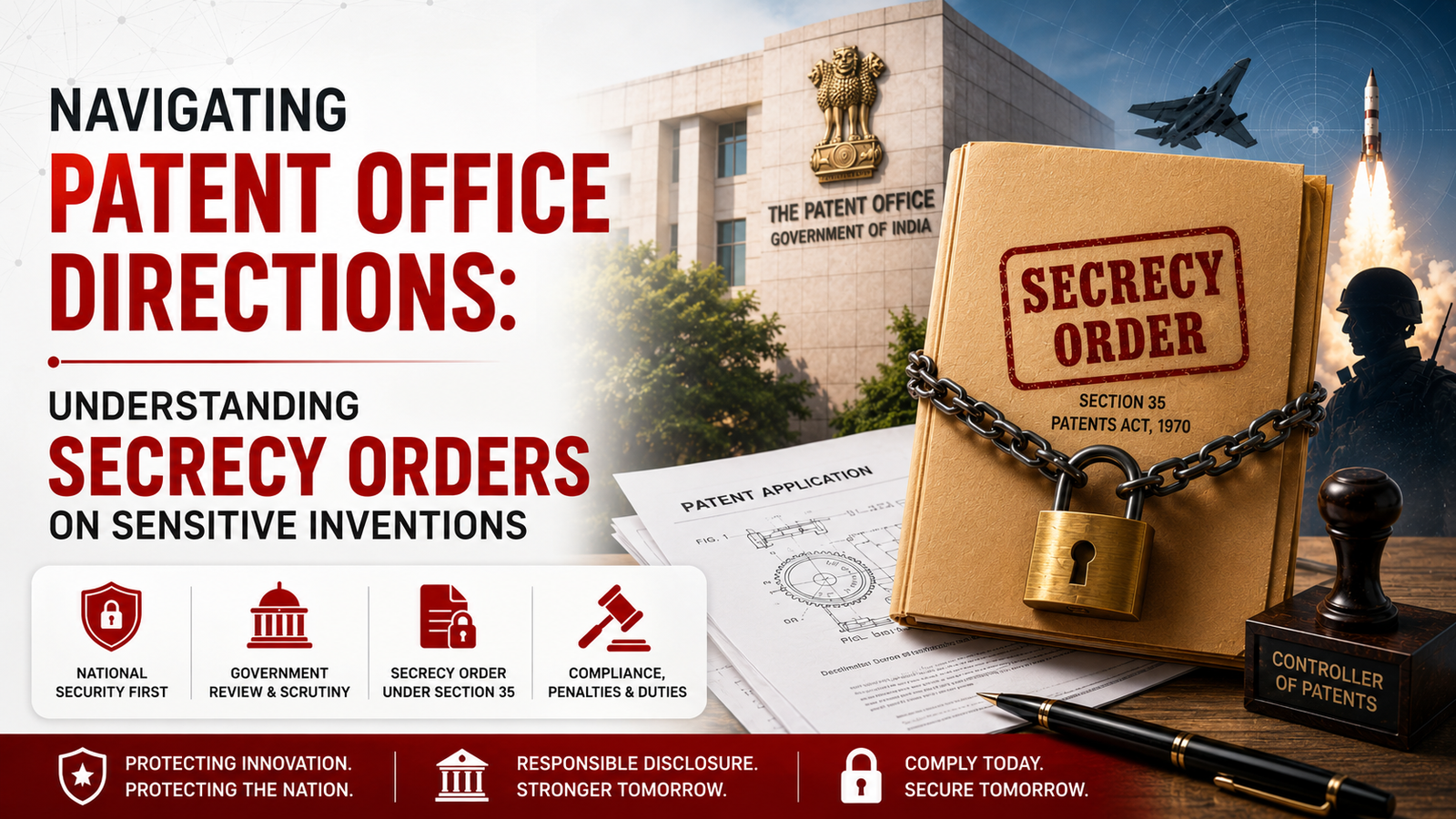
Inventions are the driving technological force that can drive progress and become the fuel for economic growth for any country’s growth and development, but certain breakthrough ideas can cross directly into the national defence territory. When an applicant submits a patent application containing sensitive technology, national security considerations immediately take precedence over traditional commercial property rights. The Controller General of Patents, Designs and Trade Marks (CGPDTM) screens the incoming applications to identify technological designs that could impact national defence or security if application to identify technological designs which could impact the national defence or security if published prematurely. Consequently, investors or researchers operating in India must understand how authorities handle filings containing strategic research, military technology, or sensitive capabilities.
Understanding the Invention Secrecy and Security Reviews under the Indian Patent Act
The invention secrecy framework in India operates under Section 35 of the Patent Act, 1970. In the standard patent prosecution evaluates novelty, inventive step, and industrial applicability, but national defence will take into consideration and take immediate statutory priority. Therefore, the Indian Patent Office(IPO) issues administrative directives which can restrict the publication and dissemination of flagged patent applications.
Now, understanding how Indian authorities and defence agencies can assess patent disclosures enables corporate entities and research institutes to build robust compliance protocols. Alignment minimises prosecution delays and will ensure full compliance with statutory obligations.
Section 35 in the Indian Patent Act 1970 empowers the Controller of Patents to issue secrecy directions on advice from the central government. Screening mechanisms have the power to categorise inventions based on orders by the Ministry of Defence.
National Security Review Patent Office
The National Security Council can review the process at the Indian Patent Office initiates immediate actions after an applicant files a patent specification. The patent examiner inspects claims that are against the notified category of defence-relevant technologies before even allowing the standard publication under Section 11A. If an application falls within the sensitive classes, the IPO routes technical documents to security officials and the Ministry of Defence.
Defence agency reviews patent applications.
A defence agency review of patent applications in India involves key bodies such as the Ministry of Defence (MoD) and the Defence Research and Development Organisation (DRDO). These agencies assess whether the submitted specification discloses sensitive military designs, tactical algorithms, or proprietary defence hardware.
National security review patent office
The national security review process at the Indian Patent Office starts right after an applicant submits a patent specification. Patent examiners check the claims against listed categories of defence-related technologies before allowing the publication under Section 11A. If an application is in a sensitive group, the IPO sends the technical documents to security officials and the Ministry of Defence.

During this review, technical experts look at whether sharing the information would hurt defence readiness, important infrastructure or national security. Non-sensitive applications go through the process, while those that are sensitive get official secrecy orders under Section 35. The check happens before the required 18-month publication in the Patent Office Journal.
Examiners work directly with defence personnel during the time when the application is first received and during the review.
Applications that do not have security issues get handling and permission to file abroad under Section 39.
Defence agency review for patent applications
A defence agency review reviews patent applications in India that involves groups such as the Ministry of Defence (MoD) and the Defence Research and Development Organisation (DRDO). These organisations will check whether the applicant has included information about military designs, military strategies, or special defence equipment.
If the reviewing groups decide that sharing this information could harm the country’s interests, they tell the Controller to issue a secrecy order. The Controller follows these suggestions, creating rules that stop people from sharing technical details without permission.
Special defence groups look at dual-use patent applications. Security checks stop technology from being given to foreign countries. Official suggestions from defence groups control how long and how strict the secrecy orders are.
Operational Impact of Secrecy Directions (Section 35)
Receiving a secrecy invention direction under Section 35 can alter standard intellectual Property Rights and business timelines. A secrecy direction halts publications, stops grant procedure, and prohibits filings
Impact of secrecy orders on patent applications
Secrecy orders can affect patent applications in India by pausing the statutory procedure in the patent lifecycle. Section 39 of the Indian Patent Act, 1970 prohibits Indian residents from filing foreign patent applications for the restricted invention without prior permission from the Controller. As a result, global expansion plans must be suspended until official restrictions are revoked or foreign filing permissions are granted.
How to handle a patent secrecy order

Handling a patent secrecy direction in India requires prompt organizational measures and strict regulatory adherence. First, management must isolate all types of physical documents, software source code, and working prototypes related to the covered invention. Key research staff must be notified regarding strict confidentiality requirements.
How long a secrecy order lasts
Understanding how long patent secrecy orders last in India requires examining Section 36 of the Patent Act, 1970. A secrecy direction remains in force as long as the Central Government considers the restriction necessary for national defence.
The Central Government conducts mandatory reviews of every secrecy direction at least once every six months. If authorities determine national security risks no longer exist, the Controller immediately revokes the direction under Section 38, allowing standard patent prosecution to resume.
Penalties for violating patent secrecy orders
The penalties for violating patent secrecy orders in India are strict and codified under Section 118 of the Patents Act, 1970. Disclosing restricted technical details or filing foreign patent applications in violation of Section 35 or Section 39 carries severe legal ramifications.
If an applicant violates secrecy directions, the patent application is deemed abandoned, and any resulting patent is subject to revocation under Section 64. Furthermore, individuals and corporate officers face criminal liability, including monetary fines, imprisonment for up to two years, or both.
Conclusion
Navigating the place where patent protection and national security meet requires innovators, research institutions, and technology firms to find a balance between commercial plans and following the law under the Patents Act, 1970. When a secrecy direction is received under Section 35, it stops the publication from happening and stops expansion around the world. By making sure documents are secure and keeping open lines of communication with the Controller and the Ministry of Defence, companies can protect their legal rights and important assets. By following the six-month review cycles and getting permission to file in countries under Section 39 when it is allowed, organizations can keep their priority dates, avoid big legal problems, and get ready to sell their new technologies for a long time once the security rules are lifted. For any kind of guidance, you can contact Intellect Bastion!
FAQs
1. What is a patent secrecy direction under Section 35?
A patent secrecy direction under Section 35 of the Indian Patents Act is an order issued by the Controller of Patents that prohibits or restricts the publication or communication of information concerning a sensitive patent application. This order ensures that inventions relevant to defence remain confidential while under evaluation by government authorities. Patent secrecy direction prevents publication of patent specifications in the official Patent Office Journal. A patent secrecy direction suspends patent grant proceedings while preserving priority rights. It also restricts the transmission of invention details outside India without authorization.
2. Why does the Indian Patent Office issue secrecy orders?
The Indian Patent Office issues secrecy directions to prevent sensitive technological disclosures that could compromise national security or military readiness. Because open patent filings become public documents globally, publishing critical defence technologies could allow foreign entities or adversaries to counter or replicate sensitive capabilities. Protects national security, territorial defence, and strategic national assets. Prevents unauthorized access to defence innovations published in open patent databases. Preserves technological advantages for Indian defence forces and research institutions.
3. What types of inventions trigger secrecy orders in India?
Inventions related to weapons systems, explosives, radar systems, specialized military alloys, cryptographic algorithms, and nuclear technology frequently trigger secrecy directions. Additionally, dual-use technologies with both commercial and defence applications undergo rigorous screening by security officers.
4. Can I commercialize an invention under a secrecy direction in India?
Commercializing an invention under a secrecy order requires official permission from the Central Government. Applicants cannot sell the invention publicly, run any kind of marketing compaigns or share the details of their invention publicly without permission while the restriction remains in force. However, applicants may provide the technology directly to the indian defence forces or to government entities approved under secure agreements. They cannot sell the technology to the public or send it abroad while the restriction remains active.
5. How can a patent attorney help with a secrecy direction in India?
An experienced Indian patent attorney guides applicants through regulatory compliance, statutory reviews, and formal petitions. Counsel assists in establishing internal confidentiality protocols, filing representations to the Ministry of Defence, and pursuing foreign filing permissions under Section 39 when permissible.