
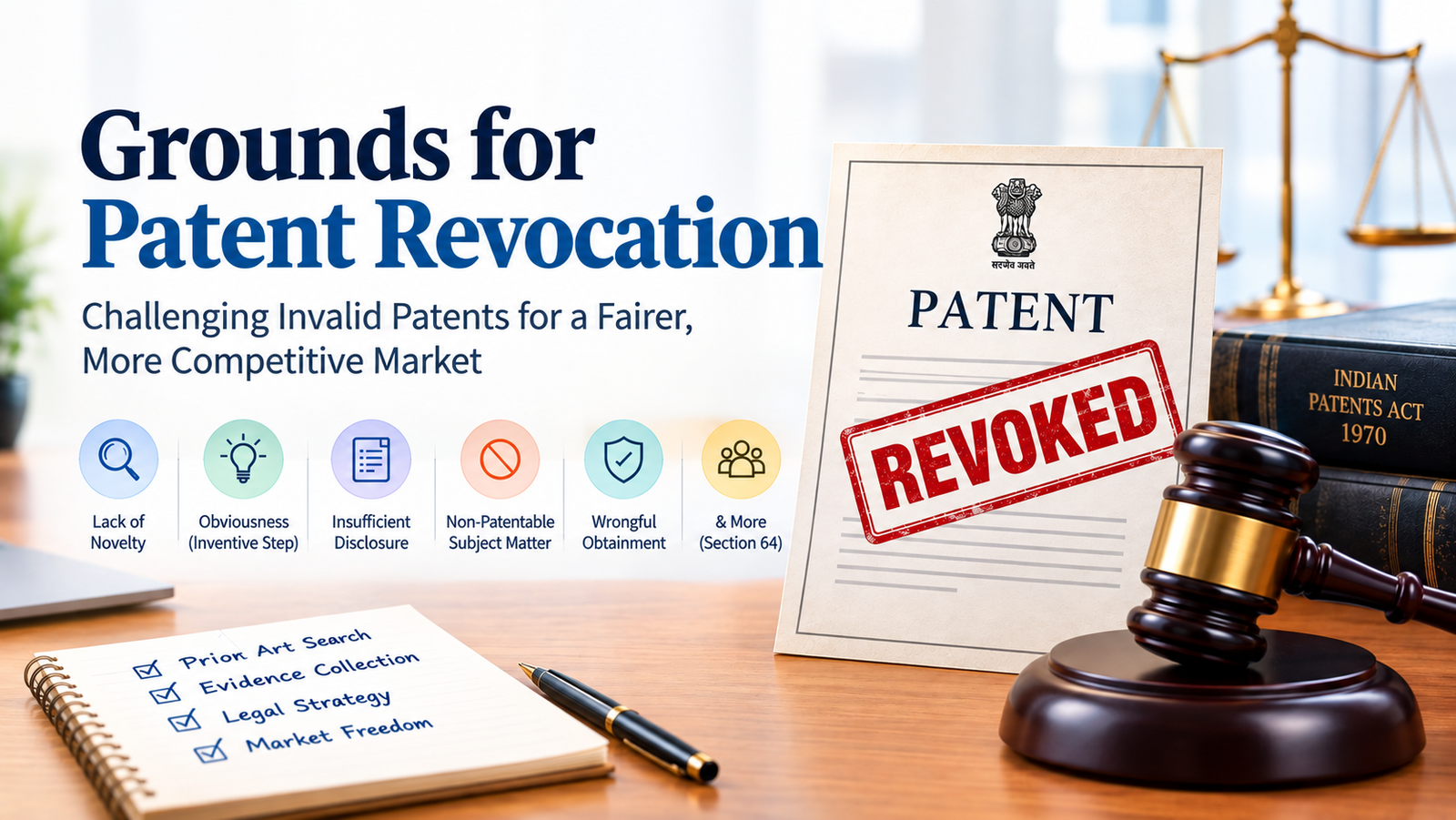
Patent revocation can eventually safeguard against invalid rights that can harm market competition. The Indian Patents Act of 1970 presents Section 64 on patent revocation, which allows entities to directly challenge unmerited monopolies. Legal authorities can revoke a granted patent when the specification is ambiguous or fails to satisfy essential components of the statutory legal framework. Competitors have the power to regularly challenge granted patents to clear operational pathways and safeguard their product lines.
Statutory frameworks set out precise legal provisions for removing flawed patents from public registers. Challengers usually combine multiple technical arguments and evidence that supports their arguments to increase their chances before the court.
Patent revocation involves different grounds to challenge the granted patent
- Prior Art and Lack of novelty: A comprehensive prior art search is the most effective way to expose the global publications that invalidate the claim’s novelty. Prior art forms a benchmark baseline for determining whether the granted invention genuinely deserves exclusive patent protection or lacks novelty and is the same as prior art. Courts evaluate prior art across all media formats worldwide. Before upholding any granted monopoly rights. Competitors generally rely on technical concepts that can destroy their claim validity. Any invention lacks novelty if every technical element of the invention is disclosed in a single prior reference published before the filing date. Therefore, establishing anticipation usually requires establishing complete identity between the earlier prior art. Therefore, disclosure and the latest invention with the target patent claims.
- Obviousness: Demonstrating obviousness is quite challenging, as it requires proving that the claimed invention lacks any technical advancement or economic significance beyond existing public knowledge. Under Section 64(1)(f), competitors can challenge the patents because an average industry worker in their everyday routine can derive the solution.
- Insufficient Disclosure: Pursuant to Section 64(1)(h) of the Patent Act, a court can invalidate a granted patent if a complete specification fails to sufficiently and fairly describe an invention. The valid complete specification of the description must contain a complete technical disclosure. When applicants draft vague or overbroad claims to hide their true invention and make it seem more obvious, competitors can exploit this to replicate the same invention.
- Non-patentable subject matter: Under Section 64(1)(k) of the Patents Act, courts will revoke any patents whose claims encompass subject matter that is non-patentable under statutory exclusions. Lawmakers generally explicitly exclude the patent from grant under Section 3 and Section 4 of the Act,
- Wrong Obtainment: Under Section 64(1)(b) and Section 64(1)(c) of the Patent Act, a court may revoke a granted patent if the applicant derived the invention unlawfully or lacked entitlement. Patent ownership belongs strictly to the true and first inventor or their authorised assignees. When any party misappropriate research, violates non-disclosure agreements, or submits a fraudulent assignment declaration which can lead to affected entities can initiate immediate revocation proceedings.
How to Challenge the Granted Patent?
Successfully invalidating a patent generally requires a structured approach to evidence collection and legal strategy. Competitors often initiate early research on various prior art before the formal litigation begins. Comprehensive validity analysis helps managers weigh litigation costs against to analyse the market access.
Opposing parties must present clear and concise evidence collection with proper legal strategy. Specialised technical experts provide crucial support during the complex evidentiary hearings.
Post-Grant Opposition vs Patent Revocation
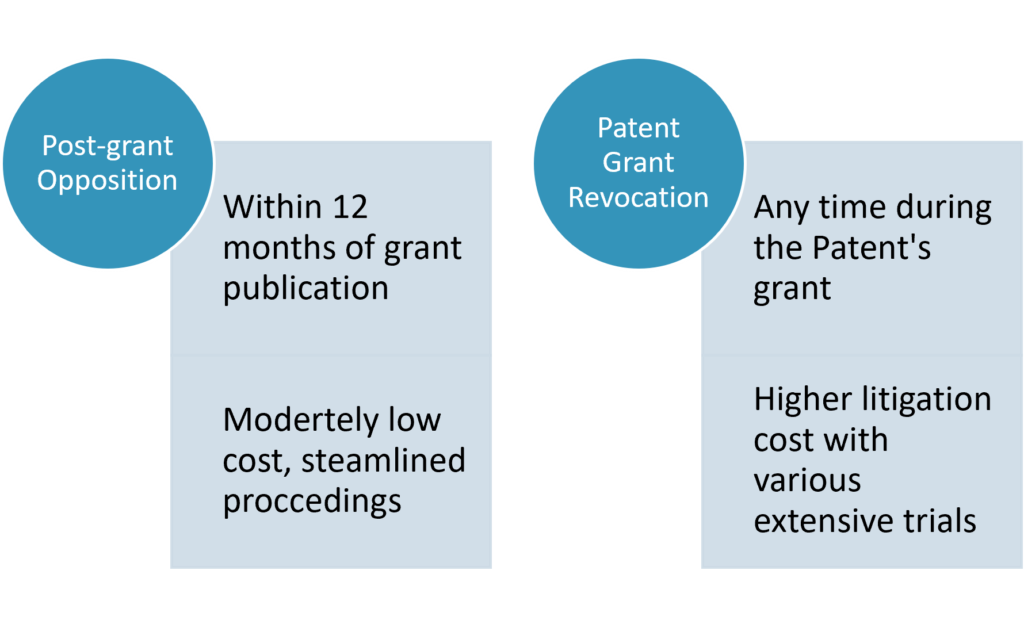
Competitors must evaluate their administrative and judicial dispute in order to oppose. Post-grant opposition can offer a cost-effective administrative route within twelve months of patent publication.
Counter-Claim for Patent Revocation in Infringement Suits
Infringement allegations often prompt aggressive validity challenges from accused infringers. An infringement defence is effective when it also includes an immediate counterclaim for patent revocation. This enables the shifting of the dispute to the High Court. A counterclaim typically compels the patent holder to present the defence against the patent in question in the lawsuit.
Patent Revocation Procedure for the Competitors
In Section 64, the patent revocation petition comprises a typical set of steps dictating the civil court procedures. High courts demand structured pleadings together with the certified prior-art documentation. Litigants have to prove their standing as the “person interested” at an early stage to confirm it.
- Establishing Standing: Commercial competitors submit evidence of sales or manufacturing plans to demonstrate a legitimate interest.
- Submission of Pleadings: The plaintiffs make formal petitions indicating legal flaws in the granted specification.
- Pleadings Exchange: Patent holders file detailed written responses. Then the challenger files its rejoinder.
- Pleadings Exchange: Patent holders file detailed written responses. Then the challenger files its rejoinder.
- Final Judgment: The courts make final decrees to sustain, alter, or cancel the patent.
Proving Lack of Novelty and Obviousness in Patent Cancellation
To prove lack of novelty, you need a single prior art reference with all the elements of the claim. In contrast, proving obviousness requires combining several references to demonstrate the absence of inventive steps.
To prove lack of novelty, you need a single prior art reference with all the elements of the claim. In contrast, proving obviousness requires combining several references to demonstrate the absence of inventive steps.
Challengers must show that the gap would have been readily filled by one skilled in the art. Successful invalidation arguments are driven by clear documentary evidence. Courts evaluate technical claims based on objective physical standards and expert testimony.
- Precise filing date: Litigants set priority dates to mark publicly available knowledge with precise filing dates.
- Anticipation: Single complete documents defeat novelty of claims.
- Mosaic of Prior Art: Obviousness Arguments Combine Complementary Technical Documents to Show Predictable Changes.
- The Person Skilled in the Art: Litigants establish practical knowledge levels for the typical industry professional.
Market competitors get an immediate commercial opportunity from an invalid patent. Invalidation judgments can eliminate threat vectors and can provide total operational freedom. Companies can launch their competing products in the market without any fear of future injunctions or damages. Legal remedies can be extended far beyond simple court victories. Successful challenges can restructure entire market monopolies and unlock fair competitors to survive in the market.
Revocation can remove several legal barriers, granting businesses freedom to operate without any fear in manufacturing, scaling and distribution across the market. Any pending infringement lawsuits brought by the former patent holder can instantly collapse once the underlying patent is declared invalid, eliminating potential damages or injunction threats. Furthermore, the existing licensees can terminate costly royalty payments or injunction threats. Ultimately, these open market conditions can eliminate unmerited monopolies, lower consumer prices, and expand market access.
Conclusion
By successfully challenging an invalid patent, you will change the competitive environment of your marketplace as these unwarranted monopolies are removed, restoring a level playing field. Under section 64 of the Patents Act, there are various ways in which businesses can use this legislation to remove poorly conceived and/or wrongly awarded claims.
The removal of these claims may be by way of a petition directly to the Patent Office (IPO) or as a counterclaim within an infringement suit. In either case, should you be able to prove that the claim lacks novelty, is obvious or that the application was poorly disclosed, then you will stop abusive litigation and establish your business’s right to operate freely long-term.
Navigating the process of patent revocation is time-consuming, requires careful preparation, evidence of commercial interest and thorough prior art searching. Competitors who proactively challenge weak patents protect their investment in technology, avoid paying large sums in royalties and prevent distortion of the market. The Courts require strict compliance with the statutory provisions to ensure that only those inventions which represent true technical advances receive the benefit of exclusivity. Invalidating weak patents restores important scientific principles to the public domain and enables unrestricted growth of industries. Businesses should include structured patent validity assessments as part of their overall legal strategy to allow for continued flexibility in the markets, reduction in consumer prices and ongoing commercial innovation. For any kind of guidance and support, please contact Intellect Bastion LLP!
FAQs
1. What is the legal definition of patent revocation?
Patent revocation is the withdrawal of a granted patent by a court or patent office, which cancels the patent from the register and deprives the proprietor of the monopoly from the commencement of the patent.
2. Who has the legal standing to file a patent revocation petition?
Any “person interested” may file a petition, including commercial competitors, research centres, business competitors or entities whose business would be directly affected by the patent.
3. What are the primary legal grounds for revoking a granted patent under Section 64?
Primary grounds include lack of novelty, obviousness (lack of inventive step), insufficient description, non-patentable subject matter, wrongful obtainment, and material false statements made during prosecution.
4. How does a competitor file a counterclaim for revocation during an infringement lawsuit?
An accused infringer files a counterclaim for revocation in his/ her written defence. This filing promptly escalates the dispute from the lower district courts to the High Court for judgment.
5. What is the difference between a post-grant opposition and a revocation petition?
Challengers must file a post-grant opposition with the patent Office within 12 months of grant within 12 months of grant publication. They can file a revocation petition at any time.
6. What role does prior art play in establishing a patent's lack of novelty?
Prior art acts as documentary evidence showing that the technical invention was publicly disclosed globally before the priority filing date. A single prior art document matching every claim element completely destroys novelty.
7. Which judicial authorities or courts handle patent revocation proceedings?
High Courts handle Section 64 revocation petitions and infringement counter-claims, usually through their dedicated Intellectual Property Divisions (IPD).
8. What types of evidence are required to successfully challenge an inventive step (obviousness)?
The most challenging obviousness case is to submit a mosaic of prior art documents, expert witness affidavits, scientific trial reports and technical literature proving that the solution could be routinely derived by an average industry worker.
9. What happens to a product or market space once a competitor successfully revokes a patent?
The patented invention enters the public domain immediately. Competitors gain total freedom to manufacture and distribute the product, pending infringement lawsuits collapse, and royalty obligations vanish.
10. Can the Central Government initiate a patent revocation on public interest grounds?
Yes. According to Sections 66 and 64(1)(b), any patent may be revoked by the Central Government if it is proved to be mischievous to the State, prejudicial to the public or related to an atomic energy invention.
Author: Shubhra Pandey