
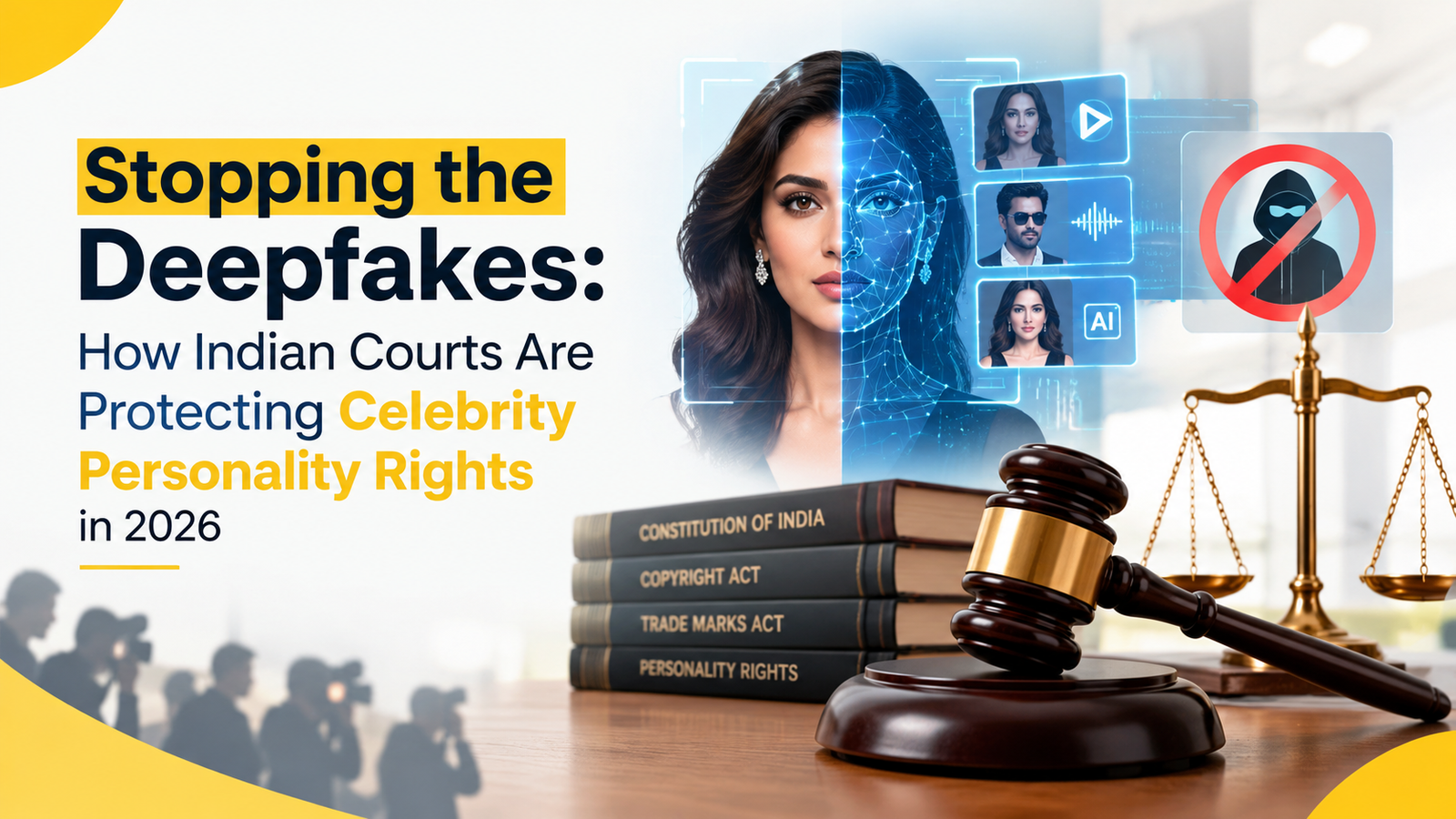
Generative AI has revolutionized the digital world in 2026. But with this technology comes a rise in digital impersonation like never before. Rogue creators regularly use highly realistic deepfakes, AI voice clones, and avatars to leverage celebrity identity. This results in severe reputational loss as well as financial fraud. Because no separate personality rights legislation protects victims, turning to the judicial system remains their best option at present. Luckily, the Indian judiciary has come up with some quick fixes that the law of deepfakes 2026 requires. Deepfake orders by high courts have laid down proper limits to digital likenesses. Moreover, the judicial orders on celebrity rights provide for effective implementation of those orders online. In fact, courts regularly pass injunction orders in deepfake India cases to counter digital threats instantly.
The Rise of Generative AI Misuse and Celebrity Persona Theft in 2026
Cybercriminals and creators use AI-based technologies to replicate human faces and voices almost instantly. The technology allows cybercriminals to develop fake endorsements by celebrities, financial market advice, and sexually explicit content. This leads to misleading marketing activities on the one hand and identity theft issues faced by celebrities on the other.
Until now, there were no statutory definitions under Indian intellectual property laws in respect of personality rights. Nevertheless, judicial creativity has helped overcome this legal lacuna. Courts view an individual’s name, photograph, voice, signature, and unique catchphrases as important legal properties. Hence, any commercial use without authorization amounts to a violation of the basic constitutional rights enshrined under Article 21 of the Indian Constitution.
Indian judgments on deepfakes have established that deepfake identity cloning is not merely about experimenting with new technologies. Rather, courts have held unauthorized generative AI deepfake outputs to be commercial misappropriation and passing off. As generative AI technology progresses, so must the courts’ protection of deepfake mechanisms keep pace.
Legal Precedent Set by Indian High Courts on Celebrity Personality Rights Protection
Jurisprudence in relation to the protection of digital persona in India has developed quite fast in the recent past. High courts all over India have established landmark jurisprudence to safeguard the dignity of the individual from digital abuse. A comprehensive legal basis underpins the jurisprudence that Indian high courts established to protect celebrity rights. The judge used the common law tort of passing off, the Copyright Act of 1957, the Trade Marks Act of 1999, and the constitutional right to privacy.
The decisive moment came when the Delhi High Court offered protection to actor Anil Kapoor from AI abuse. The judge banned many organizations from using his voice, digital image, and catchphrases in commercial activities. Similarly, the Delhi High Court offered protection to actor Jackie Shroff from AI bots and merchandise. Again, the Bombay High Court offered protection to singer Arijit Singh from voice cloning via AI platforms. In the year 2026, courts have applied these principles to doctors, authors, and spiritual leaders.
Such judgments clearly indicate that commercial use without the consent of an individual is a violation of personal autonomy. As such, the Indian judiciary’s role in curbing unapproved celebrity deepfakes no longer merely enforces trademarks, but actively protects digital identity as well.
How Indian Courts Issue Ex-Parte Injunctions Against AI Deepfakes in 2026
The speed at which one can respond is the single most important aspect in fighting viral deepfakes. The speed at which the deepfake video may become viral means that the legal victim cannot wait for a trial to be conducted before he/she receives any form of protection. This has necessitated the use of injunctive relief by the Indian courts to resolve this challenge.

The process through which the Indian court gives an ex parte injunction in relation to the AI deepfakes in 2026 is very sophisticated. Courts urgently issue ex parte ad-interim injunctions without prior notice to the defendant when an immediate threat to the plaintiff exists. Applicants must satisfy three main requirements before a court grants an ex parte injunction. These include proving a prima facie case of infringement, balance of convenience, and irreparable injury from the unaddressed infringement.
In addition, courts often employ John Doe orders (commonly referred to as Ashok Kumar orders) to target anonymous authors. Such orders target unidentified individuals operating within encrypted networks or temporary domain names. As such, copyright owners will be able to file suits against unidentified individuals immediately upon identification of their presence online. Further, courts grant dynamic injunctions which cover mirror and cloned websites of the defendant automatically.
Court Directions to Tech Platforms for Deepfake Removal Under 2026 Jurisprudence
Issuing an injunction against anonymous deepfake creators involves the active participation of technology intermediaries. Current celebrity protection orders bind social media networks, domain registrars, and ISPs.
2026 court orders requiring deepfake removal by tech platforms have reshaped intermediary liability. According to the Information Technology Rules, the technology platforms must take down the infringing synthetic media within the statutory period. Courts require intermediaries to block synthetic media URLs within 24 to 48 hours of an order.
Moreover, courts have also issued global takedown notices where creators have made deepfake videos targeting people globally. Understanding Indian courts’ global takedown process for voice clones and deepfakes is essential. Courts order global platforms like YouTube, X, Meta, and Telegram to block Indian-generated or Indian-impacting deepfakes internationally. Domain registrars need to block TLDs for fake AI voice generation services.
Judicial Guidelines for Blocking Fake Celebrity Endorsements in India (2026)
One of the most perilous uses of deepfake technologies is through fake celebrity endorsements. Fraudsters use realistic AI celebrity videos to promote scams, fake medical products, or gambling apps. As a result, unsuspecting people lose millions of rupees, while celebrities face defamation.
To counter this threat, courts established 2026 guidelines banning fake celebrity endorsements. First of all, courts consider any unauthorized commercial voice or image creation to be a prima facie deceptive trade practice. Second, courts hold ad platforms strictly liable for publishing unverified celebrity deepfakes. Finally, courts ask platforms to use AI-based tools in advance to intercept synthetic endorsements.
The guidelines also distinguish commercial usage from artistic expression. Courts have protected news reporting, political speech, and parody by Article 19(1)(a). Conversely, courts apply strict liability when synthetic media deceives people into spending money. As a result, courts require advertisers to obtain written licenses for AI-generated persona attributes.
Digital Identity Protection in the Era of Generative AI
The rise of generative AI technology has introduced numerous legal issues regarding digital identity protection. Yet the Indian judiciary has shown tremendous flexibility and commitment in protecting individuals and public personalities from any form of digital exploitation. By issuing ex parte ad interim injunctions, John Doe orders, and stringent directions to intermediaries, the Indian high courts have developed a formidable legal front against the misuse of synthetic media.
This judicial front against deepfakes reinforces the idea that the rights of personal persona cannot be infringed upon in the digital age. While legislatures are making their best efforts in crafting legislative statutes, judicial orders will be the formidable shield until then. In sum, Indian courts have made it abundantly clear to the mischievous AI developers and digital platforms that any unauthorized exploitation of human persona will attract legal repercussions. You may contact Intellect Bastion to safeguard your digital persona.
Frequently Asked Questions
What judicial measures do Indian courts grant to curb the real-time broadcasts of deepfakes?
Immediate and interim ex parte injunctions are provided by Indian courts to curb the real-time broadcast of deepfakes. Courts pass emergent John Doe orders that compel the immediate removal of deepfakes from all digital platforms. Moreover, Indian courts also order internet service providers to block any related IP addresses or domains within a couple of hours.
What means do Indian courts use for asserting jurisdiction over international AI platforms disseminating videos of fake celebrities?
The courts assert jurisdiction over foreign AI platforms on the basis of the long-arm jurisdiction of extraterritorial effects. When foreign AI platforms disseminate content that injures the reputation of a celebrity or consumer interest in India, the Indian courts assert subject matter jurisdiction over them.
What is the standard of evidence for proving violation of personality rights through deepfakes in Indian courts?
The plaintiffs are required to satisfy the standard of a prima facie case when it comes to the preliminary injunction stage. Right holders have to bring forensic reports, hash values, and expert certificates of comparison, as per Section 63B of the Bharatiya Sakshya Adhiniyam, which used to be Section 65B of the Indian Evidence Act.
In what ways have Indian high courts applied conventional doctrines of publicity rights to address generative AI in 2026?
The Indian High Courts have modified the conventional doctrines of passing off and publicity to cover characteristics which include face geometry, vocal timbre, and AI-driven neural models. Physical objects are no longer necessary for demonstrating the violation of commerce laws; rather, it has become clear that generating an AI model through the use of a personality’s voice or image without permission is an actionable infringement.
What are the penalties imposed by courts on websites and social platforms that disregard interim deepfake injunction orders?
Courts take serious action against websites and social platforms that disregard interim deepfake injunction orders by filing contempt of court cases against them under the Contempt of Courts Act. The process entails financial penalties as well as incarceration of the executives of the respective websites. Furthermore, the non-compliant websites forfeit the statutory protection they had from liability for third-party infringement.
How are the John Doe orders used by courts in cases involving deepfakes from creators who use decentralized/encrypted networks?
The courts create dynamic John Doe orders, which attack not just the creators but also the whole distribution infrastructure. The orders require domain name registrar services, hosting services, VPN services, and app stores to ban the infringing asset accounts. In addition to this, courts require the encrypted messaging apps to block the viral distribution links.
YASHIKA KORANGA
Senior Patent Associate at Intellect Bastion