
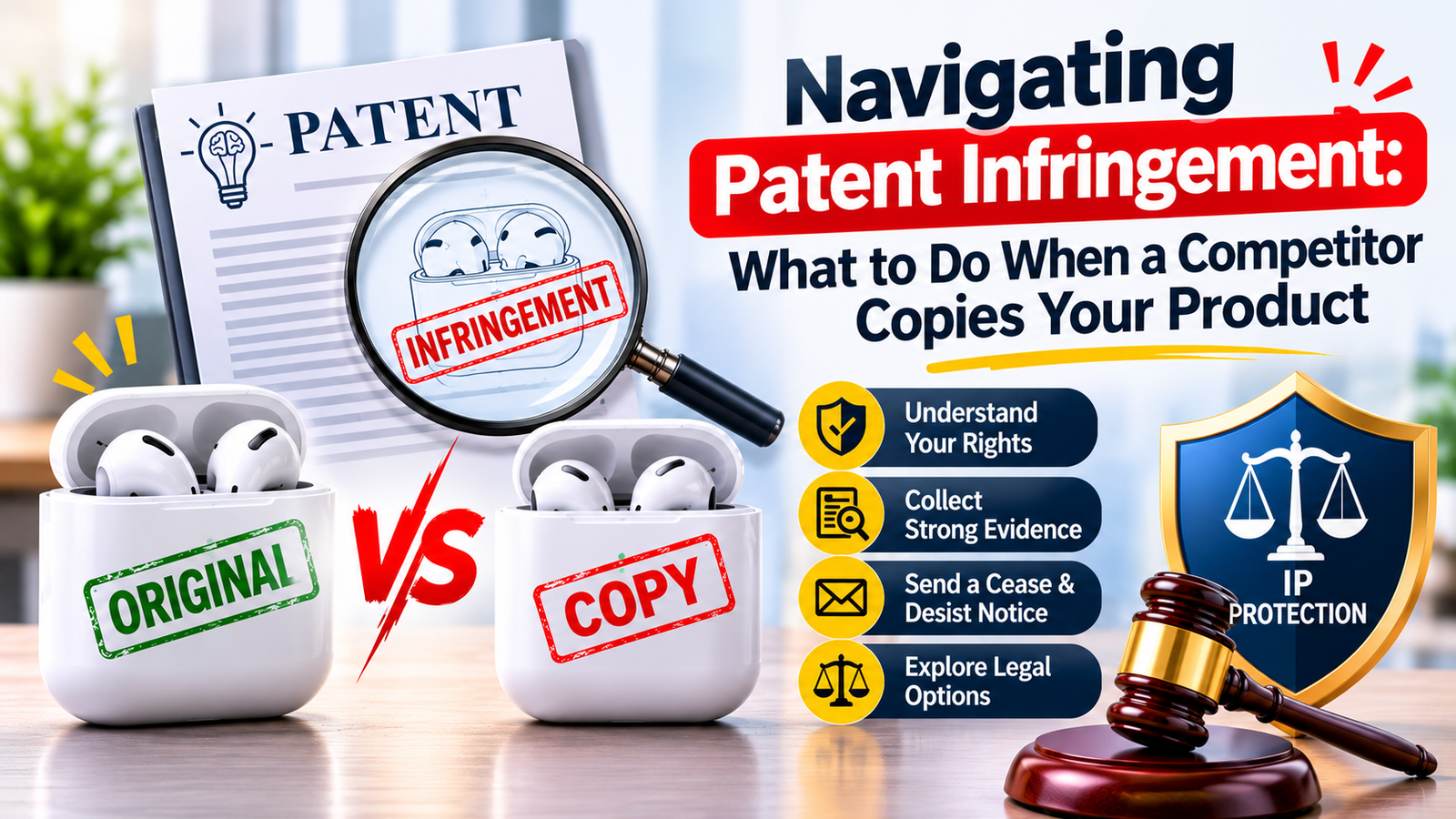
Innovating within the industry is not an easy task and can take years, combined with money and planning. When you find out that someone is copying your work, you will feel threatened. Understanding what constitutes patent infringement will help protect your business. This is when someone makes, uses, sells or imports your invention without consent. You should review your patent claims to see how much protection you have against patent infringement.
Moreover, small design changes do not usually protect against copycat liability. Specifically, the courts look to whether the competitor’s product “functions substantially the same way and achieves the same result.
Examine the granted patent claims and determine the exact overlaps.
- Find out the functional features of the competitor’s product and contrast them with the protected specification.
- Get legal advice from an IP attorney to verify the infringement.
Initial Action Steps and Evidence Collection
The moment of discovery is critical when it comes to taking action against IP theft. So it is advisable to perform the initial actions that you take upon discovering a competitor has infringed on your patented design quickly. In particular, save all physical and digital evidence before the competitor makes changes to marketing materials or product listings. Also, the sample of the infringing article becomes concrete evidence for future legal action.
Furthermore, evidence needs to be well organised and tracked in a timely manner. Specifically, there are certain elements to be documented, and they include taking screenshots of the competitor’s product, saving receipts of purchase of the competitor product and recording the public launch date. This comprehensive documentation will greatly support your legal arguments. Moreover, an organised evidence file discourages frivolous counter-suits and speeds the enforcement process.
- Purchase a physical sample of the infringing product directly.
- Capture time-stamped screenshots of online listings and promotional claims.
- Log all dates regarding when you first discovered the copycat item.
Enforcing Your Rights with a Cease and Desist
Defending against a competitor requires a combination of business savvy and legal expertise. Therefore, it is crucial to do patent enforcement proactively, so as to avoid market erosion and loss of brand value. In general, any type of formal communication channel can be used to communicate your plans, which can protect your IP rights. Many illegal sellers then stop their business when they get formal legal notice.
Moreover, being aware of how to draft a cease and desist letter for patent infringement guarantees that it can be done properly. However, specifically, your lawyer can create a specific document that can provide the details of your patent rights and require that sales be ceased immediately. Also, the letter identifies financial requests or payments of any kind if damages have already been incurred. Therefore, a formal notice is a very important step in the process before full litigation is instituted.
- Draft a formal letter detailing the infringed patent numbers.
- Outline specific demands, including halting sales and removing advertisements.
- Set a strict deadline for the competitor to respond or comply.
Protecting Your Future Innovations and Long-Term Strategy
Winners learn some lessons from the patent theft. Thus, it is important to strengthen your IP portfolio to protect against future emerging threats. In particular, you can easily identify copycats by keeping an eye on online marketplaces regularly. Thus, proactive defence protects your long-term Brand Value.
Moreover, stringent NDAs are effective at safeguarding designs that are confidential during production. Therefore, by combining legal protections with market vigilance, businesses can enjoy a safe environment. Besides, this constant innovation means that your rivals have trouble keeping up.

- Establish automated alerts for unauthorised product listings.
- File continuation patents for evolving product iterations.
- Educate internal teams regarding strict intellectual property protocols.
Evaluating Legal Options and Initiating Litigation
Sometimes cease and desist letters are ineffective in stopping an ongoing copycat. Thus, consideration must be given to the alternatives to litigation, such as dispute resolution. In particular, a federal lawsuit affords official permission to seek monetary compensation. In turn, your business will have no tolerance for IP violations.
Also, litigation is a costly endeavour and emotionally demanding. Therefore, your legal team needs to assess damages in line with projected legal expenses. Furthermore, securing a permanent injunction permanently removes the infringing product from the market.
- File a formal complaint in federal district court.
- Request preliminary injunctions to halt sales immediately.
- Prepare for discovery, depositions, and courtroom arguments.
Conclusion
When a competitor copycat emulates, and you find out, it can be devastating. In particular, patent infringement is when someone makes, sells, or uses your patented invention without your permission. Thus, it is important for every business owner who is dealing with IP theft to understand what constitutes infringing a patent. The first thing you need to do is to take action quickly. In particular, the first steps to follow after seeing evidence of a competitor copying your patented design include collecting tangible evidence. Buy the offending product, take screenshots of it, and record its sale date.
Assess the extent of the violation. Is there literal infringement, or does the doctrine of equivalents apply to the competing product? Therefore, it is important to rely on an experienced patent attorney to help you figure it out.
The next best steps, in most cases, are formal legal communications. Drafting a cease and desist letter to stop patent infringement involves specifying the precise claims of your patent and an urgent request to stop any sales of the infringing product. In the end, proactive patent enforcement will secure your hard-won market share and will deter subsequent copycats. Be vigilant, record everything, and protect your intellectual property rights now. For any Kind of guidance, kindly contact Intellect Bastion LLP!
FAQs
1. What is the first thing I should do if I suspect a competitor copied my patented product?
Look at your patent documents to find the claims of your granted patent and see how they map to those features, specifications and marketing material of your competitor. Maintain your patent; ensure you keep your maintenance fees up to date. Don’t make any public accusations. This can make it harder to move forward with the next steps of your legal action and can result in counterclaims.
2. How do I determine if a competitor's product actually violates my patent claims?
Before the cease-and-desist notice, a literal infringement analysis is crucial. If every step of an independent claim of the patent is in the competitor’s product, then there is literal infringement. This is if the elements are not a literal match, do the competitor’s features perform substantially the same function in substantially the same way to produce.
3. What is the difference between direct product copying and legal design-around?
Direct Infringement occurs when another party produces copies of your protected design in its entirety. This would infringe your claims of originality. Design-around occurs when another party intentionally alters, or removes, a specific feature within their competitive product design that would infringe your patent. However, it will avoid using any literal wording from your patent.
4. Can I sue a competitor for patent infringement if my patent application is still pending?
No patent rights to enforce: Until the patent is officially granted by the patent office, you may not enforce it in court.
Provisional protection: By announcing that a product is “Patent Pending”, the market is notified, and in some jurisdictions, it allows the same company to claim reasonable compensation for using the product after it is patented.
5. How do I gather legally admissible evidence that a competitor is infringing on my patent?
Secure purchases: Secure purchases means that to make a secure purchases by purchasing the standard commercial products and keeping all receipts, packaging and shipping papers.
Digital preservation: Take screenshots, download brochures, promotional videos and user manuals providing information on product specs with dates.
Chain of custody: Secure storage (both physical and digital) and recording who got the evidence and how they got it.
6. Should I Contact a competitor directly before hiring a patent litigation attorney?
It is generally advised that reaching out informally can alert the competitor to your intentions; otherwise, it will give them time to alter the design or hide the asserts. They can make basic changes to manipulate the asserts. It can also lead to jurisdictional risks, as unsolicited or poorly worded communications can sometimes prompt the competitor, which will allow them to file a preemptive declaratory judgment action in the court of their choosing.
7. What are the risks of sending a cease and desist letter without preliminary legal review?
Overreach liability arises when you assert claims or misunderstand the scope of your patent. Overreach liability puts you at risk of accusations of fraud or unfair competition. Premature litigation triggers can result from a drafted letter. Premature litigation triggers may cause a competitor to sue you first in order to invalidate your patent. Weak enforcement occurs when letters lack claim charts and solid legal backing. Weak enforcement often leads competitors to ignore such letters.
Author: Shubhra Pandey