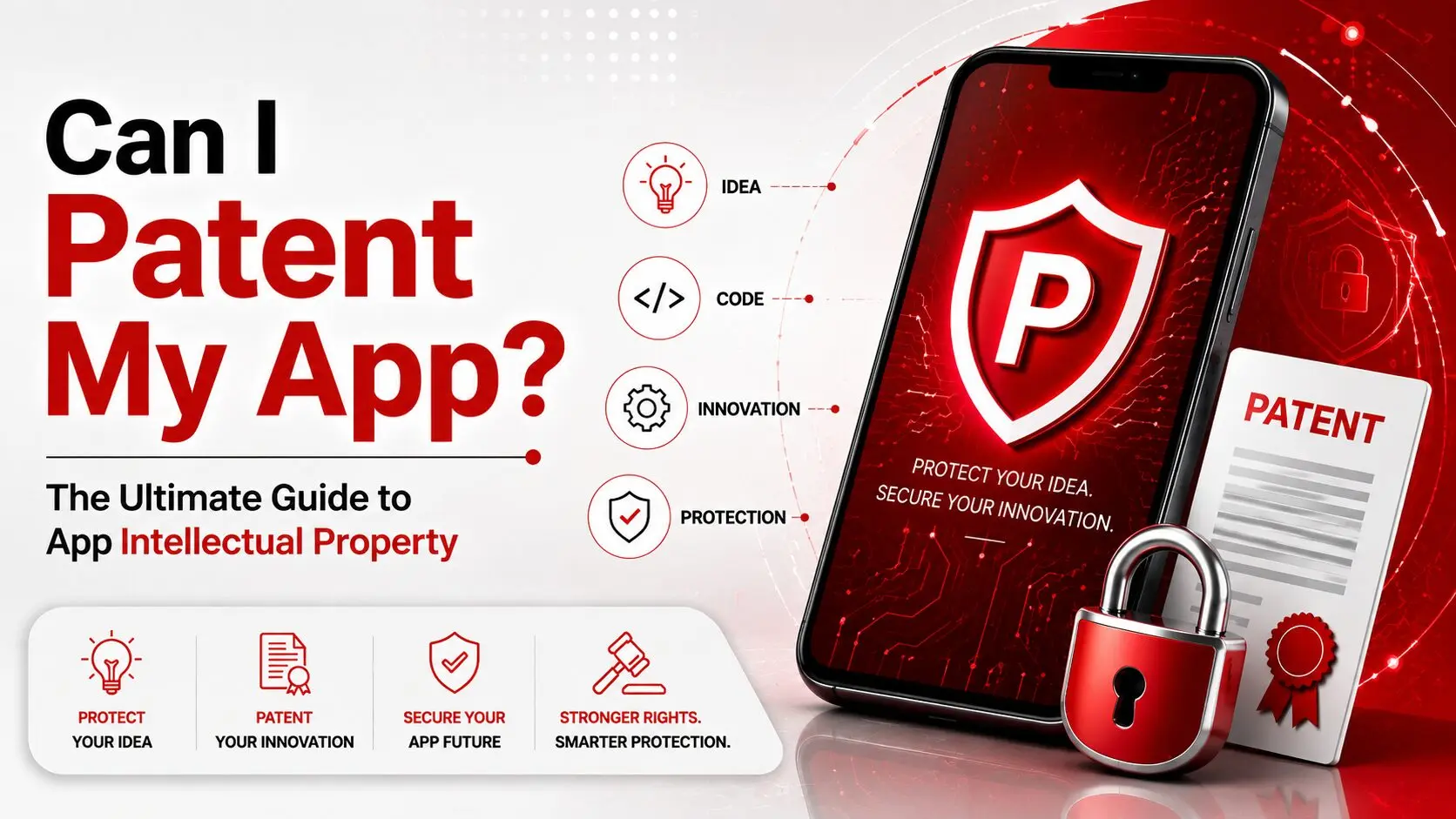
Creating a mobile application with a unique design involves a great deal of time, effort, and resources. As a natural consequence, many people who create apps fear that competitors will imitate them. As a result, one of the primary concerns is whether an app developer can patent their app.
The answer is that yes, he can. Note that patenting a mobile app involves following a set of stringent rules. Thus, one cannot patent a mere idea or even a business method; instead, one needs to protect the exact code or function of the software itself.
Intellectual property law related to mobile apps can be rather confusing for developers and entrepreneurs. In this regard, the following guide aims to provide all the necessary information concerning patents on apps.
Understanding App Intellectual Property: Can You Patent a Mobile Application?
Founders always wonder whether it is possible to patent a mobile application before its official release into the app stores. It is possible to legally protect software applications in accordance with patent laws. But at the same time, there are very definite borders that the patent authorities around the world set for tech patents.
Patent examiners do not legally protect mere ideas or concepts. They only protect technical implementations, which yield some tangible results of operation. Thus, your mobile application should be an implementation of a new technical solution to a problem.
Key Software Patent Requirements
To qualify, your application must meet three key criteria in software patenting:
- Novelty: Your application must have an aspect that does not exist anywhere else. Patent examiners refer to previously developed software, research papers, and patents as “prior art.” If prior art includes your core features, examiners will reject your application immediately.
- Non-obviousness: Your solution cannot be obvious to the average software developer. It is very unlikely that merging two common tools will pass this test. There should be some kind of technical innovation present.
- Utility: Your software must have a tangible, practical purpose.
Can You Patent a Software Algorithm?
The question frequently asked by engineers is whether one can patent a software algorithm. In most cases, patent laws consider a mathematical algorithm an abstract idea. This means that a standalone mathematical formula cannot be patented.
But an application for a patent for an algorithm can be filed if it yields tangible technical results. If, for instance, the algorithm maximizes mobile battery life or secures wireless communication data through encryption in a new manner, it will get an application for a patent.
Can You Patent a Business Method App?
Business owners frequently wonder, can you patent a business method app? In the past, courts allowed broad software patents for simple business concepts. Today, patent examiners scrutinize business method applications heavily.
To patent a business method app, you cannot merely move a traditional offline transaction onto a smartphone screen. Instead, your application must introduce a unique technical process that enables the business method. The novelty must stem from the underlying technology itself, not just the financial concept.

How to Patent an App Idea: Step-by-Step
The process of patenting an app idea requires following a legal process step-by-step. Doing it systematically helps save money and protects your interests all the way through the procedure.
Step 1: Performing a Complete Prior Art Search
Before drafting the application, perform a complete search of all patents and software applications. Search the Google Patents database, USPTO, and any other international database. Detecting competing products beforehand will help save you thousands of dollars in legal expenses.
Step 2: Producing Technical Documentation
Prior to applying for a patent, you need to produce technical documentation of your software. Produce diagrams of system architecture, database structure, and user flowcharts. Provide information about how the data travels from the server side via API to the client side.
Step 3: Submitting a Provisional Patent Application for Mobile App
For many early-stage entrepreneurs, the first patent they apply for is a provisional patent for mobile apps. A provisional patent application serves as a placeholder with the patent office. It provides the inventor with the priority filing date while not involving as many legal claims as a full application. Furthermore, filing a provisional application allows you to label your software as “patent pending” for twelve months. During this period, you can pitch investors, test user demand, and build your minimum viable product (MVP).
Step 4: Filing the Non-Provisional Patent Application
Within 12 months from the time when you filed the provisional application, you should file a non-provisional patent application. The latter is a formal document that consists of very strict legal claims, detailed specifications, and official drawings. Patent examiners analyze this document to find out whether to issue you a patent for software.
Step 5: Prosecution of the Patent Application
In the course of examination process, the patent office usually issues office actions. They are official letters in which the patent office expresses its objections and rejections to some of your claims due to prior art.
Cost to Patent an App Idea and Expected Timelines
Financial planning plays a crucial role in securing your app idea protection. Startup founders must budget for initial legal costs, filing fees, and long-term maintenance.
Breaking Down the Cost to Patent an App Idea
The cost incurred in the process of obtaining patent protection for the app idea varies with respect to the applicant classification, technical complexity of the case, and professional attorney charges.
- Provisional Patent Application: The cost incurred in the preparation and filing of a provisional patent application is between ₹15,000 and ₹35,000. It is the sum of the filing charge at the IPO amounting to ₹1,600 for individual and start-up companies (and ₹8,000 for corporate applicants) together with the professional drafting charges.
- Non-Provisional Patent Application (Complete specification): The filing and preparation cost of the complete specification of the non-provisional application amounts to ₹35,000 and ₹75,000+. More complicated software backend and integration of IoT devices require increased professional attorney fees.
- Patent Examination & Prosecution: The cost of filing the Request for Examination Form 18 is ₹4,000 for the standard procedure and ₹8,000 for start-ups (for expedited process). Dealing with the first examination report and hearing objection is done by professional attorneys for ₹15,000-₹30,000.
- Maintenance Cost: The annual maintenance fees commence from Year 3 after issuance of the patent. It varies from ₹800 to ₹8,000 annually till Year 20 (or ₹4,000 to ₹20,000 annually for corporates). Although self-filing reduces upfront costs, drafting legal claims without professional experience often results in weak protection. Consequently, working with a certified patent attorney remains a wise investment.
Although the cost of filing by oneself is lower, filing legal claims without having proper expertise is likely to lead to inadequate protection or rejection under Section 3(k) of the Indian Patent Act. Therefore, it is worth consulting a patent attorney.
App Patent Processing Timelines
Patent registration is a time-consuming process. It generally takes between two and four years for the whole examination process to be completed after the non-provisional application. The good thing is that your provisional application provides you with a priority date right away.
How to Protect an App Idea Without a Patent
Patents are costly and time-consuming; however, they make up for just a small part of the entire legal structure. You can always create a comprehensive protection structure using copyrights, trademarks, trade secrets, and confidentiality agreements without filing any patents for your software.
1. Secure your Software through Copyrights

A patent is used to protect the functionality of the system, whereas a copyright is used to secure its creative expression. Thus, as soon as you create your source code and design your user interface, copyright immediately begins protecting your intellectual property. It means that you are automatically protected by copyright regarding your visual designs, custom graphics, and text-based information. Still, it is worth registering your copyright in order to be able to sue people who violate it for monetary compensation.
2. Protect your Reputation Using Trademark
While copyright is used to secure the code itself, you can secure your reputation in the market through trademarking. Thus, registering an app name, logo, and slogan prevents your competitors from imitating your brand identity. They may try to imitate your product functionalities. Nevertheless, you can be sure that you are protected from brand identity imitation due to trademark registration.
3. Use NDAs to Ensure Secrecy
Do not disclose your technical architecture and any wireframes to any third parties without a prior guarantee that your idea will be kept in secret. You should make all freelance developers, agencies, and even advisors sign Non-Disclosure Agreement in order to create legal obligation to preserve confidentiality.
4. Make Your Backend Logic a Trade Secret
You can skip patenting your algorithms if the competitors do not have access to them. Formulas and data pipelines are considered to be trade secrets as long as you keep them secret. Thus, your secret sauce should stay hidden on your server-side databases.
Steps to be Taken Strategically for Safeguarding Your Mobile App
Patenting a mobile app needs much strategic effort, thorough documentation, and adequate financing. However, safeguarding your mobile app’s intellectual property essential to protect your technological inventions in a cutthroat business environment.
Through searching prior art, utilizing a provisional patent for your mobile app, and using patents alongside copyright and trademarks, you can establish a strong commercial barrier for your business. It is necessary for you to evaluate your technological inventions wisely, consult an expert patent attorney, and take action. Contact Intellect Bastion for thorough guidance and support.
Frequently Asked Questions About Mobile App Patents
Can I patent my mobile application idea without developing it yet?
It is possible to apply for a patent even before writing code for an application. But there is no way you will patent an idea that is still very raw and abstract. Provide technical descriptions that will explain how your technology functions. The developer needs to create the application using only your patent descriptions.
Which requirements must my application meet to qualify for a software patent?
Your application meets the criteria when it offers a unique and non-obvious technological solution to the technical problem. Your application should increase computing effectiveness, make the process of transferring data more efficient, improve security algorithms, or change hardware physical state. Patent examiners will not patent regular business processes that you simply automate on a phone screen.
Can I patent a mobile app using existing technology or APIs in a new way?
Sure, it is possible to patent software using the existing APIs in a novel manner, which provides some inventive technical result. Note that your patent claims must cover your system workflow rather than any third-party technologies.
How much time does it take to obtain a mobile app patent?
In total, the entire procedure will take from two to four years. At the same time, by applying for a provisional patent, you will gain “patent pending” status from the first day. Also, the applicant can choose to pay additional governmental fees for fast-track examination procedures to receive the final decision within twelve months.
What is the difference between patents, copyrights, and trademarks?
These three measures protect different parts of your software company:
Patents safeguard functional mechanics, architecture, and processes. Copyrights cover source code, visual assets of the user interface, graphics, and media files. Trademarks protect commercial brands, names, logos, and slogans.
Can my competitor replicate my app if I only have a provisional patent?
With a provisional application, you can claim “patent pending” status, which is, however, not enforceable. You need an approved non-provisional patent before you can sue someone for infringement. Once approved, the rights begin dating from the initial filing of your provisional application. In addition, “patent pending” serves as a discouragement for any competitors.
Which types of apps or software inventions cannot be patented?
It is legally clear that abstract concepts, mathematical algorithms without practical use, mental acts, and business methods without technical content cannot be patented. Moreover, if your application only digitizes physical activities or accumulates data from public sources through technical means, then it will be rejected straight away.
Do I apply for an NDA or for a patent before approaching investors with the idea of my application?
Application of the provisional patent is the best decision that can be made before pitching to investors. Professional venture capital firms rarely sign any NDAs before preliminary pitches. Applying for a provisional patent enables you to have priority while talking to your investors.
YASHIKA KORANGA
Patent Associate at Intellect Bastion