
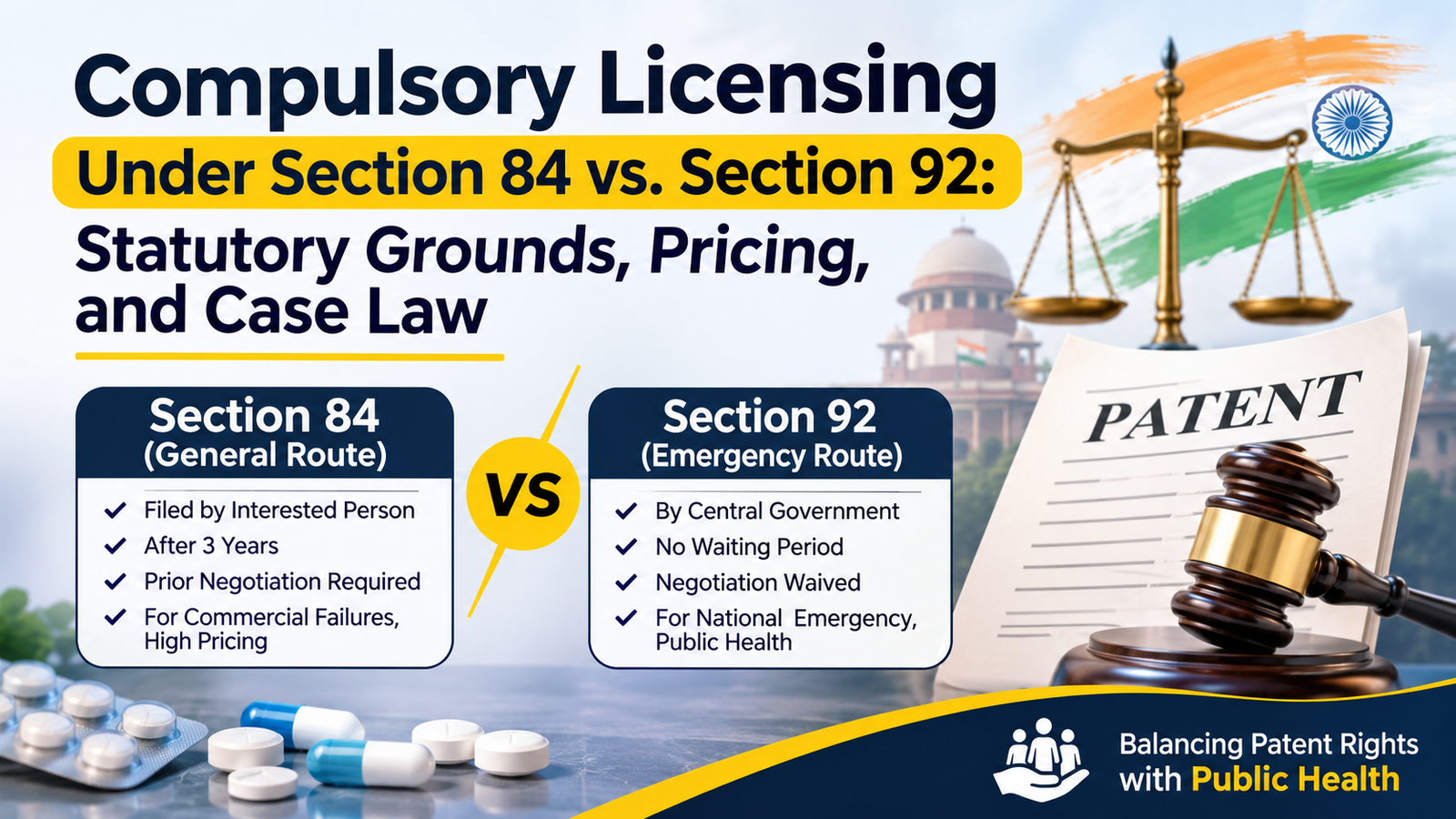
The Indian patent laws ensure a delicate balance between promoting innovation and safeguarding public health. According to the Patents Act, 1970, compulsory licensing is an important legal mechanism. The patentees cannot be allowed to create any undue monopoly in the market and charge unreasonable rates for patented products. Chapter XVI of the Act ensures that there are legal means at the disposal of the Indian Patent Office and the Central Government to overcome the exclusive rights.
Compulsory licensing would have to be understood against the backdrop of a proper contrast between Section 84 of the Patents Act provisions and Section 92 on compulsory licenses.
The Framework of Indian Patent Law
According to the Patents Act of 1970, patents enjoy the status of an exclusive 20-year monopoly. Nevertheless, such an exclusive privilege entails some social responsibility too. The government makes sure that such patents do not stand in the way of public healthcare and industrial growth in the country. This is consistent with Article 31 of the TRIPS Agreement of the WTO and the 2001 Doha Declaration on TRIPS and Public Health.
Difference between Section 84 and Section 92 Compulsory Licensing
The key distinction between compulsory licensing under Sections 84 and 92 is based on whether the process is initiated and the degree of urgency involved.
- Section 84 is the normal procedure for an applicant seeking a private patent. This can be done by any individual to the Controller General of Patents, Designs, and Trademarks within three years from the date of the patent grant.
- Section 92 acts as an emergency procedure whereby the Central Government issues a notice published in the Official Gazette in emergency conditions.
| Feature | Section 84 (General Route) | Section 92 (Emergency Route) |
|---|---|---|
| Initiating Authority | Any interested person (e.g., generic firm) | Central Government (via Gazette Notification) |
| Waiting Period | 3 years post-patent grant | No waiting period required |
| Voluntary License Mandate | Mandatory prior negotiation (up to 6 months) | Waived upon government notification |
| Primary Focus | Commercial failure, high pricing, non-working | National emergency, extreme urgency, public use |
Statutory Grounds for Compulsory License in India
The licensee must meet certain statutory grounds as per the Indian Patents Act, 1970 to get a license.
Statutory Grounds as Per Section 84
As per Section 84(1), an applicant may apply for a compulsory license three years after the Patent Office grants the patent. The applicant should meet at least one of the following three statutory grounds for a compulsory license in India:
- Public requirements unfulfilled: There is non-compliance with the requirements of the public regarding the patented invention. Such compliance arises where the patentee fails to grant licenses on reasonable terms and prejudices local trade, manufacturing or market requirements.
- Pricing too expensive: The invention is not obtainable at a reasonably affordable price by the members of the public.
- Not manufactured in India: There is no working of the invention in India. Just importation without manufacturing or any other satisfactory reasons will attract this ground.
Moreover, Section 84(6) requires the applicant to show that they made genuine efforts to negotiate a voluntary license with the patent owner on reasonable terms and conditions. The law deems these efforts unsuccessful if the parties fail to negotiate within a reasonable timeframe, usually not exceeding six months.
Emergency Compulsory Licensing Under Section 92 of the Patents Act
Emergency Compulsory Licensing under Section 92 of the Patents Act is provided in specific situations. A Central Government declaration triggers this provision. The Central Government issues this declaration when any one of the following situations is satisfied:
- National emergency due to a widespread crisis such as large-scale military conflict or health disaster.
- Extreme urgency due to sudden outbreak of epidemic/pandemic disease.
- Public Non-commercial use where the Government puts the patent to use for non-profit public healthcare schemes or welfare schemes.
After the government issues the declaration/notice, any interested party may directly file an application to the Controller General. The law explicitly states that there is no need to attempt to obtain a voluntary license.

How the Controller Determines Royalty Pricing for Compulsory Licenses
Readers should understand that compulsory licensing does not take away the patent owner’s rights; in fact, they hold a statutory right to receive royalties. To understand the methodology of assigning royalty rates in compulsory licensing scenarios, we need to look at section 90 of the Patents Act, 1970.
Section 90 specifies the terms and conditions that the Controller must include in any license it grants:
- Reasonable Compensation – Royalty rates must be fair to the patentee. The Controller considers the type of invention, costs incurred and risks taken by the inventor.
- Affordable Price – The Controller must grant the license to ensure sellers offer the products to the public at the lowest possible prices, with the licensee receiving reasonable profits.
- Primarily for Sale within India – The Controller grants the license for sale within India. Unless specialized circumstances exist, such as Export under Section 92A, distributors cannot export products without authorization.
- Non-Exclusive and Non-Assignable – The statutory license remains non-exclusive, and the licensee cannot assign it.
The Indian Patent Office often refer to guidelines set by international bodies such as the United Nations Development Programme (UNDP) Royalty Guidelines. Typically, royalty rates are between 4-7% of the net selling price of the generic product.
Compulsory Licensing Landmark Case Law India
Let us see how these provisions have been practically applied through some landmark cases of compulsory licensing. The following case law will give an insight into how the Indian Judiciary deals with the statutory provisions:
- Natco Pharma Ltd. V. Bayer Corporation (2012)
This case is the most famous judgment regarding patents in India. Bayer had a patent for the drug ‘Sorafenib Tosylate’ (Nexavar), which is a life-saving drug for late-stage kidney and liver cancer. The drug was sold by Bayer at a price of approximately ₹2,80,000 per month of treatment.
Natco Pharma claimed a compulsory license under section 84 of the Act. It offered to sell the drug at a much lower price of ₹8,800 per month. The Controller General issued the first compulsory license in India because Natco could establish the following 3 statutory conditions:
- Bayer could meet less than 2% of the demand of patients in India.
- The drug was very expensive for the public at large (₹2,80,000 per month).
- The drug was imported and not manufactured in India.
A royalty of 6% was fixed by the Controller. The Bombay High Court increased this to 7% when appealed.
- BDR Pharmaceuticals v Bristol-Myers Squibb (2013)
BDR Pharmaceuticals made an application to grant a compulsory licence for Dasatinib (a cancer drug). However, they only made one inquiry regarding a licence and quickly applied for a compulsory licence.
This was denied by the Controller General. It was held that there is a mandatory requirement in section 84(6) to make “genuine and sustained attempts” to obtain a voluntary licence.
- Lee Pharma v. AstraZeneca (2015)
Lee Pharma made an application to the Controller General seeking a Compulsory License under Section 84 for AstraZeneca’s anti-diabetic drug Saxagliptin. However, their application was denied due to a lack of evidence of market comparisons. The Patent Office found that the applicant was unable to provide evidence that:
- The demand for the drug was clearly defined.
- The drug was too expensive when there are alternative versions of the drug available (Sitagliptin & Vildagliptin) in the market for a similar price.
This decision shows that there is a high burden of proof on those applying for a Compulsory License, and you cannot simply say that the price is high.
Balancing Monopoly Rights and Public Welfare
The Indian Patents Act, 1970 contains provisions of Compulsory Licensing which strike a fine balance between the monopoly rights of the patentee and the public interest. Section 84 provides a legal remedy to overcome market failures, non-working patents and high prices of patented products. Section 92 provides a speedy remedy to the Government during times of national emergency and health crisis. Cases such as Natco v. Bayer have shown that India has measures in place to maintain public access to essential medicines through its patent regime while requiring applicants to provide rigorous proof to avoid arbitrary practice. An understanding of these provisions is key for generic producers, innovators and legal professionals within the Indian pharmaceutical industry. For expert guidance, reach out to Intellect Bastion today.
Frequently Asked Questions
State the difference between Section 84 and Section 92 of the Indian Patents Act.
Section 84 provides that any interested party may obtain a license 3 years after the Controller grants the patent on the grounds of commercial failure, high prices, and non-working of the patent, while Section 92 empowers the Central Government to allow an emergency route during a crisis, thereby eliminating the 3-year waiting period and the need to negotiate for a license.
List out the grounds for applying for a compulsory license under Section 84.
The applicant must establish that the patentee does not meet the reasonable needs/requirements of the public, does not offer the product at cheap rates, and does not work the patent within India. The applicant must also show that the parties failed to reach a voluntary license agreement (Section 84(6)).
Under which conditions can the Central Government apply section 92?
The Central Government applies this section by a formal notification during times of national emergency, extreme urgency or non-commercial use of the product by the public.
How does the Controller General determine royalty for granting a compulsory license in India?
The Controller General determines the royalty under Section 90. The Controller sets royalty terms to compensate the patentee fairly for their R&D costs while making the drug available to the public at an affordable price. Royalty is generally between 4-7% of the sales of the generic drug.
What are the major Case Laws and Precedents in the Indian Pharmaceutical Industry?
The landmark case is Natco Pharma Ltd. v. Bayer Corporation (2012), which saw the granting of the first-ever Compulsory License in India. Other cases have shown that there is a high standard of proof needed to be met. This includes BDR Pharmaceuticals (2013) and Lee Pharma v. AstraZeneca (2015).
What is the format and official fee for filing an application for Compulsory License?
An application under section 84 or 92 shall be made by filling up Form 17 as provided under rule 96 of the Patents Rules, 2003. The official fee charged for filing of application by large entities such as corporate pharma companies is INR 12,000 for online filing whereas, INR 2,400 for online filing by startups, small entities or individuals.
YASHIKA KORANGA
Senior Patent Associate at Intellect Bastion