Every new idea is the seed of a new curiosity. To keep that idea safe, you need to think things through. People who come up with things often ask themselves if they can get help from the law with a patent and still keep their new ideas hidden from other companies. This is a question that a lot of people, with new ideas, people who start their own businesses, researchers and technology companies think about.
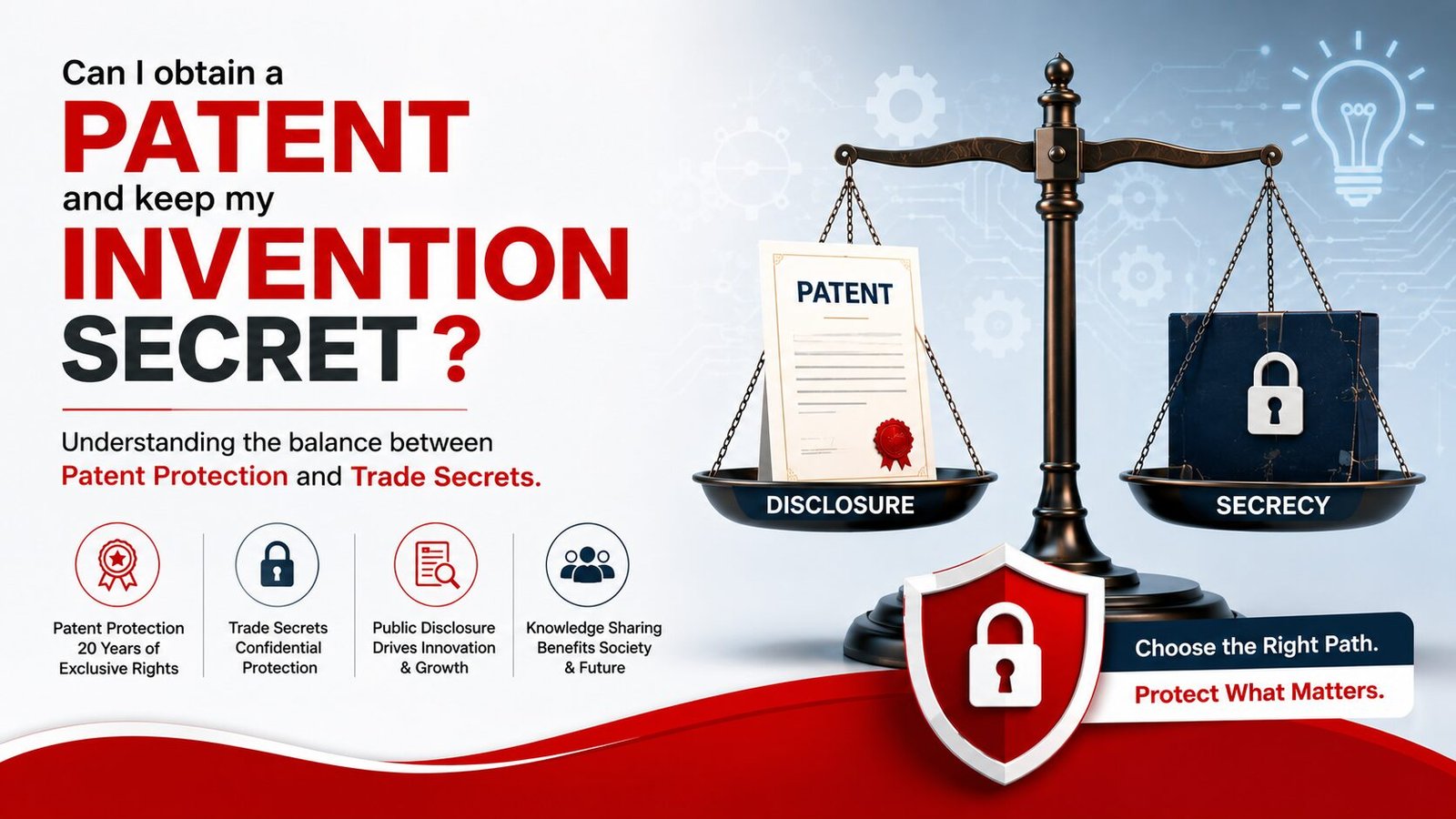
The answer to this question is not a basic yes or no, but it has a deeper level of depth. Patent law requires inventors to disclose their inventions in the public domain in exchange for all the exclusive legal rights, while Trade secrets protect valuable business information by allowing businesses to keep it confidential as long as they maintain its secrecy.
Patent vs Trade Secrets: The main dilemma
Patents and Trade Secrets both protect intellectual property. However, they both work in totally different directions. Choosing the right path depends upon the nature of the invention, business goals and the likelihood of the competitors discovering your technology.
What do patents offer?
Patents provide exclusive legal rights to the invention for about 20 years; during that time span of 20 years, the inventor has all the exclusive rights, which the inventor can take legal action against unauthorised use, but in exchange for complete public disclosure. It provides full protection even if the competitor independently develops the same invention.
What do Trade Secrets offer?
Trade secrets can protect confidential business information without requiring any registration, but businesses must actively maintain their secrecy to safeguard the company’s information. In trade secrets, no government filing is required, and protection depends solely on the secrecy remaining intact.
Patent disclosure
Patent disclosure means providing a complete description of the invention. The application enables a person in the relevant field to reproduce the invention without excessive experimentation. A typical patent application contains technical drawings, patent claims, background and the summary.
Why does Patent Law require Public Disclosure?
The patent system is built on a balanced exchange system between inventors and society. In return for the exclusive rights to the invention for a time period, the inventor provides a detailed disclosure of how the invention works. This disclosure enriches the public body, society, and different communities with knowledge of that technical field, while encouraging innovation.
Patent disclosure also supports scientific and technological advancement. Researchers, scientific communities, and universities can gain knowledge from published patent innovations. As a result, the patent system promotes knowledge sharing while ensuring that the inventor receives protection for their invention.

Benefits of patent disclosure:
- Expands global repository with technical knowledge.
- Encourages technology transfer between the researchers and industry.
- It supports education and academic researchers through publicly available technical information.
- Promotes brand collaborations, licensing and commercialisation of new technologies.
How does a patent protect against similar products?
A Patent is an exclusive right that prevents other competitors from commercialisation without the patent owner’s permission, who is usually the one who holds all the legal rights after the grant.
Patent protection is valuable when competitors develop products to incorporate the same patented technology, even if those products differ in appearance or branding. Since patent right defined by patent claims, the focus is on whether the competing product uses the claimed inventions rather than whether it looks identical.
If the patent owner believes that a competitor is infringing their patent, they have the right to safeguard their invention by:
- By monitoring the market for potentially infringing products
- Sending a cease-and-desist notice to the infringing party
- Negotiating licensing or settlement agreements
- Initiating patent infringement proceedings before the appropriate court or authority.
Patent law
Patent law says that people who invent things have to tell everyone about them. This is called the patent bargain. When the government gives an inventor the right to make and sell their invention for a certain amount of time, usually 20 years, the inventor has to tell everyone how it works. The government gives the inventor this right so they can make money from their invention.
The reason for this is to help people keep making things and to help everyone. Inventors would probably keep their inventions secret if they did not have to tell people about them. This means the inventor holds the right and but when it gets people’s disclosure, it becomes a source of knowledge for other researchers working in other or the sectors, it will help students from all over the world to read how the technology is evolving, it makes more research and other scientific collaborations to occur which will be beneficial for the research and development all over the world.
Patent Bargain
Also, when inventors tell people about their inventions, it helps companies know what they can and cannot make. The paper that inventors fill out when they get a patent says what their invention is, so other companies know what is okay to copy and what is not. This helps prevent companies from getting into trouble with the law by accident. It also helps companies think of ideas and make new things.
Finally, when the time is up for an inventor’s right, anyone can make and sell their invention. This is good because it helps companies compete with each other, which makes prices lower. It also means that the invention is no longer just owned by one person. By everyone. Patent law and the patent bargain are important for patent law and the patent bargain. The patent bargain is what makes it all work, and patent law is what makes sure the patent bargain is fair. The patent bargain and patent law are important for inventors and everyone.
Conclusion
Choosing between patent protection and trade secret protection will depend on the nature of the invention and the business goals of its commercialisation. Patents and trade secrets serve the same purpose of protecting valuable ideas; however, in exchange for patent rights, the owner gets the right to enforce a prohibition against unauthorised usage during the term of the patent.
Before the inventors make a decision about applying for a patent or using trade secrets, they have to carefully analyse all conditions of the situation, such as risk of reverse engineering, commercial potential and future goals of their business. Please note that the advice and recommendations of the qualified patent professional will help develop an intellectual property strategy that will maximise the costs of innovation in the long run. For the best support, you can contact Intellect Bastion!
FAQ’s
1. Can an invention be patented and kept completely secret?
There is no standard system that can prevent disclosure of the patent in the public domain. Patent applications are usually published after a specified period, which allows public access to the disclosed technical information while enabling the patent owner to retain all their exclusive rights.
2. What is the 18-month publication rule in patent law?
The 18-month publication rule means that most patent applications get published, around 18 months from the filing date. This publication helps the public see the details. It happens while the patent application is still being checked.
3. Is every granted patent open to the public?
Yes. Granted patents generally become part of the public patent records. Anyone can access commercial patent databases in order for exploration various inventions, do research about patents and keep up with the latest technology trends.
4. Can you file a patent application anonymously or under a pseudonym?
Patent regulations generally require inventors to provide their valid details in the patent application. However, inventors still have the possibility of transferring ownership rights to their invention to a corporation or another legal body.
5. What happens if you keep a patented invention a secret?
When a patent application is made public or a patent is granted, the details are out in the open for everyone else to see. The people who own the patent still have control over what happens with the invention. They can prevent others from commercialisation in open market.
6. Should you get a patent? Keep your idea a secret?
It depends upon the nature of the invention and the business strategy. Patents suit inventions that can benefit from exclusive legal protection and commercialisation, while trade secrets protect confidential information that has value only while secrecy remains intact. Many businesses combine both forms of intellectual property protection.
7. How does a company protect technology without filing a patent?
Companies keep their secrets private by various measures, such as making all employees sign a confidentiality agreement, often limiting who can access the information, using cybersecurity measures. Companies often use these methods to protect their information.
8. Can someone else patent your invention if you keep it as a trade secret?
Yes. If the competitor independently develops the secret invention and files a patent application first, they will win the patent rights. As trade secrets are kept private, the patent office has no record of the work to block their application. You only retain “Prior use right” to continue your current business operations, but you lose the right to stop them.
9. What is a government secrecy order, and who qualifies for one?
A government secrecy order is a legal restriction that delays the publication or grant of a certain patent application that involves an invention that can affect national security or defence interests. Such orders are only applicable in limited circumstances and under applicable national laws.
10. Can you request non-publication for a standard utility patent application?
Yes, you can request non-publication for a standard utility patent application, but you must submit the request at the exact time of filing the application. You cannot make the request later and certify that you will not file the application in a foreign country or under an international treaty that requires 18-month publication.
11. Do provisional patent applications become public records?
No. The provisional patent application remains confidential. A published or granted non-provisional patent application must reference them before the public can even access them.