A patent grant provides all the exclusive commercial rights for the invention. However, patent offices do not always grant it at the initial examination stage. The market is always open for competitors, researchers and third parties who often discover prior art or invalidity grounds that the patent examiner missed. The legal system provides clear, open pathways to challenge any granted patent, while ensuring that invalid monopolies do not stifle innovation.
You are a business owner who is facing an infringement threat, or you could be an innovator defending your intellectual property rights; challenging a granted patent is a gold standard method in every country with modern patent filing law. Through this, we will learn how post-grant challenges work and the specific administrative proceeding that occurs, the grounds required for revocation, and answer some of the most critical legal questions surrounding the whole process.
Pre-Grant vs. Post-Grant Patent Opposition
It is important to note that time is essential, as the legal procedure will be entirely different from the moment the patent office has published the patent officially. Third parties’ involvement is high, and they intervene either before or after the patent office makes its final decision.
- Pre-Grant Opposition: After the filed application is published online, but before the official grant. It makes the third-parties to submit their prior art or arguments to the examiner directly to prevent any misuse of the published patents.
- Post-Grant Opposition: This type of opposition is initiated when the patent office officially issues the patent. This process involves formal legal petitions to revoke or narrow the already granted claims.
Now, let’s understand that pre-grant opposition is much less expensive and is more informal, while post-grant challenges often carry higher stakes as the patent is already present in the market.
Mechanisms to Challenge a Patent
The modern patent system offers too many administrative routes to challenge a patent’s validity without entering full-scale judicial litigation
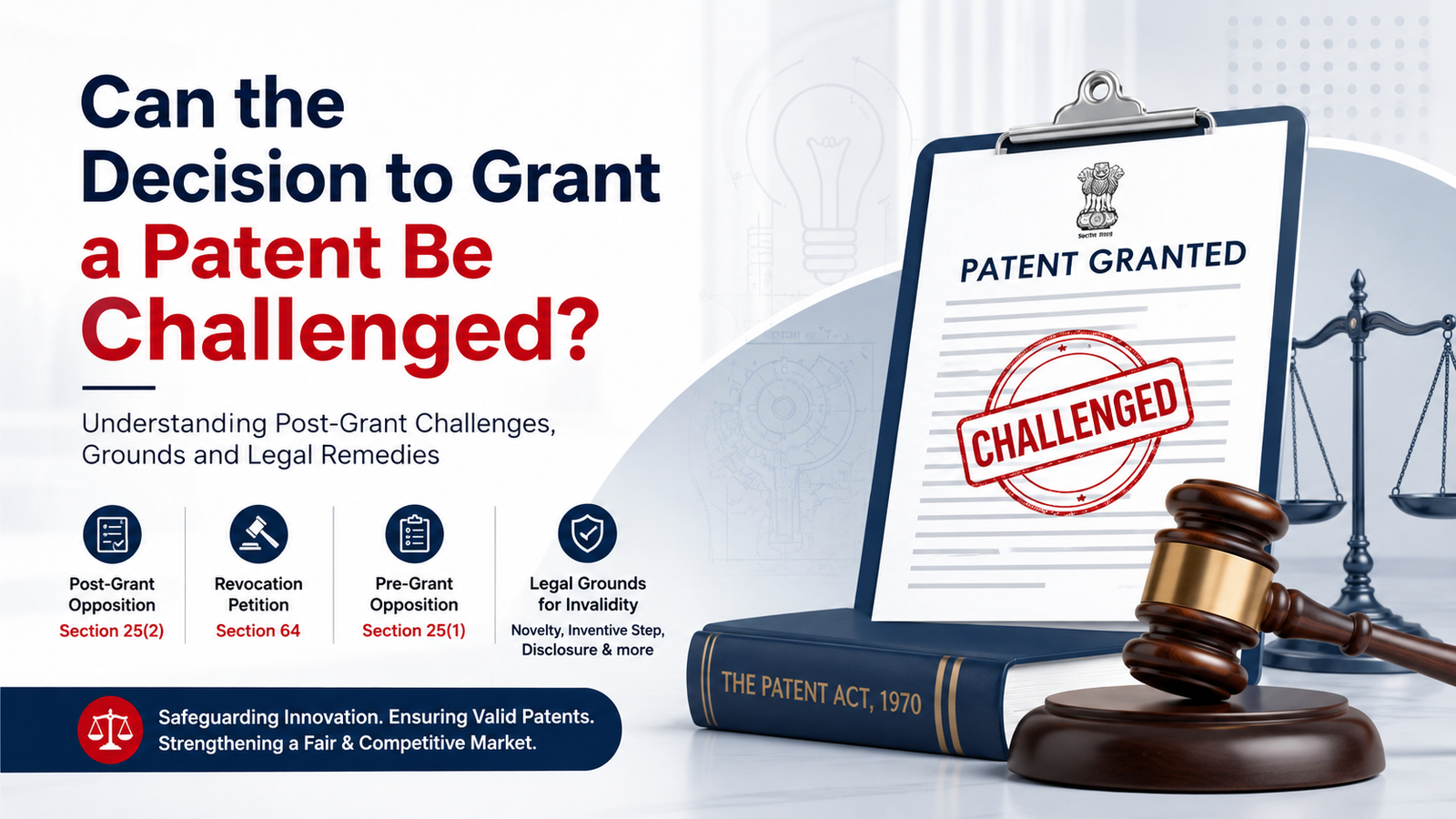
Decision to Challenge Issued Patent
- Post-Grant Opposition (Section 25(2))- Anyone interested may lodge a petition for this purpose within one year after the grant of the patent.
- Revocation Petition (Section 64)- Anyone interested may petition this anytime after 12 months after the grant of the patent.
1) Post-Grant Opposition:
Post-Grant Opposition allows an interested party to attack an issued patent before the official Patent Office (IPO). However, the notice of opposition must be filed within the time period of 12-months until the window following the publication of the grant of the patent.
This proceeding is conducted before the Controller of Patents, who usually convenes an opposition Board to examine all the evidence and provide suitable recommendations. It offers a structured and cost- effective mechanism to challenge a patent early in its lifecycle.
2) Revocation Petition (Section 64)
If the 12- month window for Post-Grant Opposition has lapsed, a challenger must file a Revocation Petition under Section 64 of the Patent Act, 1960. A revocation Petition must be filed at any point during the enforceable lifecycle of the patent.
Following the dissolution of the Intellectual Property Appellate Board (IPAB) under the Tribunals Reforms Act, 2021, revocation petitions are directly filed before the High Court (specifically within their IP Divisions) or raised as a counterclaim in an infringement suit.
3) Pre-Grant Opposition (Section 25(1))
Section 3 acts as a critical prevention mechanism. Any person, without the need to prove a commercial interest, can submit written objections after application publication up until the Controller officially grants the patent.
Legal Grounds for Invalidating a Granted Patent
In order to successfully revoke or narrow any patent under the Indian Patent Act, 1970(Section 25(2) and Section 64), a challenger must prove that the invention fails one or more fundamental legal eligibility criteria. Merely asserting that a patent is unfair or inconvenient for your business model is insufficient.
- Lack of Novelty/Prior Publication (Section 64(1)(a) & (b)): Demonstrating that the invention was publicly known, used or published in India or abroad before the priority date.

- Lack of Inventive Step/Obviousness (Section 64(1)(f)): It suggests that the invention is obvious to the person skilled in the art and does not involve technical advance or economic significance.
- Non-Patentable Subject Matter (Section 3& 4): Proving the patent claims an invention barred under Section 3 (e.g., Section 3(d) for incremental changes or any abstract theories, software per se, or any natural substance).
- Insufficiency of Disclosure (Section 64(1)(h): Establishing that the specification fails to describe any invention fully or particularly or fails to disclose the best method of performing it.
How to challenge an issued Patent?
Now the main question arises: how can we challenge the issued patent? Invalidating any issued patent requires meticulous preparation and strict adherence to draw any statutory conclusion. Skipping any preliminary research steps can destroy an otherwise valid challenge.
Challengers must start their journey by conducting comprehensive global searches for prior art across the patent databases, technical journals and technical knowledge archives. After collecting all the documents, legal teams can map their prior art search and draw a conclusion by comparing detailed comparison charts. Moreover, the challengers must establish their statutory legal stand by compiling commercial and technical proof of their industry presence.
Patentability Search
Patent specialists perform novelty searches prior to applying for a patent in order to find out if an invention can be patented, as well as find any related patents and/or non-patent publications.
An already existing comparison of patent claims to their disclosed subject matter in the form of a chart would be quite helpful for your analysis.
Such a search will help you discover untapped markets and thus will allow patent holders or applicants to produce, use, sell and/or license the invention.
- Conduct an exhaustive prior art search
- Verify Commercial standing
- Draft Detailed Claims Charts for comparison
- Secure Expert Witness Affidavits
- Submit the Final written Pleadings to the Patent Office
Indian Law provides indirect mechanisms to challenge a patentee’s exclusive market dominance. These mechanisms ensure that patent holders do not hold their monopoly rights to create an artificial market to create a market shortage.
Indirect Strategic Tools: Working Statements & Compulsory Licenses
Section 146 mandates that every patent owner must periodically submit a Statement of Working (Form 27). Under the revised Patent rules, Patent holders must file this Statement once in every three financial years. This document discloses whether the patented invention is being commercially manufactured or imported into India in reasonable quantities. If the patent owner fails to work the patent commercially, third parties can use this to build a strong case for compulsory licensing.
Conclusion
Under the Indian Patent Act, 1970, there are methods of challenging a grant order both administratively and judicially, thereby ensuring that monopolies, which are weak or too broad, do not hamper proper market competition. Any party who has a vested interest can make an opposition to the grant order through Section 25(2) of the Indian Patent Act, 1970, within a span of one year of the publication of the grant order. Within the time period of 12 months or directly in response to the infringement lawsuit, an interested party can petition the granted patent. Valid statutory grounds for these challenges include lack of novelty, inventiveness and lack of technology transfer. Furthermore, competitors can use indirect strategic measures such as challenging non-working patents, Form 27 filings, and compulsory licensing under Section 84. For any kind of support or guidance, you can contact Intellect Bastion LLP!
Frequently Asked Questions (FAQ)
1) Who has the legal standing to challenge a decided patent grant?
Section 25(2) and Section 64 of the Indian Patent Act provide that only a ‘person interested” can possess legal standing and initiate post-grant proceedings. Under Section 2(1), an interested person is defined as anyone engaged in or actively promoting research, manufacturing or any kind of commercial trade in the same technical inventions that can counterattack the patented invention.
2) What is the strict deadline for filing a post-grant patent opposition after the patent office issues the grant?
A Post-granted Opposition Under Section 25(2) must hold a legal right to file within exactly 12 months from the date of application for the patent grant in the Official Journal. If you missed this 12-month deadline, you could no longer file before the patent office, though you can still file a Revocation Petition later in the High Court under Section 64.
3) Can you challenge a granted patent directly in a High Court without appealing to the Patent Office?
Yes, challengers hold this right to file a Revocation petition under Section 64 of the Indian Patent Act of 1970 at any time during the patent’s lifetime. Moreover, if the patentee sues a company for any kind of infringement, the defendant can counterclaim the opposition directly in the court proceedings.
4) Which specific types of prior art count as valid evidence when a challenger contests an already-issued patent?
A valid prior art search includes a Patent Search Report, which comprises the virtual mapping of existing patents that are published and the subject matter. It includes all types of published research papers, trade catalogues, public uses, prior commercial sales, or oral disclosure anywhere globally published before the priority date. Additionally, India’s traditional knowledge library (TKDL) serves as authoritative prior art against biopiracy and traditional knowledge claims.
5) What happens to a product’s market status while a patent grant challenge is pending?
Filing a post-grant opposition or revocation does not automatically suspend the right to the patent owner’s exclusive rights. The patent remains presumptively valid and legal, and the patentee can use all the rights until and unless the High Court explicitly issues an interim stay order against the enforcement.
6) What are the financial risks or potential penalties for filing an unsuccessful patent grant challenge?
If the post-grant opposition before the controller fails, administrative costs awarded to the patentee remain minimal under statutory schedules. However, if an unsuccessful revocation challenge occurs within the High Court litigation, the court may order the losing party to pay a substantial amount of legal costs to the patentee and publicly reinforce all the patent’s legal strength.
7. Can a patent owner amend their claims during a post-grant challenge proceeding?
Yes, Patent owners retain the statutory rights to request claim amendments under Section 57 and Section 59 during the challenge proceedings. However, all the proposed amendments must be restrictive, serving as disclaimers, corrections or explanations without extending the original scope of protection.