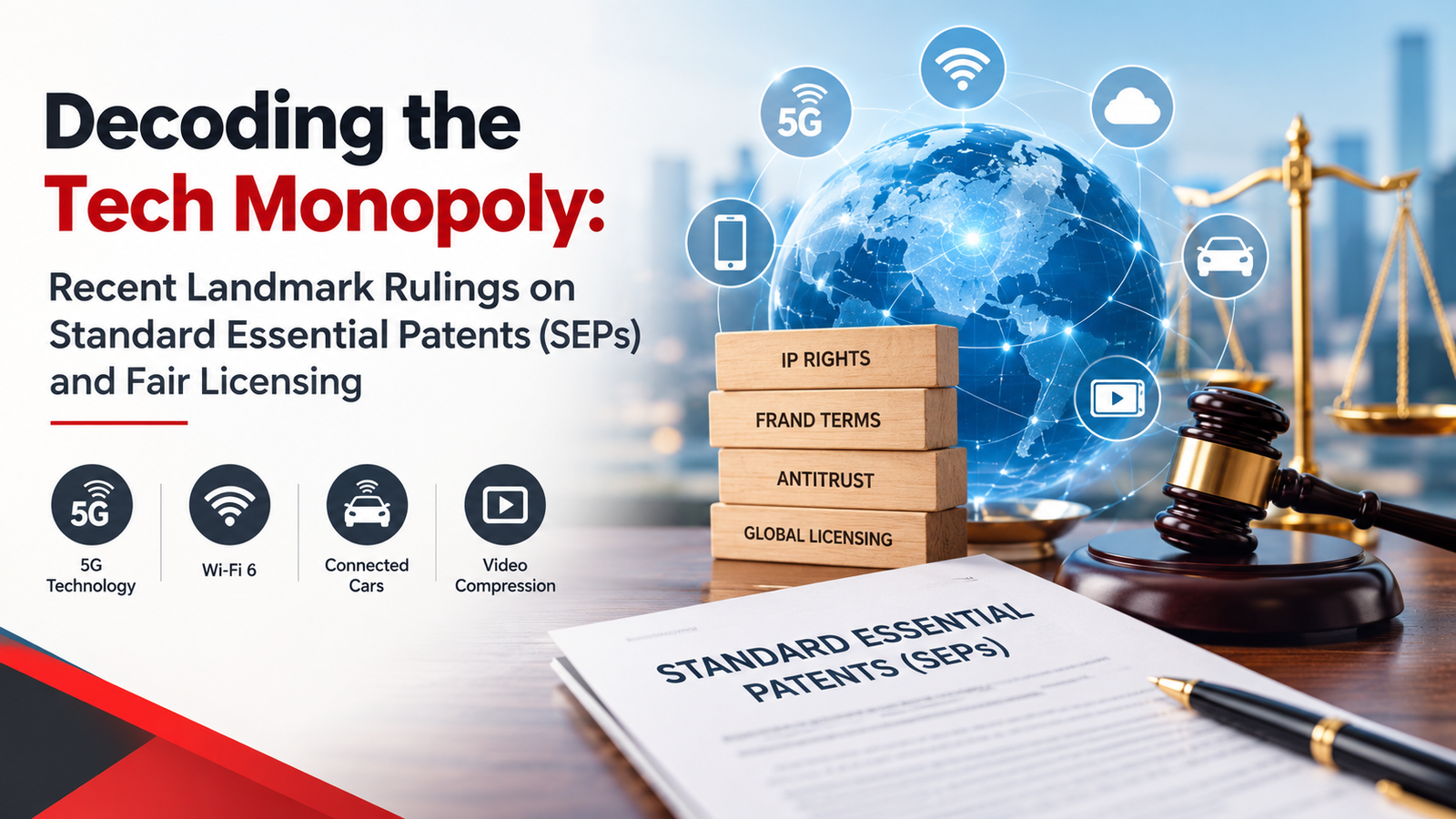
Standard Essential Patents lie at the heart of all connectivity in today’s age. Every connection—from a 5G phone to a network to a connected car syncing navigation—relies on proprietary technology. Standardization bodies set certain technological guidelines in place in order for different devices to interact perfectly in global networks.
Nevertheless, incorporation of patented technology into standards grants patent owners significant power. This leads to an important tension between intellectual property and competition. As global tech leaders fight for market control, courts worldwide are reassessing fair licensing. Understanding how recent court decisions affect SEPs, antitrust law, and global technology licensing is essential.
What is a Standard Essential Patent (SEP) and Why is it Central to Tech Monopoly Debates?
A Standard Essential Patent (SEP) protects technology required for a product to meet an industry standard. Standards are created in different sectors by technical standard-setting bodies, such as 5G, Wi-Fi 6, and video compression technology. It is impossible to manufacture a compliant device without implementing the technology protected by the SEP.
This technological dependency poses the risk of market dominance. After adopting the relevant industry standard, companies spend huge amounts of money creating compliant manufacturing equipment. They become victims of blackmail on the part of SEP owners demanding unreasonably high royalties and threatening legal bans. Such unfair practices can exclude the competition from the market.
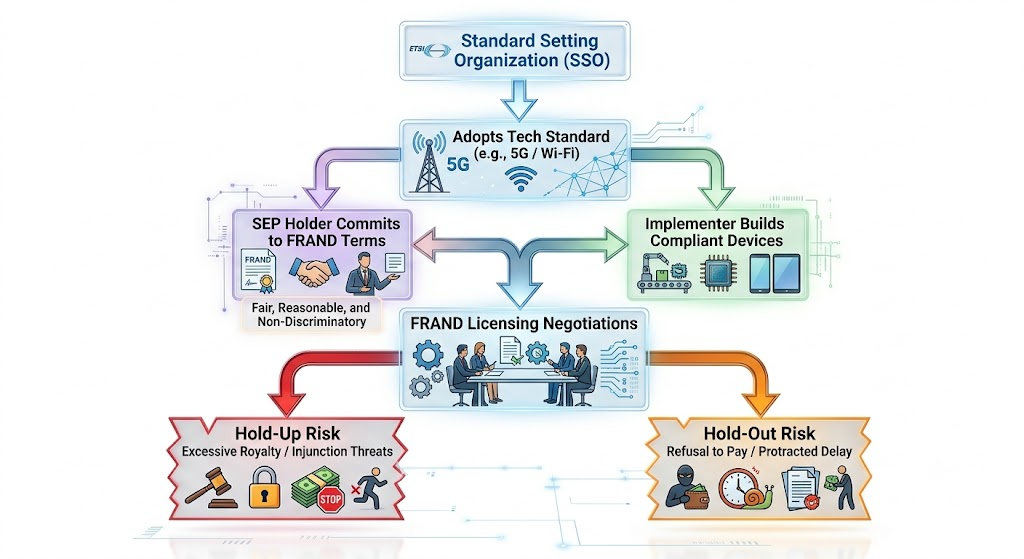
To stop market domination, standard-setting bodies require patent holders to sign voluntary licensing agreements before adding their technology to a standard.
They should grant a license under FRAND terms (fair, reasonable, and non-discriminatory).
How Recent Landmark Rulings Redefine FRAND Terms
Global courts are becoming proactive in resolving prolonged licensing disputes, suppressing anticompetitive activity, and maintaining a proper process of valuation. The recent development in enforcing telecom and technology patents shows that courts are increasingly exercising broader jurisdiction over global licensing fees.
Expansion of the Courts' Jurisdiction Over the Global FRAND Rate
Courts are not confining their jurisdiction to national frontiers anymore. The UK Supreme Court created an early case law when establishing global FRAND licensing terms for global patent pools. Following this example, the UK Supreme Court adjudicated on pool licensing disputes, confirming that national courts may define global FRAND rates for patent pools.
Global FRAND rate-setting by national courts was established by the UK Supreme Court (Unwired Planet v. Huawei, 2020). The landmark EU ruling governing SEPs is Huawei v. ZTE (CJEU, 2015), which established the legal framework and negotiation steps for seeking injunctions without violating EU competition law (Article 102 TFEU), not a sweeping jurisdiction mechanism over foreign non-EU patents.
Good-Faith Bargaining in India
In Indian law, the High Court set a milestone in the case of Telefonaktiebolaget LM Ericsson v. Lava International Ltd., the Delhi High Court explicitly rejected the SSPPU approach as well as the Top-Down approach. The court ruled that royalties must be calculated based on the net selling price of the end product (final device) rather than individual chipsets, relying on comparable licenses placed on record.
Understanding Hold-Up and Hold-Out Tactics in Modern SEP Cases
Standard essential patent disagreements frequently lead to strategic manoeuvring. There are aggressive tactical moves that both parties make while negotiating.
- SEP Hold-Up: The practice of hold-up involves leveraging the market injunction threat for the imposition of outrageous royalty rates. As the implementer has invested in the standard, switching to another technology would be difficult. The SEP holder exploits this leverage to demand royalties far exceeding the feature’s true value.
- SEP Hold-Out: Hold-out tactics involve stalling, exploiting the patented technology, and refusing to pay fair royalty fees. The implementer exploits the complicated legal process to drag small SEP holders into lengthy and costly litigation.
Antitrust cases are all about preventing such tactics. Authorities examine the negotiation history to see whether a party acted in good faith or not.
Striking a Balance Between IP Protection and Antitrust Laws/Competition Regulations
The conflict between patent laws and antitrust regulations is one that continues to arise regularly. Patent law grants temporary exclusive rights to reward innovators, while antitrust law prevents dominant players from abusing those rights to stifle competition.
Court systems continue to find ways to apply competition law to SEP issues:
- Failure to License and Market Abuse: Standardization gives the SEP owner inherent market power. Demanding unfair royalties or refusing to license competitors can constitute an abuse of dominance under competition laws.
- Jurisdiction Limits: Courts are constantly determining limits to statutory solutions for patent problems as opposed to antitrust regulations. In India, judicial precedent mandates settling royalty and licensing disputes through patent law (Compulsory Licensing) rather than the Competition Commission.
- Access to Injunctions: Courts bar SEP owners from seeking injunctions unless the implementer proves unwilling to negotiate a FRAND agreement.
Role of Standard Setting Organizations (SSOs) in Governing SEP Commitments
Standard Setting Organizations (SSOs), including ETSI, IEEE, and ITU, form the administrative basis for global technology interoperability. The non-profit organizations have clear guidelines that do not allow standard essential patents to become a barrier to trade.
SSOs implement IP policies that obligate participating members to disclose essential patents at the beginning of the standard-setting procedure. Most importantly, SSOs demand that their members sign letters of commitment which obligate them to license SEPs on FRAND terms.
As far as SSOs insist on such contracts, they deliberately do not impose any specific amount of royalties or money value. This means that the courts need to appraise the value of the patents, the licensing process, and the contracts.
Calculating Royalty Rates for Multi-Component Tech Products
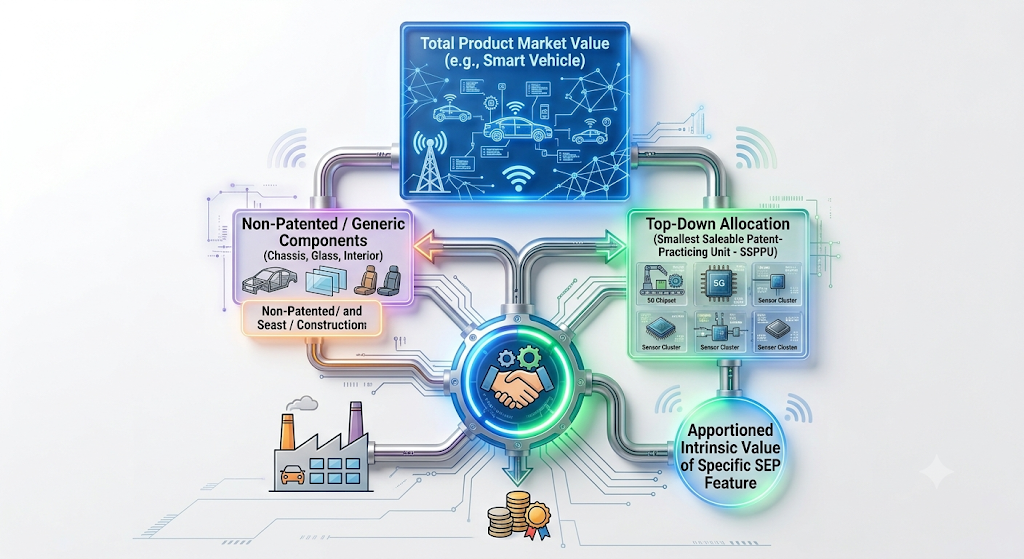
However, calculating royalty rates that courts consider fair, reasonable, and non-discriminatory when applied to highly complex electronic gadgets requires rather advanced economic models. Nowadays, modern cell phones, cars and IoT gateways contain many thousands of patents, making the occurrence of the phenomenon called royalty stacking very likely.
In order to come up with clear calculation formulas, courts apply two main economic approaches:
- 1. Smallest Saleable Patent-Practicing Unit (SSPPU): According to this approach, courts should calculate royalty payments based on the price of the specific component practising the patent (e.g., the baseband microchip in question) rather than the price of the final product itself (e.g., the phone screen or case).
2. Top-Down Approach: Under this approach, the court evaluates the overall royalty burden of the entire standard. The court defines what a reasonable total royalty cap will be for all SEPs and then distributes it among the patent holders.
Can an SEP Owner Refuse to License Competitors Without Facing Antitrust Examination?
An SEP owner cannot typically refuse to license competitors that wish to comply with the standard without facing harsh antitrust examination. The reason for such a rule is the absence of other options due to the implementation of the technical standard, which means that the refusal to grant a license restrains trade and inhibits further technological developments.
According to the existing international principles, an SEP owner needs to license willing parties that wish to comply with the standard. If an SEP owner selectively refuses to license component competitors while granting licenses to product makers, the antitrust authorities can examine such behaviour as the abuse of dominant market position.
Nevertheless, an SEP owner maintains the opportunity to file cases in court in case the implementer acts in bad faith, keeps refusing reasonable offers, and does not want to undergo transparent arbitration.
Evidentiary Standards for Proving SEP Infringement Versus Non-Infringement
Litigating standard essential patents requires meeting rigorous legal standards. Parties must present detailed technical evidence to establish either infringement or non-infringement in landmark trials:
Proving Patent Infringement
To prove patent infringement, the claimant has to show that the patent is essential. For proving infringement, the patent owner has to produce a claim chart specifying every limitation of the patented claim to technical specifications published by the SSO. In cases where a patented method is required by nature of the standard, compliance with the standard would constitute prima facie proof of patent infringement.
Proving Non-Infringement and Patent Invalidity
The implementers defend themselves against the claims of infringement in the following ways:
–Non-Essentiality Mapping: Demonstrates that the product is implemented using non-infringing methods that comply with the standard.
-Prior Art Defence: Providing clear evidence of the absence of novelty or obviousness of the asserted claim in comparison with prior technological art and thus proving the invalidity of the patent.
–Unwilling Defence of Patent: The defence can show that the claimant failed to provide a timely and mathematically justified FRAND offer before starting judicial procedures.
Managing the Future of Technology Monopoly and Standard Essential Patents Licensing
The international laws concerning the use of standard essential patents continue to shift swiftly. In light of the increasing use of 5G technology, expansion of IoT networks, and the integration of technologies into traditional sectors, there remains the need for proper licensing policies in the interest of sustainable technology development.
Innovation in the world today demands managing technology licensing litigation, managing technology monopolies and FRAND compliance. Technology developers and users need to ensure that their negotiations are in good faith, use proper valuation models and license their technologies. You can contact Intellect Bastion for the best guidance and support.
Frequently Asked Questions (FAQs)
What does a Standard Essential Patent (SEP) mean and why is it important for discussions on monopoly in the tech world?
SEP refers to a patent covering a technological feature that manufacturers must implement to adhere to industry standards. The fact that manufacturers are unable to work their way around such standards implies that SEPs provide market power to patent holders.
How do landmark court decisions shape the concept of FRAND licensing?
In light of recent landmark court decisions, it becomes clear that national courts can determine FRAND licensing terms that would be applicable internationally. Moreover, courts have decided that the implementer’s delay in entering into negotiations makes them an unwilling licensee.
What do "hold-up" or "hold-out" approaches mean in SEP cases?
Courts define hold-up as an approach where a party makes threats of injunctive relief to secure excessive royalty payments. On the other hand, courts define hold-out as an approach where implementers postpone licensing talks while using the technology.
How are courts seeking to protect intellectual property rights and competition law interests?
Courts seek to achieve a balance between these two rights by enforcing FRAND commitments and limiting injunctions against willing licensees. Courts also steer dispute resolution on pricing issues and contractual agreements through patent law remedies before imposing antitrust sanctions.
How do standard setting organizations regulate SEP commitments?
Standard setting organizations set up open standards and make mandatory disclosure of patents essential for the technology. Patent holders are required to make legally binding commitments to license the SEPs under FRAND terms.
YASHIKA KORANGA
Senior Patent Associate at Intellect Bastion